

How we make money here: stretching.shop makes the printed pieces in this shop ourselves. Anything on this page marked Recommended gear is made by someone else and sold by a retailer, and we may earn a small commission if you buy through our link at no extra cost to you. We recommend gear we would use, and we say when a cheaper option is the better buy.
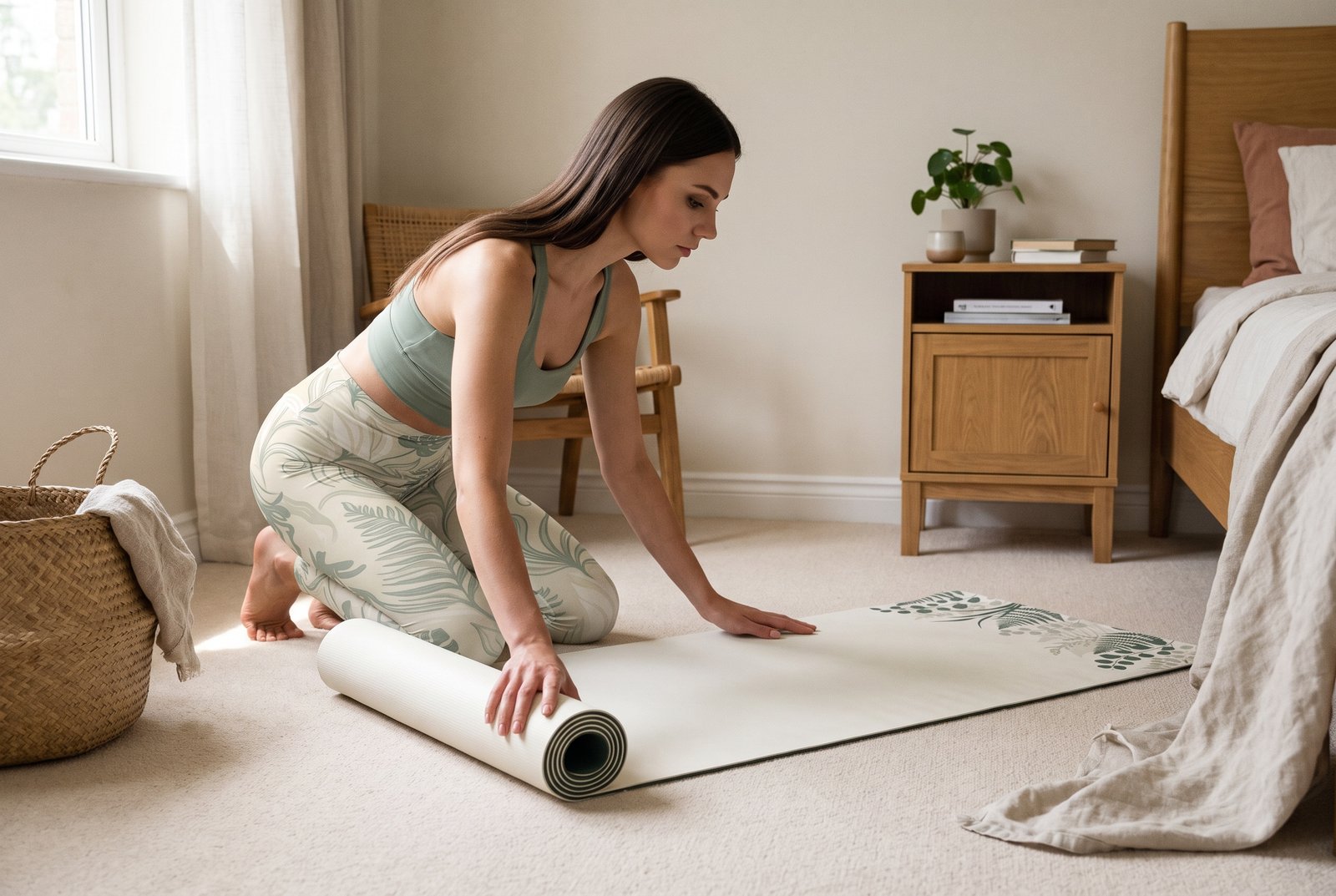
Yes, a mat still helps on carpet, though usually a thinner one than you’d choose for floorboards. Carpet has already solved padding. What it hasn’t solved is a level, predictable surface that does not move when you push against it.
That’s the whole problem, and it shows up in three places: hands in plank, heels in a lunge, and one foot in tree pose. Everything else about stretching on carpet is fine, and in some ways better than a hard floor.
Can you use a yoga mat on carpet?
You can, and nothing about carpet damages a mat. What people are really asking is whether it works, and the honest answer depends on one measurement almost nobody checks: pile height.
Rough bands, from carpet trade descriptions: low pile sits under about 6mm, medium pile around 6–12mm, and deep or shag pile runs from 15mm up past 40mm. Underneath that, most domestic installations have 6–11mm of foam or crumb underlay. So a “thin” bedroom carpet can still mean 15mm of compressible material under your mat, and a deep one can mean 50mm.
A mat laid over 50mm of soft structure doesn’t become firm. It becomes a skin on top of a mattress. Your 5mm of closed-cell foam isn’t the layer deciding what your wrist feels.
What carpet gives you, and what it takes away
Carpet gives you free padding. Kneeling work, side-lying hip stretches, supine twists, savasana — all of these are more comfortable on carpet than on tile, and you don’t need to buy anything to get that.
What it takes away is less obvious until you’re mid-pose:
- Hand stability. In plank or downward dog, your hands press into pile that compresses unevenly under the heel of the palm and the fingertips. The surface tilts slightly as you load it.
- Heel reference. A back heel in a low lunge sinks. You lose the feedback that tells you how far forward your hips actually are.
- Single-leg balance. Pile under the ball of the foot shifts on every correction, so the correction never finishes.
- Grip direction. Carpet does not grip the mat so much as hold it loosely. Push backwards in dog and a light mat can walk or rumple.
- Level. Edges, seams and the join to a doorway bar can leave a mat sitting at a slight angle.
Four of those five only matter for standing and weight-bearing work. If your routine is mostly floor-based, meaning hamstrings, hips and spine, carpet plus a blanket may be all you need.
Do I need a yoga mat on carpet, or is a mat unnecessary?
For seated and lying stretches on clean, low-pile carpet: no, not strictly. A folded blanket under the hips and knees does the same job, and a blanket is washable in a way a mat is not. We wrote about blanket choices in best blanket for restorative yoga, and that piece is relevant here even if you never buy a mat.
A mat earns its place when you want one of three things: a hygiene barrier between your face and the carpet, a marked-out area that signals “this is the practice spot”, or a firmer, flatter surface for hands and feet.
That third one is the only one where thickness matters, and it matters in the opposite direction from what most people assume.
Why thin and dense beats thick and squishy over pile
Firmness isn’t a property of a mat alone. It’s a property of the whole stack: your hand, the mat, the carpet, the underlay, the subfloor. Soft layers add up.
Put a 6mm open-cell foam mat on 20mm of pile and you’ve stacked squash on squash. Put a 3mm natural rubber mat on the same carpet and you have a thin, dense sheet that spreads your hand pressure across a wider patch of pile instead of sinking into it. That’s why “hard yoga mat for carpet” and “firm yoga mat for carpet” are more useful search terms than “thick”.
Density is published inconsistently, which is annoying. Weight is a decent proxy. A 4mm natural rubber mat of standard size is commonly listed around 2.3–2.9kg; a 6mm foam mat of the same footprint is often under 1.2kg. More mass in less thickness means denser material, and heavier also means less likely to shift on pile.
If you want the thickness trade-offs laid out properly, that’s the subject of 3mm vs 5mm vs 6mm.
What yoga mat is best for carpet: comparing published specs
We have not tested these over carpet. The table below compares specifications as manufacturers publish them, plus what those specs imply for a compressible surface.
| Option | Typical published thickness | Typical weight, standard size | What the spec implies over pile |
|---|---|---|---|
| Natural rubber, thin | 1.5–3mm | 1.8–2.6kg | Dense and heavy for its thickness; stays put; hands get a flat reference. Little padding of its own — carpet supplies that. |
| Natural rubber or rubber/PU, mid | 4–5mm | 2.3–3.2kg | The all-round pick if the same mat also goes on hard floors. Heavy to carry. |
| TPE, closed cell | 4–6mm | 0.9–1.5kg | Light, so more prone to creeping on pile. Softer feel compounds carpet softness. |
| PVC “sticky” mat | 3–6mm | 1.2–2.2kg | Grip relies on tack, which carpet does not reward. Thin versions behave better than thick. |
| Cork over rubber | 3–5mm | 2.0–3.0kg | Firm top layer, good for hand placement. Cork grip improves with moisture, unrelated to the carpet underneath. |
| Pilates/exercise mat | 10–15mm | 0.6–1.4kg | Wrong tool over carpet. Redundant padding, poor stability for standing work. |
On deep carpet, thinner and denser is the better bet; on low pile, a 4–5mm mat is fine. If you’re starting from scratch, how to choose a yoga mat covers width, length and surface separately from this.
The yoga mat board for carpet, and the free version of it
Here’s the fix that costs almost nothing, and it beats buying a dearer mat.
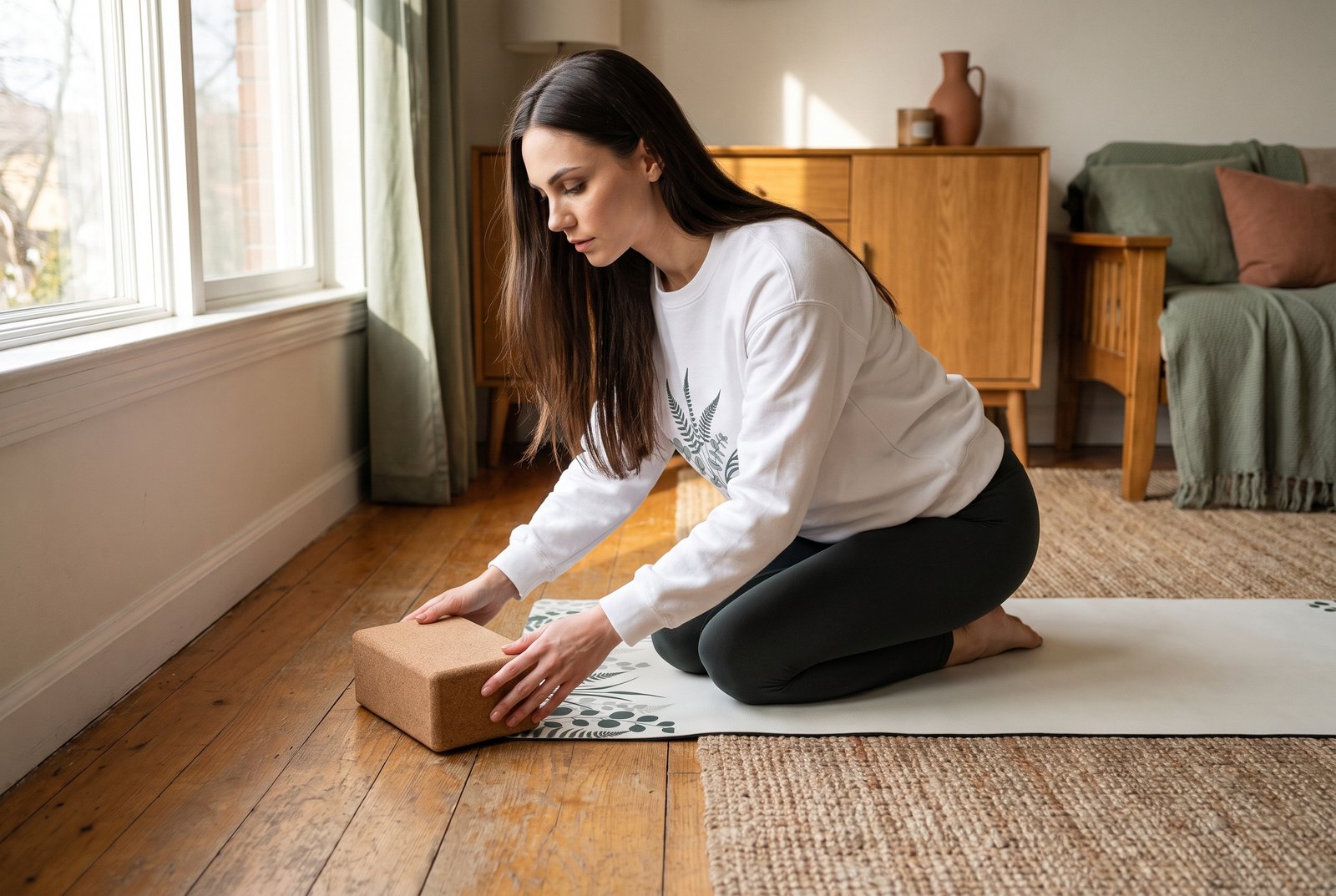
Find bare floor. Most homes have a strip of laminate, tile or board at a doorway, in a hallway, or in the kitchen. A 60cm width of hard floor is enough for tree pose, warrior III, standing hamstring work and anything balance-dependent. Do the balance portion there, then move back to the carpet for the floor work.
If no bare floor exists, a board does it. People search “yoga mat board for carpet” and the answer is unglamorous: a sheet of 12–18mm plywood or MDF, cut to roughly 60 × 60cm for hands and feet, or 90 × 60cm if you want both hands in dog. Sand the edges, lay your mat over it. A single sheet from a timber merchant costs a fraction of any mat and solves the stability problem outright.
Two cautions. A board on deep pile can rock at the corners if the pile is uneven, so press it down and check before loading it. And don’t put a hard board under your knees without the mat between.
Yoga mat vs rug vs carpet
A rug is not a substitute. Most domestic rugs have no backing grip worth the name, so they slide on top of carpet rather than anchoring to it, and the pile adds a third soft layer. A cotton yoga rug, the traditional kind at around 1–2mm woven cotton, is a different thing: it’s a sweat-absorbing top surface, and over carpet it does nothing for stability.
Carpet alone, no mat, is perfectly reasonable for stretching if the carpet is clean and you’re not doing load-bearing hand work. The honest comparison: carpet beats a hard floor for comfort, loses to it for every pose where you need to know exactly where the ground is.
Yoga mat on carpet or hard floor?
Split the routine by what each pose needs.
- Carpet: kneeling, side-lying, supine, long holds, restorative, anything with the spine on the ground.
- Hard floor, or board: standing balance, plank family, downward dog, anything on one leg, anything where your hands carry load.
- Either: seated forward folds, pigeon, most hip work.
A short seated routine like the one in this hamstring sequence for desk sitting is almost entirely category one, which is why carpet never feels like a problem until you add standing work.
When carpet is not the issue
Wrist pain in plank, knee pain in kneeling poses, or numbness in a foot during long holds aren’t surface problems you can fix by buying a mat. If a symptom persists for more than a couple of weeks, worsens during practice, or involves pins and needles, see a physiotherapist rather than adjusting your flooring.
If your carpet is deep and you only practise there: buy thin and dense — 1.5–3mm rubber or cork-over-rubber, with published weight on the heavier side. Skip anything over 5mm.
If the same mat has to work on carpet and on a kitchen floor: 4–5mm rubber is the compromise, and it’s a good one. Expect 2.3–3.2kg, which is fine if the mat lives at home.
If your problem is balance, not padding: don’t buy a mat. Find 60cm of bare floor at a doorway, or cut a 60 × 60cm piece of 15mm plywood and lay your existing mat over it. That solves it for the price of offcut timber.
If you’re setting the whole corner up from nothing: work out the standing-surface question first, then spend on the mat. The order is laid out in building a stretching corner under 200.
Written with Elena, our AI stretch guide, and checked against our editorial and safety rules before publishing. General movement guidance, not medical advice. Photographs are AI-generated illustrations.


