

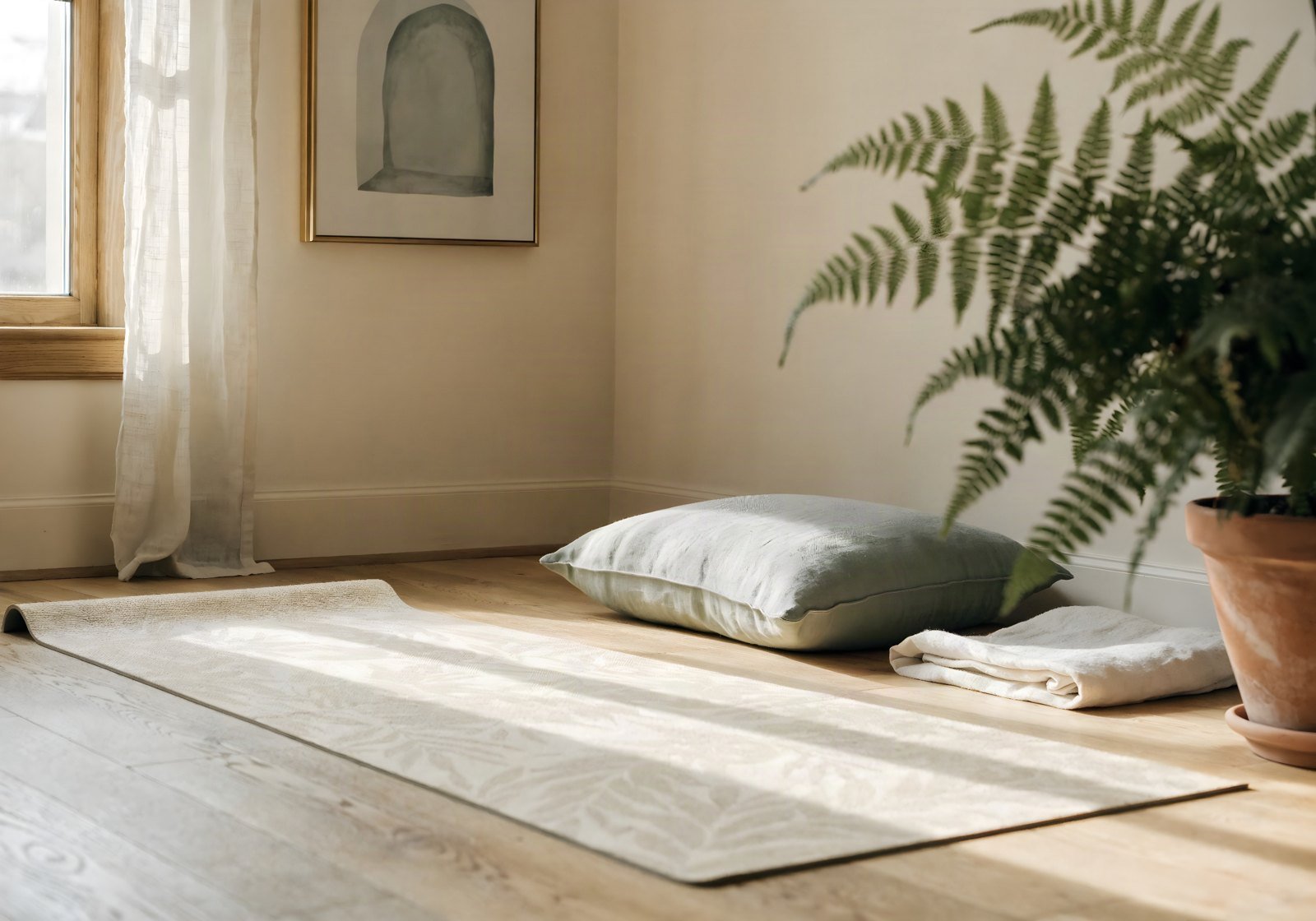
The stretching you skip is almost never the stretching you didn’t want to do. It’s the stretching that needed the mat out of the cupboard, the furniture moved, and eight minutes of setting up before anything happened.
A home stretching corner solves that and nothing else. It isn’t a home gym. It’s roughly two square metres of floor that stays permanently ready, so the gap between deciding and starting is zero.
Here’s how to build one, in the order each item earns its place. Prices are what you’d realistically pay in 2026, and the total below comes in under $200 without cutting anything that matters.
First: pick the floor, not the furniture
Before you buy anything, choose the spot. Three rules, in order:
- You can see it from where you sit in the evening. Out of sight really is out of mind — a corner behind a door won’t get used.
- It takes daylight at the time you plan to use it. Morning people need an east-ish window; evening people need a lamp they’re willing to turn on.
- Nothing has to be moved first. If the coffee table has to shift, you haven’t built a corner, you’ve built a chore.
A strip of floor 2 m × 1 m is enough for every stretch in a normal routine. You don’t need a spare room.
The mat (about $85, and the one thing not to cheapen)
This is the piece that gets used every single session, so it’s the piece worth the money. Two specs matter: length (72″ if you’re anywhere near 5′10″) and surface (microfibre suede grips better as you warm up; rubber grips dry).
Thickness is a trade, not an upgrade — we wrote the whole argument in 3 mm vs 5 mm vs 6 mm. For a corner that lives in a room you sit in, there’s a second consideration that has nothing to do with performance: a mat you like looking at stays unrolled, and a mat that stays unrolled gets used. Ours is the Sage Meadow mat, which we make, so weigh that accordingly.
Something to sit on (about $43)
Most home routines fall apart at the seated section. Sitting cross-legged on a hard floor with tight hips tips your pelvis backwards, rounds your lower back, and makes ten minutes feel like thirty.
Lifting your hips by even four inches fixes the mechanics straight away. A firm cushion, a folded blanket, or a proper zafu all work. A cushion that also belongs on the sofa is the version that survives living with other people.
A blanket (about $75, and it is three things)
The single most versatile prop in the room, and the one people buy last:
- Folded in three under the hips it does the job of the cushion above.
- Rolled under the knees it makes lying twists and supported bridge actually restful instead of a hamstring argument.
- Over you in savasana it stops the drop in body temperature that makes the last five minutes of a session unpleasant in winter.
Cotton, woven rather than printed, in a size around 60 × 50″. Ours is the Fern Study woven throw.
Two blocks or two thick books (free to $25)
Blocks bring the floor up to your hands. If your fingertips don’t comfortably reach the ground in a forward fold, blocks aren’t optional equipment, they’re the difference between doing the pose and doing a worse pose badly.
Honest note: two hardback books work for the first month. Buy real blocks when you notice you’re reaching for books twice a week.
Something on the wall (about $29)
This one sounds like decoration. Not quite. In a savasana or a long supported pose your eyes need somewhere neutral to rest, and a blank wall with a light switch on it isn’t that. A quiet print does the job without becoming something to read. Ours is Breathe; anything calm and unbusy works.
A written log (about $29, or a notebook you own)
Three weeks from now you’ll know that something helped your hip and have no idea what. Four lines a day: what you did, how long, what was tight, what to repeat. That turns a habit you keep restarting into a record you can read backwards. We make a lined journal for exactly this, and any notebook does the same job.
The running total
| Piece | Why it earns the space | Realistic 2026 price |
|---|---|---|
| Mat, 72″ | Used every session | $65–$95 |
| Cushion | Makes seated work possible | $30–$45 |
| Cotton throw | Prop, bolster and warmth in one | $45–$75 |
| Blocks | Brings the floor to your hands | $0–$25 |
| Wall print | Somewhere to rest your eyes | $25–$35 |
| Journal | Turns sessions into a habit | $0–$29 |
At the lower end of each row you’re at about $165. At the upper end, about $304. Under $200 is comfortably achievable if you use books for blocks in month one.
What to skip, at least at first
- A second mat “for travel.” You won’t take it.
- A wheel. Beautiful on Instagram, used four times, bulky forever.
- An expensive bolster, until you’ve run out of things the folded blanket can do.
- Straps, if you own a belt or a dressing-gown cord. Same job.
If you only buy two things: a 72″ mat and a cotton throw. Between them they cover the floor, the hips, the knees and the cold feet, which is most of what goes wrong.
Set it up tonight and leave it out. The corner does the persuading after that.
How this comparison was made: we compared manufacturers’ own published specifications and materials, read on the dates shown. We have not physically tested every product listed, and we say so rather than implying a lab. Where we sell something ourselves, we say that too. Scene photographs in this article are AI-generated illustrations; the photographs on our product pages are the manufacturer’s production mockups.


