

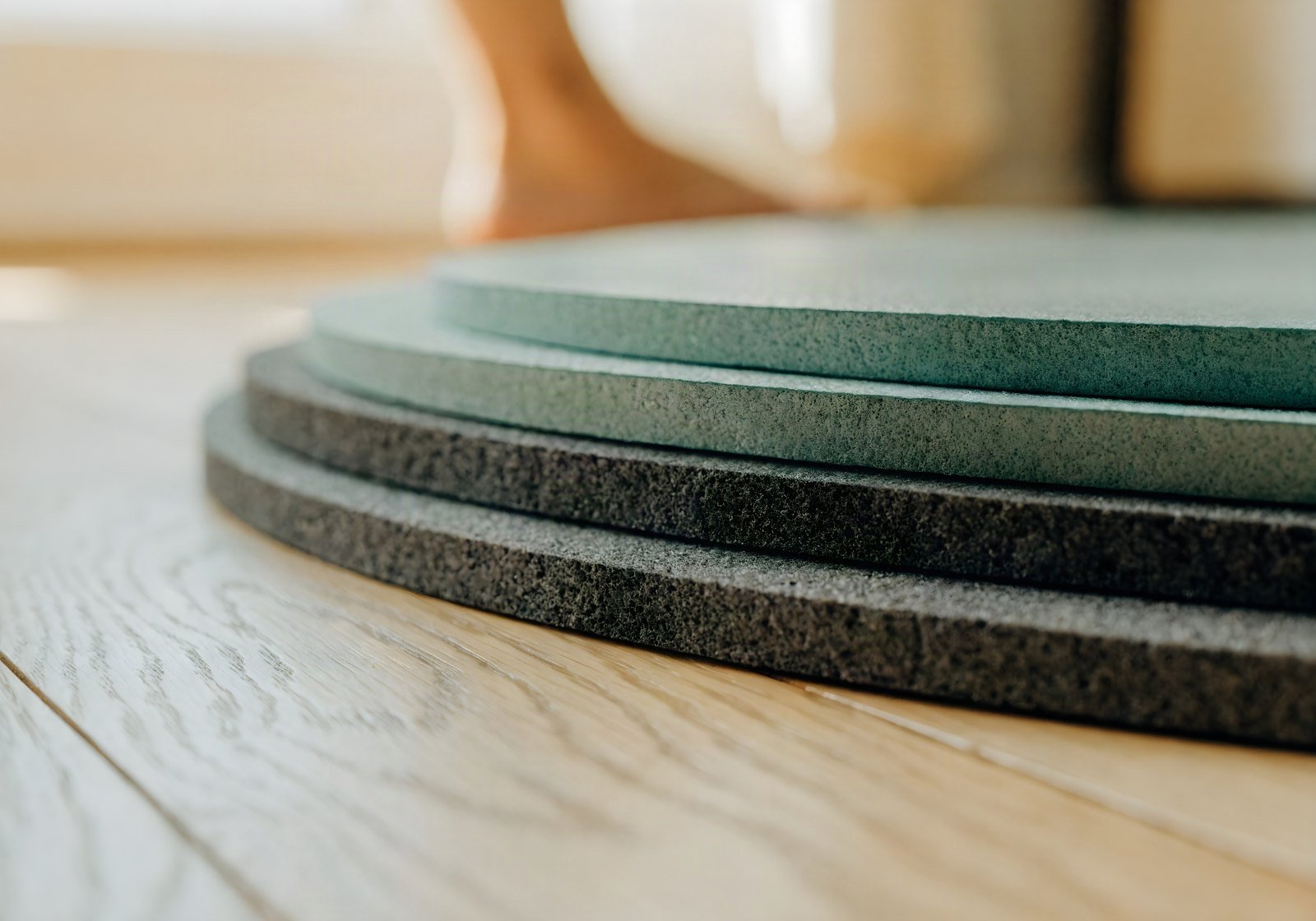
Nobody returns a yoga mat because of the colour. They return it because their knees hurt on it, or because they couldn’t balance on it, and both of those come down to one number nobody explains properly: thickness.
Here’s the whole decision in one line. Thin mats give you stability. Thick mats give you cushioning. You can’t have both, and the right answer depends on what you do on the floor, not on how much you’re willing to spend.
What thickness actually changes
A yoga mat has one job that fights itself. It has to put a soft layer between you and a hard floor, and it has to keep your foot, hand or sit-bone from wobbling. Every millimetre you add to the first takes something from the second.
- Under your knees and elbows — more millimetres, less pain. This is where thin mats fail.
- Under your standing foot — fewer millimetres, better balance. This is where thick mats fail. On a 6 mm mat, a single-leg balance has a soft, mushy platform underneath it and your ankle works harder to correct.
- Rolled up in a bag — thickness is weight and bulk. A 6 mm mat is roughly twice the roll of a 3 mm one.
3 mm: travel weight, honest about it
A 3 mm mat is the standard for anyone who wants to feel the floor. Standing sequences, flow, balance work, general stretching on carpet — that’s its territory. It rolls tight, it fits in a tote, and it doesn’t curl at the corners as easily as thinner mats do.
It isn’t a knee saver. On a wooden or tiled floor, long kneeling work (low lunges, camel, tabletop holds) will get uncomfortable inside ten minutes. There’s a simple, free fix that nobody selling mats mentions: put the thin mat on a rug, or fold a towel under the knee for the two or three poses that need it. That combination beats a thick mat, because you keep the stable surface everywhere else.
Our own Sage Meadow printed mat is 3 mm with a microfibre suede top and a natural rubber base. We sell it, so treat that as a disclosure rather than a recommendation: it’s the right mat if you stretch and flow, and the wrong mat if your programme is mostly kneeling on tile.
5 mm: the compromise most people should buy first
Five millimetres is the middle of the market for a reason. It’s thick enough that ten minutes in a low lunge doesn’t turn into a negotiation with your kneecap, and thin enough that a tree pose still feels like it’s happening on the ground rather than on a mattress.
If you’re buying your first mat and you genuinely don’t know yet whether your practice will be standing-heavy or floor-heavy, 5 mm is the answer that won’t be wrong.
6 mm and above: floor work, rehab, and joints that hurt
At 6 mm and thicker you’ve stopped buying a yoga mat and started buying a padded floor. That’s a perfectly reasonable thing to want. Pilates-style mat work, physio exercises, anything where you’re lying on your spine, and anyone with knee pain that isn’t negotiable — this is the category.
Accept what it costs you. Standing balance is genuinely harder. The mat is heavier to carry, slower to dry, and takes more cupboard.
The comparison, in one table
| Thickness | Best at | Worst at | Buy it if |
|---|---|---|---|
| 3 mm | Balance, flow, travel, stretching on carpet | Kneeling on a hard floor | You want to feel grounded and carry it easily |
| 5 mm | Almost everything, moderately well | Nothing badly, nothing brilliantly | It is your first mat and you are still deciding |
| 6 mm+ | Floor work, rehab, sore knees | Single-leg balance, portability | Your practice is mostly on your back or your knees |
The three things that matter more than thickness
Once you’ve picked a number, thickness stops being the interesting question. These three decide whether you actually use the mat.
1. The top surface, not the padding
Grip comes from the surface, and surfaces behave differently when you sweat. Closed-cell PVC gets slippery when wet and wipes clean easily. Rubber grips dry, and smells for the first fortnight. Microfibre suede (the printed-mat standard) is slightly slippery bone-dry and grips better as you sweat — backwards from what most people assume, and the reason printed mats suit warm rooms and hot yoga.
2. Length, if you are tall
The default is 68″. At 5′10″ and above, that means your heels hang off in downward dog and your head hangs off in savasana. 72″ (183 cm) is the number to look for, and it’s worth more to a tall person than any amount of padding.
3. Whether you will leave it out
The mat you use is the one you don’t put away. A mat that looks like gym equipment gets rolled into a cupboard, and a mat in a cupboard doesn’t get used on the morning you feel stiffest. This sounds like marketing. It’s still the single most reliable predictor of whether a mat gets used, and it’s why printed mats exist at all.
What we would actually tell a friend
Mostly standing, flow, stretching, or you travel with it: 3 mm, and keep a rug or folded towel nearby for kneeling.
You genuinely don’t know yet: 5 mm. It’s the least wrong answer.
Knees that already complain, or floor-based rehab work: 6 mm or more, and accept that balance poses will feel wobblier.
Tall: whatever the thickness, insist on 72″.
And if you’re still on a mat you bought in a supermarket in 2019 that curls at both ends, thickness isn’t your problem. Any of the three above will be an upgrade.
How this comparison was made: we compared manufacturers’ own published specifications and materials, read on the dates shown. We have not physically tested every product listed, and we say so rather than implying a lab. Where we sell something ourselves, we say that too. Scene photographs in this article are AI-generated illustrations; the photographs on our product pages are the manufacturer’s production mockups.


