

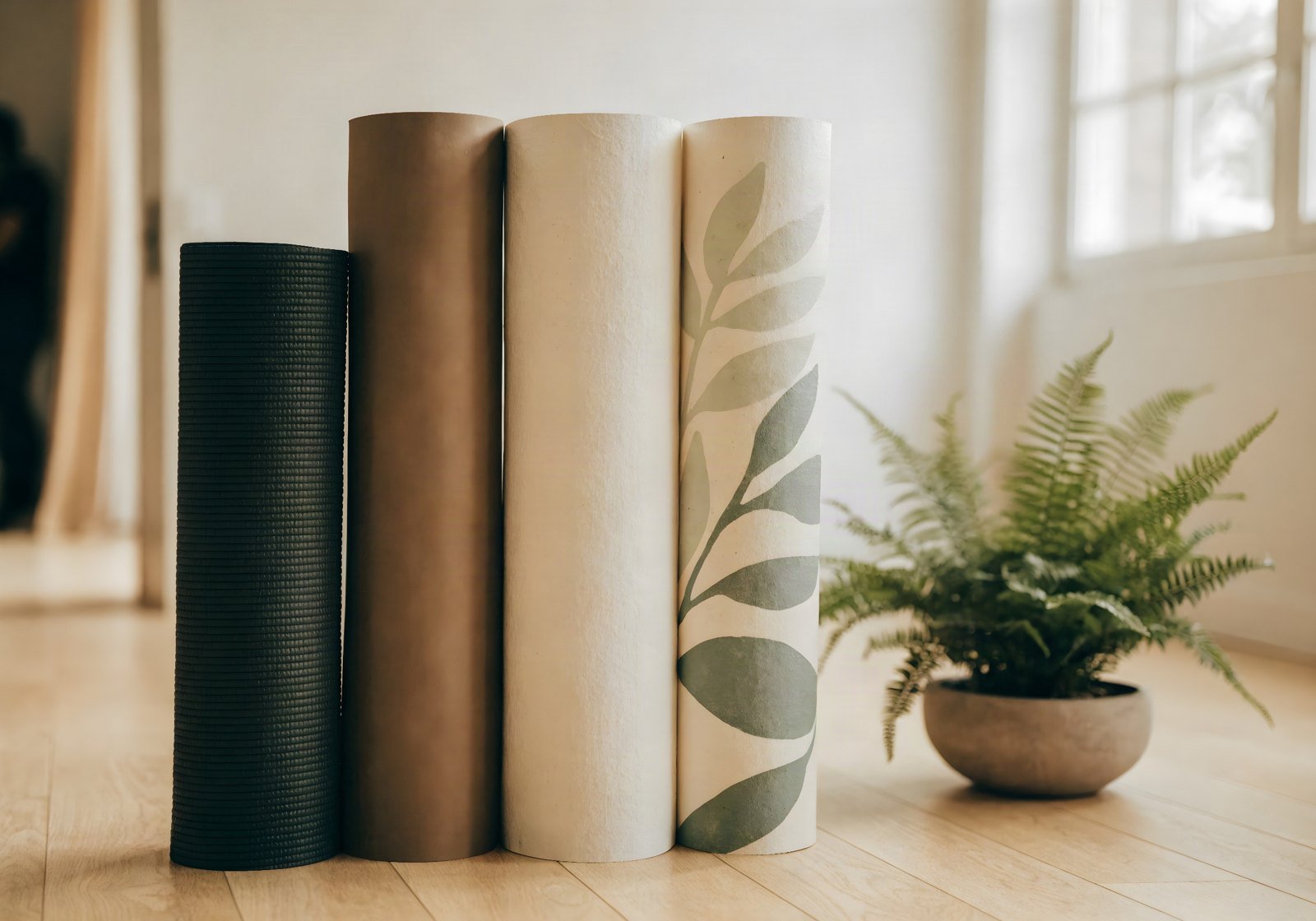
Almost every yoga mat sold online is described with the same six adjectives. Non-slip. Eco-friendly. Premium. Extra-thick. Lightweight. Durable. None of them is a measurement, and a word you can’t measure is a word you can’t compare.
These seven can be measured. Read them in this order and the choice usually makes itself.
1. Length, before anything else
The industry default is 68″. If you’re 5′10″ or taller, that mat is too short for you, and you’ll find that out in your first downward dog. Look for 72″ (183 cm). Nothing else on this list is worth as much to a tall person, and it’s usually the spec buried furthest down the page.
2. The top surface — and how it behaves wet
Grip is a property of the surface, and it changes when you sweat:
- PVC: reliable dry, slippery wet, wipes clean, cheap, lasts for years.
- Natural rubber: excellent dry grip, strong smell for the first week or two, heavier, degrades in direct sun.
- TPE: light, low odour, softer feel, generally a shorter life.
- Microfibre suede (the surface on printed mats): mildly slippery bone-dry, and grippier as it takes moisture. Counter-intuitive, and the reason printed mats suit warm rooms rather than cold ones.
If you practise in a heated room, or you sweat early, that points to microfibre or rubber. If you practise cold and dry, anything on the list will do.
3. Thickness, as a trade rather than an upgrade
Thicker isn’t better. It’s a trade: cushioning up, stability down. The whole argument is laid out in 3 mm vs 5 mm vs 6 mm. The one-line version: 3 mm for flow and travel, 5 mm if you’re unsure, 6 mm+ for knees and floor work.
4. Weight, if it ever leaves the house
A mat that lives in one room can weigh whatever it likes. A mat that goes to a class should be under about 2.5 kg, or you’ll stop taking it. Thickness and rubber both add weight fast — a 6 mm rubber mat can be twice the carry of a 3 mm printed one.
5. Smell, and how long it lasts
Natural rubber smells. It fades over one to three weeks if you unroll it in a ventilated room, and it isn’t a defect. If a strong smell in the first fortnight would put you off using the mat, and for a lot of people it genuinely does, choose PVC or microfibre instead.
6. Print quality, if you are buying a design
This is where printed mats quietly fail, and it’s easy to check. Ask for the print resolution across the 24″ width. A mat printed from a small file at around 100 dpi will look soft and slightly blocky in daylight, and the reviews will say “pixelated”. Over about 150 dpi across the full width and you’ll never notice it. Anyone selling a printed mat can answer that question. If they can’t, that’s the answer.
For the record, our own Sage Meadow mat is printed from a file built at the full print area, roughly 325 dpi across the width. We mention it because you can check it, not because it sounds good.
7. Whether you will leave it out
Not a spec, but the best predictor of use there is. A mat that looks like equipment gets rolled away. A mat that looks like an object in the room stays out, and the mat that’s already out is the one you use on the morning you feel stiffest. Buy accordingly.
The words worth ignoring
| What the label says | What to ask instead |
|---|---|
| “Non-slip” | Which surface material, and how does it behave when damp? |
| “Eco-friendly” | Which material, and certified by whom? |
| “Extra thick” | How many millimetres, and how much does it weigh? |
| “Premium” | Nothing. This word carries no information at all. |
| “Vibrant print” | What resolution across the 24″ width? |
Three profiles, three answers
Flow and stretching at home, tall, warm room: 72″, 3 mm, microfibre suede over rubber. Keep a rug nearby for kneeling.
First mat, mixed practice, cold room: 72″, 5 mm, PVC or TPE. The least wrong answer on the list.
Sore knees and floor-based work: 6 mm or more, and accept the wobble in balance poses.
Once the mat is settled, the rest of the corner costs less than you’d think — here is the whole set-up under $200.
How this comparison was made: we compared manufacturers’ own published specifications and materials, read on the dates shown. We have not physically tested every product listed, and we say so rather than implying a lab. Where we sell something ourselves, we say that too. Scene photographs in this article are AI-generated illustrations; the photographs on our product pages are the manufacturer’s production mockups.


