

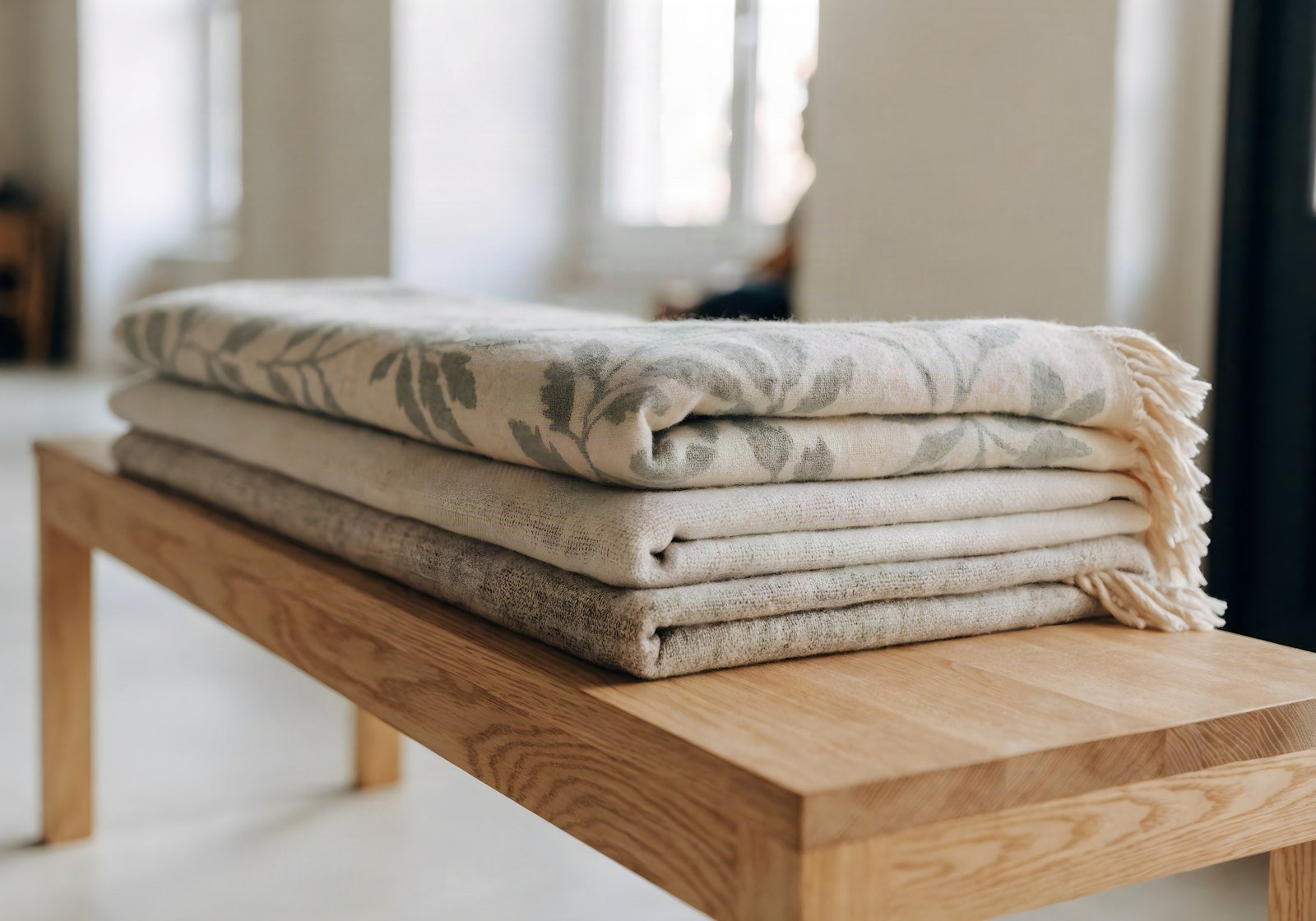
A restorative yoga blanket has one job a nice blanket doesn’t: it has to hold its shape when you put your body weight on it. Fold a fleece throw into three, lie your hips on it, and within two minutes it’s squashed to nothing and your pelvis is back on the floor.
That’s the test. Everything below is judged against it — and against the second job, which is keeping you warm for the eight minutes at the end when your body temperature drops.
The four things that decide it
- Weight and density. A prop blanket needs mass. Cotton at a real weave density holds a fold; an airy synthetic doesn’t.
- Fold behaviour. Either it folds into a firm rectangle with clean edges or it slumps into a lump. Slippery fabrics won’t stack.
- Breathability. Ten minutes under a synthetic throw and you’re warm for the first five, clammy for the last five.
- Washing. It’ll live on a floor. If it can’t go in a machine on a normal cycle, it’s the wrong blanket.
Cotton, woven
What it is: yarn woven into cloth, so the pattern is structural rather than printed on the surface.
Good at: everything a prop has to do. It has mass, it folds into a firm block with square edges, it breathes, and it survives a hot wash. It’s what studios stack in the corner, and studios aren’t choosing for looks.
Bad at: instant plush warmth. It’s a warm cloth, not a duvet. Fine detail also reads softer in a weave than in print, because thread is thicker than ink.
Buy it if you want one blanket that’s a prop first and a throw second. Ours is the Fern Study woven cotton throw, 100% cotton, 60 × 50″, with fringed edges. We make it, so read that as a disclosure.
Fleece and sherpa
What it is: brushed polyester, sometimes with a sherpa backing.
Good at: immediate warmth, low price, machine washing, and photographing as “cosy”.
Bad at: being a prop. It compresses to nothing under body weight, slides on a mat, holds static, and traps moisture, which is exactly wrong for the long, still holds that restorative work is made of.
Buy it if warmth over the top is the only job. Keep a separate folded cotton blanket for propping.
Velveteen and minky
What it is: printed polyester with a short pile, usually with a plain backing.
Good at: colour. A photographic or high-detail printed design lands sharply on this fabric.
Bad at: folding cleanly, since pile fabrics slump at the edges, and breathing. Pile also flattens along fold lines over time, so a blanket folded in the same place every day will show it.
Buy it if the look matters more than the function and you already own a prop blanket.
Wool
The studio classic, and genuinely the best prop material there is: heavy, breathable, and stiff enough to hold a fold like cardboard. It’s also itchy against bare skin for a lot of people, usually needs careful washing, and costs more. If those three don’t bother you, wool wins the propping argument outright.
Side by side
| Fabric | Holds a fold | Breathes | Warmth | Machine wash | Best role |
|---|---|---|---|---|---|
| Woven cotton | Yes | Yes | Moderate | Yes | Prop first, throw second |
| Fleece / sherpa | No | Poorly | High, immediate | Yes | Warmth over the top |
| Velveteen / minky | Partly | Poorly | Moderate | Yes, gentle | Printed design on show |
| Wool | Best | Yes | High | Often not | Studio propping |
Three folds worth knowing
- The hip lift. Fold into a firm rectangle roughly 4″ tall and sit on the front third for any cross-legged work. Hips above knees, pelvis upright, and seated stretching stops being a fight.
- The knee roll. Roll it tightly and put it under the knees in supported bridge or a lying twist. Takes the pull off the hamstrings so the pose can actually be restful.
- The savasana cover. Unfolded over the body, feet included. Body temperature drops in the last stretch of a session, and being cold is the most common reason people cut it short.
One blanket, doing the most jobs: woven cotton, around 60 × 50″.
Warmth is the only job: fleece, and keep a cotton one for propping.
You want a design to be the point: velveteen, knowing it won’t hold a firm fold.
If you’re building the corner from scratch, the blanket and the mat are the two pieces that do the most work. We set the whole thing out in How to build a home stretching corner for under $200.
How this comparison was made: we compared manufacturers’ own published specifications and materials, read on the dates shown. We have not physically tested every product listed, and we say so rather than implying a lab. Where we sell something ourselves, we say that too. Scene photographs in this article are AI-generated illustrations; the photographs on our product pages are the manufacturer’s production mockups.


