

You’ve stretched your hamstrings before and it didn’t stick. A week of touching your toes, a fortnight of forgetting, and you’re back where you started, which is roughly mid-shin.
Here’s the part that changes the outcome. After eight hours in a chair, tight hamstrings usually aren’t short. They’re protective. The nervous system has decided that range is unfamiliar, so it puts the brakes on early. You can’t bully a brake. You can talk it round, though — and that takes a different kind of stretching than the one most people do.
The two mistakes that keep you at mid-shin
Mistake one: rounding your back to reach further
Fold forward with a rounded spine and your fingers get closer to the floor, which feels like progress. It isn’t. The extra range came from your lower back, not your hamstrings, and you’ve just rehearsed the exact pattern that makes your back sore at 4pm.
The fix: bend your knees as much as you need to keep a long, flat back, then straighten the legs only to the point where the flatness ends. Less impressive, twice as effective.
Mistake two: fifteen-second holds
A fifteen-second hold changes almost nothing. Protective tension releases on a timescale of 45 to 90 seconds, and only when you stop bracing. If you’re counting down and grimacing, you’re holding the brake on with one hand while pulling with the other.
The routine: five stretches, ten minutes
Do it in this order. It’s all lying down or seated, so nothing depends on balance and you can do the lot beside a bed. Breathe out slowly on every hold — the exhale is what tells the nervous system it’s safe to give you range.
1. Supine hamstring hold, strap or belt — 90 seconds each leg
Lie on your back, loop a belt, strap or dressing-gown cord around one foot, and float that leg up until you feel a firm but calm stretch. Keep the other leg bent with the foot flat on the floor — this protects your lower back, and most people skip it. Hold, breathe out long, and let the leg drift a little higher only when it offers.
2. Half-kneeling hamstring reach — 60 seconds each leg
From kneeling, extend one leg forward with the heel down and toes up. Sit your hips back and hinge from the hip crease with a flat back until you feel it behind the straight leg. Hands on the floor or on blocks. If your kneeling knee complains, fold a blanket under it — that isn’t cheating, it just removes a distraction.
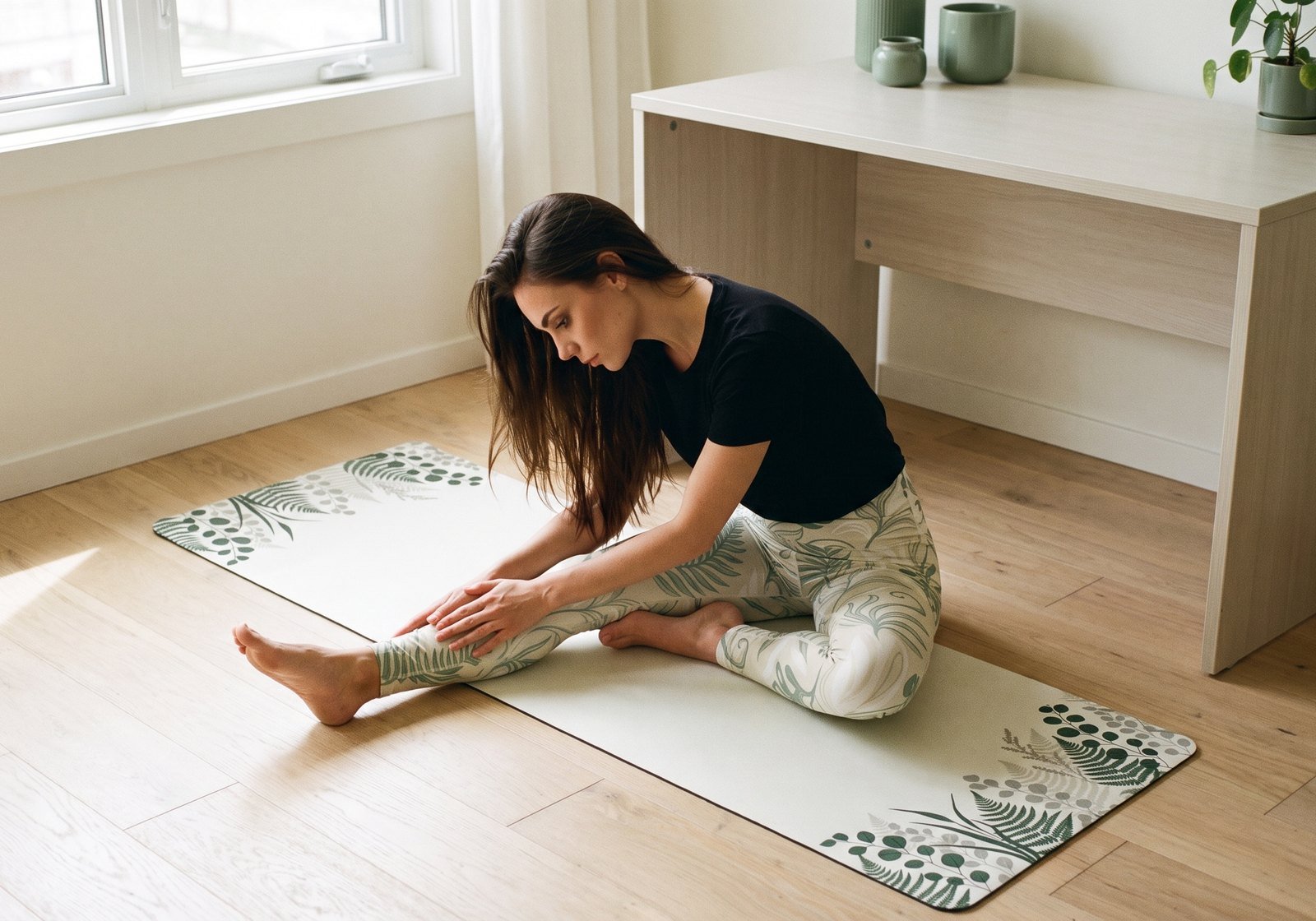
3. Seated single-leg fold — 60 seconds each leg
Sit with one leg straight, the other foot in against the inner thigh. Sit on a cushion or a folded blanket so your hips are higher than your knees. Without that lift, tight hips tip you backwards and you’ll spend the minute fighting your own pelvis. Hinge forward over the straight leg with a long spine.
4. Standing hinge at a chair — 45 seconds
Hands on a chair back or a worktop, walk your feet back, hinge at the hips until your torso is roughly parallel to the floor, knees softly bent. This is the one you can do at work without anyone noticing anything unusual, which is why the routine survives busy weeks.
5. Supported bridge — 90 seconds
Not a hamstring stretch at all — a hip-flexor counter. Lie on your back, knees bent, lift the hips and slide a rolled blanket or a block under the sacrum, then rest. Sitting shortens the front of the hip, and short hip flexors tilt the pelvis in a way that keeps the hamstrings loaded all day. Stretching the back of the leg while the front stays tight is half a job.
How often, and when it stops feeling like work
Five days a week beats seven days for two weeks and then nothing. Ten minutes is the dose; consistency is the drug.
Expect the first honest change in two to three weeks — not in range, but in how early the resistance arrives. Range follows a few weeks later. Anyone promising you the splits in ten days is selling something.
Track it, or you’ll restart it
Four lines after each session: what you did, how long, what was tight, what to repeat. Ninety seconds of writing, and it’s the difference between a habit and a series of fresh starts. We make a lined journal for it; the back of an envelope works too, as long as the envelope stays with the mat.
The short version: flat back over bent knees, holds of 45–90 seconds, exhale long, five days a week, and stretch the front of the hip as well as the back of the leg. That’s the whole method.
Want it laid out day by day? Elena’s free 7-day plan takes the same approach and spreads it across a week, one short routine at a time.
Written with Elena, our AI stretch guide, and checked against our editorial and safety rules before publishing. This is general movement guidance, not medical advice. If you are pregnant, recovering from injury or surgery, or have a health condition, check with a doctor or physiotherapist first. Scene photographs are AI-generated illustrations.


