

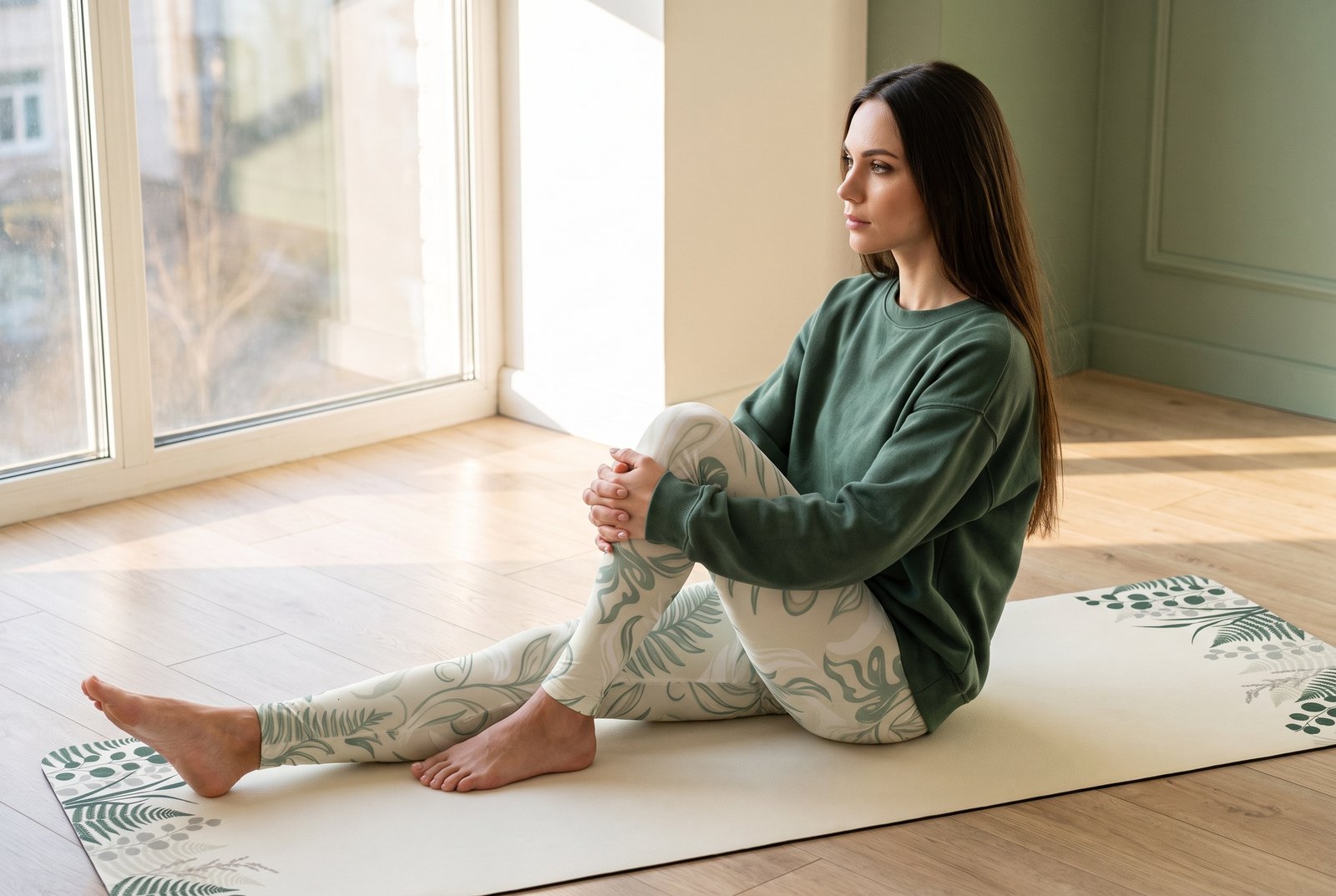
You’re halfway through a downward dog and one hand leaves the mat to hold your t-shirt hem against your ribs. Or you’re in a seated forward fold and the waistband of your leggings has folded into a hard ridge across your stomach, so you come up early. Nobody’s watching. The clothes are still in the way.
This is a guide to what to wear for yoga at home, written from published specifications rather than from any testing we’ve done. We make clothes; we haven’t put them through a lab, and we won’t pretend otherwise. What follows is how to read a spec sheet and your own drawer.
The waistband is the whole garment
Fabric gets all the marketing and the waistband causes all the problems. Home stretching is full of positions that press the front of your hips into your abdomen: seated forward folds, child’s pose, happy baby, any lunge with the back knee down. A waistband that’s comfortable standing at a desk can be genuinely unpleasant folded in half.
Three details do most of the work, and all three are usually listed in the product description. Width: anything under about 4cm tends to roll or dig, while 10-15cm spreads the pressure across the lower abdomen. Construction: a bonded or folded-over knit band with no separate elastic inside stays flat in a fold, whereas elastic sewn into a casing makes a rope. Hardware: drawcords with metal tips, grommets and hard knots sit directly under your navel in prone poses.
If you only change one thing, choose a wide, flat, seamless waistband with no front drawcord tip. For sitting-all-day bodies moving into hamstring work, this matters more than fibre content — the fold is where you feel it, as anyone who’s worked through a hamstring routine after a desk day will recognise.
What should a beginner wear for yoga: raid the drawer first
The honest answer to what should a beginner wear for yoga is: whatever you already own that passes three checks. It doesn’t slide down when you invert. It doesn’t fall over your face. Your knees and elbows can reach the floor without the fabric bunching into a lump.
An old cotton t-shirt and a pair of soft cotton-elastane joggers will pass all three for most people on most days. That costs nothing and removes the single biggest reason home routines get abandoned in week two, which is the belief that you need to buy something before you’re allowed to start. You don’t. Spend the money on floor comfort instead — a decent mat and something to sit on, as laid out in our under-£200 stretching corner, changes more than a new top will.
Buy clothing only after the routine has survived three weeks. If you’re still folding at 7am after twenty-one days, you’ve earned the right to fix a specific annoyance you’ve identified yourself.
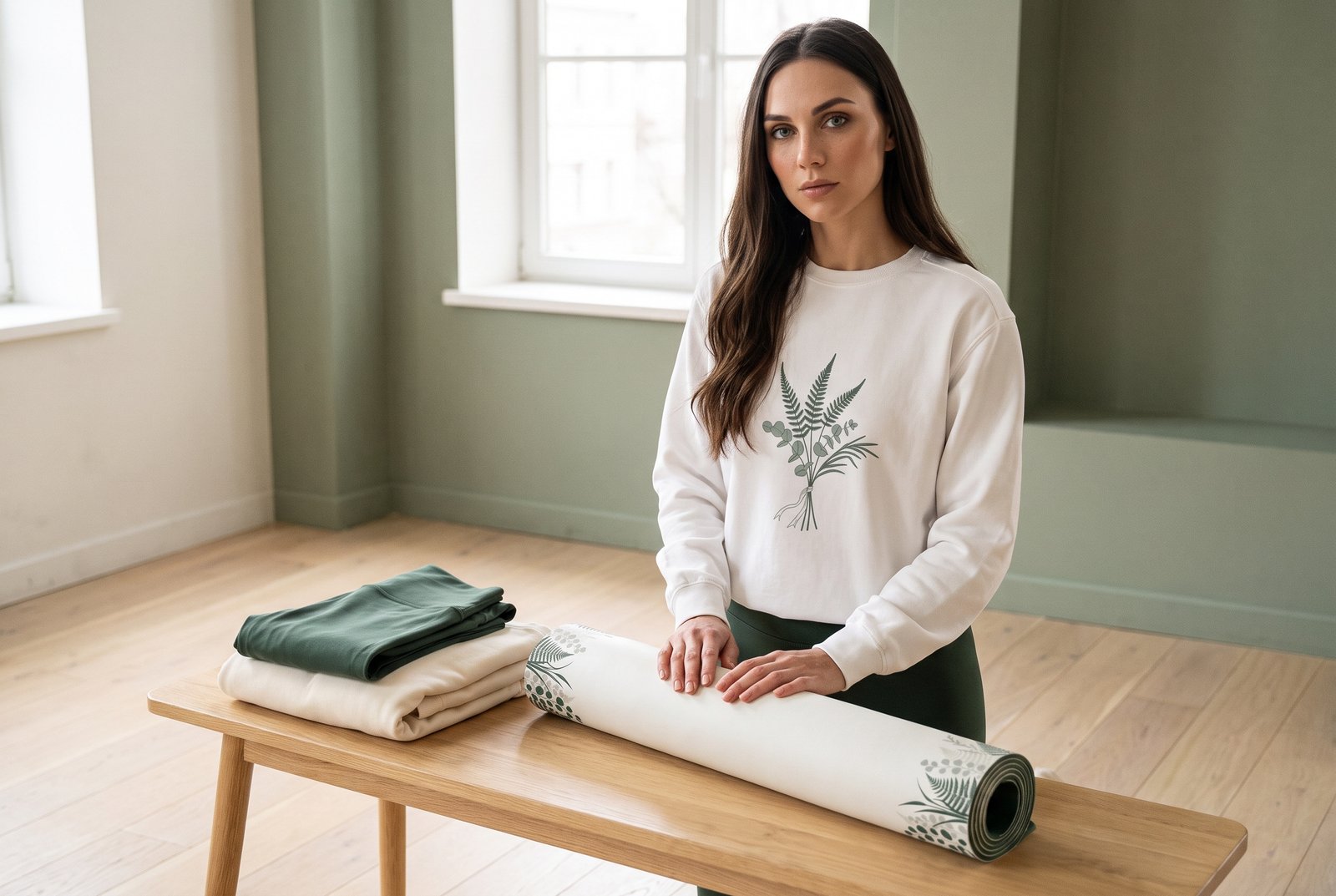
How to dress for yoga: the options side by side
Here’s how the common choices compare on attributes that appear on spec sheets and labels, not on feel. Weights are the ranges usually printed for each garment type; check the actual figure on the item you’re considering.
| Option | Typical listed weight | Waistband / hem behaviour | Opacity in a deep fold | Best for |
|---|---|---|---|---|
| Old cotton t-shirt + cotton joggers | Jersey 140-180 gsm; joggers 250-350 gsm | Drawcord, often with hard tips; hem drops over face | High, unless pale and thin | Starting out, restorative, cool rooms |
| Cotton-elastane leggings (about 92/8) | 200-280 gsm | Flat knit band; can relax and sag when warm | Good in dark colours, weaker in heather grey | Floor work, seated folds, cold floors |
| Nylon or poly-elastane leggings | 190-260 gsm, often four-way stretch | Bonded high-rise band, gusset, no front seam | Depends on knit density more than price | Sweaty rooms, faster drying |
| Loose linen or cotton trousers | 120-190 gsm | Elastic or tie waist; fabric pools at the knee | Variable; thin linen goes translucent when taut | Hot, humid rooms; slow breathing practice |
| Garment-dyed sweatshirt | 280-400 gsm fleece | Ribbed hem, stays put; bulky in twists | Full | Savasana, winter mornings, the first five minutes |
Nothing in this table is wrong for stretching; they’re wrong for different rooms.
What top to wear for yoga, and the hem test
The question of what top to wear for yoga has one mechanical answer: the hem must stay where you put it when you’re upside down. Test it in your kitchen. Bend forward, hands to the floor, and see whether the fabric slides towards your collarbone.
Loose tops pass if the hem is long enough to tuck or narrow enough to grip your hips. Cropped fitted tops pass because there’s nothing to fall. Mid-length boxy tees are the usual offenders — short enough to ride up, wide enough to swallow your face in downward dog.
Sleeves matter less than people expect, with one exception: raglan and set-in sleeves behave differently when your arms go overhead, and a tight armhole limits a side bend before your ribs do. Check the hem in a forward fold and the armhole in an overhead reach; ignore everything else about the top.
See-through depends on four things, and price isn’t one
Opacity is a function of fabric weight, knit density, colour and how far the fabric is being stretched. A 240 gsm knit at rest can go noticeably sheer at the seat when the same panel is pulled taut over a deep squat, because you’re thinning the same amount of yarn across more area.
Pale colours and heather greys show the most, because heather yarns mix undyed fibre into the blend. Flat dark colours hide the most. A gusseted crotch and no centre back seam reduce the strain on any single panel, which is why that detail appears in specifications for higher-rise leggings.
Judge opacity by listed gsm plus colour, then confirm it yourself in daylight before the first practice. Stand in front of a mirror, in the brightest light in the room, and go into your deepest squat.
Do you wear shoes for yoga?
No. Bare feet are the default because you need your toes to spread and grip, and because a shoe sole hides the information you’re trying to feel. Socks are the middle ground for cold floors, and grip socks with silicone dots on the sole exist for exactly this.
Plain cotton socks on a smooth mat will slide in downward dog, which is a genuine hazard rather than an inconvenience. If your floor is cold, the cheaper fix is a thicker mat or a folded blanket rather than footwear — and mat thickness has its own trade-offs, covered in 3mm vs 5mm vs 6mm.
Bare feet on the mat, grip socks if the floor is cold, trainers never.
What to wear for yoga in India, and other hot rooms
In a room at 30-35°C with high humidity, evaporation is the constraint. Cotton absorbs and holds moisture, so a cotton tee stays heavy and clammy through a monsoon session and can take most of a day to dry indoors. Loose cotton still wins for slow, seated, breath-led practice where you barely sweat.
For anything vigorous in that climate, a lighter knit with synthetic content in the listed composition will move moisture faster, and loose cotton trousers over fitted shorts solve both the heat and any modesty concern in a shared home. Early morning, before the day heats up, is the practical window — which is one reason a short morning sequence survives better than an evening one.
Choose loose cotton for slow practice, lighter synthetic blends for sweat, and dress for your room rather than your climate.
What a year does to a garment-dyed sweatshirt
Garment dyeing means the sweatshirt is sewn first and dyed afterwards, usually with pigment rather than reactive dye. Pigment sits on the surface of the fibre instead of bonding into it, which is why these pieces look slightly faded on day one and why they keep fading.
Over twelve months of wearing and washing, expect the colour to lift first at the cuffs, elbows and hem where abrasion is highest. Seams pucker slightly as the dyed thread and dyed fabric shrink at different rates, and the overall shade softens a step or two. Garment-dyed pieces are also dyed after cutting, so most shrinkage has already happened — the listed measurements are closer to what you get.
If you want a sweatshirt to look identical in a year, garment dyeing is the wrong process; if you want it to look like yours, it’s the right one. Wash cold, inside out, and skip the tumble dryer.
Why most people overbuy
Home practice needs two outfits: one warm for the first and last five minutes, one you can fold in. That’s a sweatshirt, a pair of leggings or soft trousers, and two tops that pass the hem test. Everything beyond that is variety, not capability.
Overbuying usually happens after an abandoned routine, when new clothes stand in for the decision to show up. The clothes arrive, the routine doesn’t. Fix the time of day before you fix the wardrobe.
One thing clothing can’t fix: if a waistband or a fold brings on pins and needles down your leg, numbness, or pain that lingers after you stand up, that isn’t a garment problem. See a physiotherapist or your doctor before you carry on practising through it.
If you’re starting this week: wear the cotton t-shirt and joggers you already own, check the hem in a forward fold, and buy nothing until day twenty-one.
If your leggings dig in a seated fold: replace them with a high-rise style whose listed waistband is 10-15cm wide, flat-knit, with no drawcord tips and a gusseted crotch.
If you practise in a hot, humid room: loose cotton for slow work, a lighter synthetic blend for anything that makes you sweat, and bare feet on the mat in both cases.
If you’re buying a garment-dyed sweatshirt: expect it to fade at cuffs and elbows within a year, wash it cold and inside out, and treat the softened colour as the point rather than a fault.
Written with Elena, our AI stretch guide, and checked against our editorial and safety rules before publishing. General movement guidance, not medical advice. Photographs are AI-generated illustrations.


