

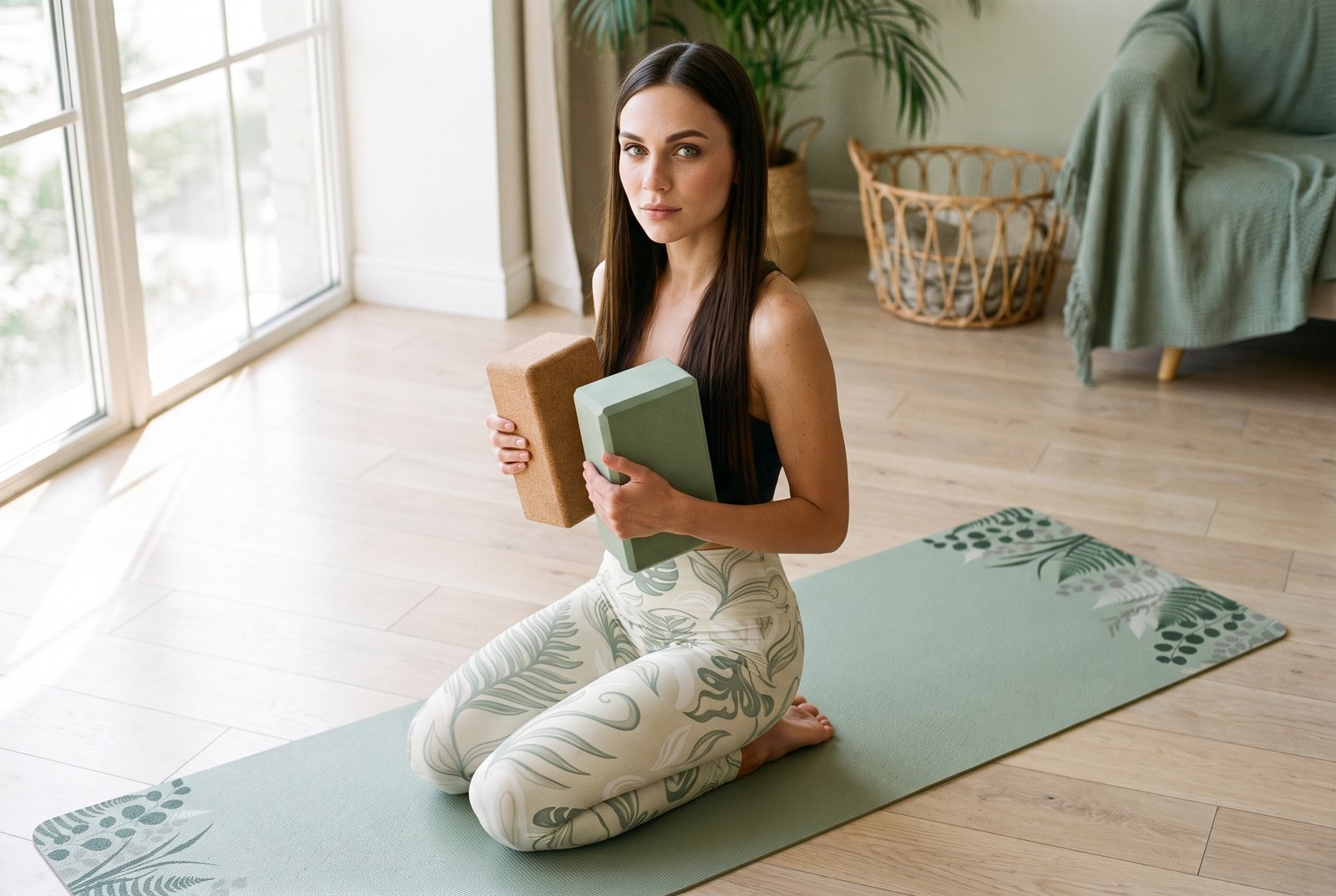
How we make money here: stretching.shop makes the printed pieces in this shop ourselves. Anything on this page marked Recommended gear is made by someone else and sold by a retailer, and we may earn a small commission if you buy through our link at no extra cost to you. We recommend gear we would use, and we say when a cheaper option is the better buy.
You bought a block because a teacher said “grab a block,” and then it spent two years holding a door open. Or you own one foam brick that slides out from under your hip in supported bridge, and you’ve never been sure whether the heavy cork one would have been the better buy. This is that comparison, done on published specifications rather than vibes.
To be clear about method: everything below comes from manufacturer spec sheets and product listings, not from any testing we have done. We haven’t weighed, compressed or measured a single block. Where the published specs go quiet, and they go quiet in one important place, the article says so.
The difference between cork and foam yoga blocks, in one paragraph
Cork blocks are made from granulated cork bark bonded under pressure, usually into a solid brick with no hollow core. Foam blocks are almost always EVA foam (closed-cell ethylene-vinyl acetate) or a recycled EPP/EPE foam, moulded or cut into the same brick shape. The shape is nearly identical; the mass is not.
Across listings, a standard 23 × 15 × 10 cm cork block is commonly published somewhere between 900 g and 1.3 kg, while the same-size EVA foam block is typically listed between 150 g and 300 g. That’s a four- to eight-fold difference in weight for the same outside dimensions, and nearly every practical consequence follows from it.
Cork vs foam yoga block: the spec comparison
| Attribute (as published) | Cork | EVA / recycled foam |
|---|---|---|
| Typical listed weight, 23 × 15 × 10 cm | 900 g – 1.3 kg | 150 g – 300 g |
| Common sizes offered | 23 × 15 × 10 cm; some 23 × 15 × 7.5 cm | 23 × 15 × 10 cm; 23 × 15 × 7.5 cm; occasional 30 cm long versions |
| Edges | Usually lightly rounded or square, hard | Usually chamfered, soft to the forearm |
| Surface described as | Grippy when dry, slightly abrasive, closed cork grain | Smooth or lightly textured, closed-cell, can be slick when damp |
| Compression under load | Described as firm or non-compressing; a figure is rarely published | Described as “high density” or “firm”; a figure is rarely published |
| Care instructions given | Wipe with a damp cloth, air dry, do not soak | Wipe with mild soap and water, closed cell so it does not absorb sweat |
| Failure mode noted in listings | Edge crumbling, chipping if dropped on a hard floor | Permanent dents, fingernail marks, corner compression |
| Material origin claims | Often renewable harvested bark, sometimes recycled cork dust | Often petrochemical EVA; recycled EPP options exist |
The spec sheets agree on dimensions and disagree on nothing except weight and material — which is why the choice is about use, not about which block is “better made.”

Is a cork or foam yoga block better for standing poses?
In a standing pose you’re putting load through the block: a hand in triangle, half moon, revolved side angle, or a block under a heel for a squat. Here the published weight works in your favour. A 1 kg cork brick resists being shunted sideways by a hand pressing at an angle, and it sits still on a 4 mm mat while you move into the pose.
A 200 g foam block skids more easily, because there’s almost nothing holding it down except your hand. Foam listings also note compression at the corners over time, and a standing pose loads one corner hard. If most of your blocks’ working life is under a hand in a standing pose, cork is the spec-sheet answer.
The counter-argument holds too. Cork’s hard, nearly square edges are unpleasant under a forearm in a supported side bend, and dropping a 1.3 kg brick on a wooden floor or a bare toe is a different event from dropping a 200 g one.
Which is better, cork or foam, for restorative and floor work?
Different job entirely. In supported bridge, reclined butterfly, legs-up-the-wall prep or any shape where the block goes under a hip, a sacrum or the back of the head, you’re lying on it for two to eight minutes. Nothing is being levered; something is being padded.
Foam’s slight give and chamfered edges fit that better, and its 200 g weight means you can slide it into place one-handed while you’re already half-reclined. A cork block under the sacrum is a brick, and plenty of people simply can’t settle on one. For restorative and floor work, foam is the sensible buy, and a folded blanket is often better than either.
That last point is worth taking seriously. A dense wool or cotton blanket folds to any height between 3 cm and 15 cm, contours to the body, and costs less than a cork block in most shops. If restorative is the bulk of what you do, read our notes on choosing a blanket for restorative work before you buy a block at all.
EVA foam vs cork yoga block: what the spec sheets do not tell you
Here’s the honest gap. Almost no manufacturer publishes a compression figure, no kg/m³ density, no deflection under a stated load. They write “high density” and leave it there. That means you can’t compare two foam blocks on firmness from their listings, and a cheap foam block and an expensive one may read identically on paper.
Where a density figure is published, use it. Where it isn’t, the only proxies in the listing are weight for a given size (heavier foam at the same dimensions is denser foam) and the returns policy. The same logic applies to mats, incidentally — thickness numbers tell you less than people assume, which we worked through in 3 mm vs 5 mm vs 6 mm mat thickness.
Cork vs foam yoga block on Reddit: the two arguments you will find
Search that phrase and the same two positions come up again and again. One camp says foam blocks dent, slide and feel cheap, and that cork is the last block you’ll buy. The other says cork is heavy, hard on the head, and unnecessary for home practice.
Both camps are describing their own practice accurately. The standing-pose practitioner is right about cork. The restorative practitioner is right about foam. The argument only looks unresolvable because nobody states what they use the block for.
Care, lifespan and the 3 cm question
Published care instructions are short. Cork: damp cloth, air dry, keep it out of standing water, since soaking can loosen the binder. Foam: mild soap and water, and it’s closed-cell, so sweat sits on the surface rather than soaking in.
On size, the choice between a 10 cm and a 7.5 cm block usually matters more than the material does. Standing poses and seated hip-opening generally want the 10 cm height; a 7.5 cm block is friendlier under the head and between the knees. If you can only own one block, a standard 23 × 15 × 10 cm turns to give you three usable heights: 10 cm, 15 cm and 23 cm.
Start with two thick books
If you own two hardbacks around 4 cm thick each, you already own an adjustable block set for nothing. Stacked they give roughly 8 cm; one alone gives 4 cm; add a third and you’re at 12 cm. Books don’t slide much on a mat, and they’ll tell you within a fortnight whether you reach for a prop at all.
Practise that way for two weeks, note which pose makes you reach, then buy the one block that fits that pose. It’s also the cheapest way to build out a corner — the same principle behind a home stretching corner under 200. If you want a block because of persistent hamstring tightness from desk hours, start with a hamstring routine built for sitting all day rather than new kit.
One limit: props manage how far you travel into a shape, not pain. If a pose produces sharp, radiating or nerve-type sensation, numbness, or if something has hurt for more than a few weeks, see a physiotherapist rather than stacking another block under it.
You mostly do standing poses and want one block: buy cork in 23 × 15 × 10 cm. The published 900 g – 1.3 kg weight is what you’re paying for, and square edges stop mattering when the block is under a hand.
Your practice is restorative, floor-based or pre-bed: buy foam, or fold a dense blanket and buy nothing. Foam’s 150 – 300 g listed weight and chamfered edges are the right spec under a hip or a head.
You own two thick hardbacks and no block: use them for a fortnight first. Note the pose that makes you reach for height, then buy exactly one block in the material that pose calls for.
You are comparing two foam blocks and the listings look identical: compare published weight at the same dimensions, since no one prints a compression figure, and treat “high density” as marketing copy rather than a spec.
How this comparison was made: we compared manufacturers’ own published specifications, not our own testing. Where we sell something ourselves we say so. Photographs are AI-generated illustrations featuring Elena, our AI guide.


