

How we make money here: stretching.shop makes the printed pieces in this shop ourselves. Anything on this page marked Recommended gear is made by someone else and sold by a retailer, and we may earn a small commission if you buy through our link at no extra cost to you. We recommend gear we would use, and we say when a cheaper option is the better buy.
A strap is the fastest to load. A zipped sleeve keeps the mat cleanest. An open tote is the only one of the three that also takes your keys, a water bottle and a jumper. That’s the comparison in three lines, and the honest fourth line is that if your mat never leaves the flat, none of them is worth buying.
What follows compares published specifications and the physical facts of a rolled mat — nothing here has been tested by us.
How to carry a yoga mat: the four options, judged on three things
A standard mat is 183 × 61 cm. Rolled, a 3 mm mat makes a cylinder roughly 8–10 cm across; a 6 mm foam mat is closer to 13–15 cm. Weight runs from about 1 kg for thin TPE to 2.5–3 kg for 4–6 mm natural rubber. Those two numbers, length and diameter, decide what will hold it.
Three questions actually matter. How many seconds does it take to pack, does the dirty side touch anything, and can it carry something other than the mat. Everything else is styling.
| Option | Pack time | Mat stays clean | Carries anything else | Added weight | Weak point |
|---|---|---|---|---|---|
| Plain strap (webbing + two loops) | 5–10 seconds | No — the roll is bare | No | Around 40–80 g | Slides off a sloped shoulder; cuts in after 20 minutes |
| Zipped sleeve | 30–60 seconds, more if the mat is 6 mm | Yes, fully enclosed | A small pocket at most | Typically 200–400 g | Traps damp; useless if the internal diameter is under your roll |
| Open tote | 10–15 seconds | Partly — top third sticks out | Yes: bottle, layers, lunch | Typically 250–500 g | Mat can slide out when you lean forward |
| Nothing (under the arm) | 0 seconds | No | You have one hand left | 0 g | Fine for 400 m, miserable for 2 km |
The strap and the sleeve, on specifications
A strap is two adjustable loops on a length of webbing, usually 150–180 cm long and 25–38 mm wide. The wider the webbing, the less it bites. Loops tighten around the roll near each end, which means a strap only works on a mat that holds its own roll — a soft 6 mm foam mat will squash into an oval and the loops will creep towards the middle.
That squashing has a second cost. Webbing cinched tight for weeks leaves a visible ridge in 5–6 mm foam, so if you own a thicker mat, loosen the strap at home rather than storing it under tension. The same logic sits behind the thickness trade-off: the mat that is kindest to your knees is the worst one to carry.
Sleeves are sized by internal diameter and length, and the listings vary enough that you have to read them. A sleeve with a stated internal diameter of 15 cm will swallow a 6 mm roll; one listed at 11 cm won’t, whatever the photograph suggests. Length matters less. Most are cut for a 61 cm mat width, and a 66 cm “extra wide” mat needs the longer version.
The real sleeve problem is moisture. Zipping a damp mat into a nylon tube is how mats start to smell. If you sweat, a sleeve costs you a drying stop somewhere, or an open top.
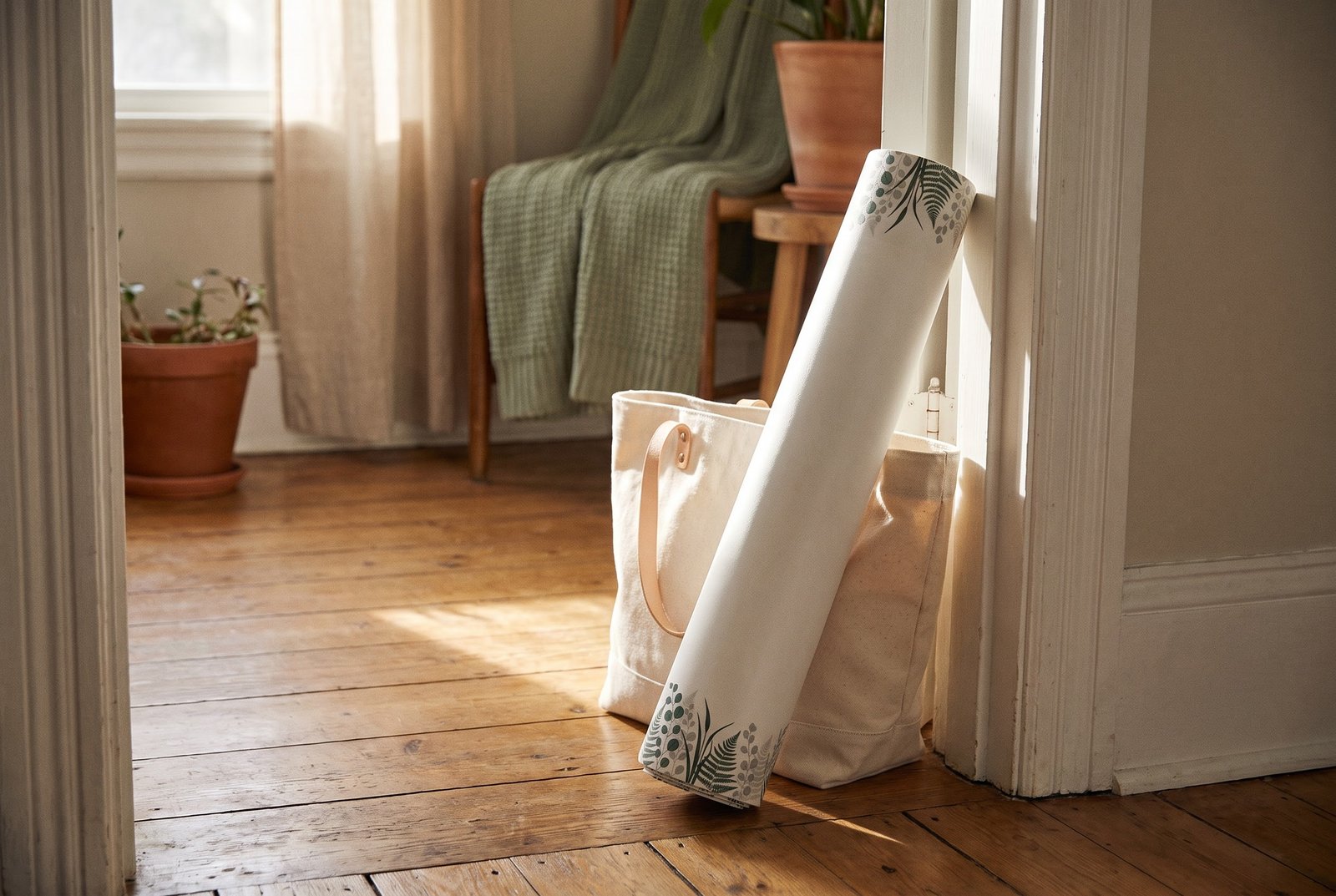
Why an open tote suits most trips, and how to hold a yoga mat in one
The open tote — a long bag with an unzipped or drawstring top, often with a side pocket — wins on the thing people actually complain about: arriving at the studio juggling a mat, a bottle and a phone. The mat drops in vertically, about two-thirds swallowed, and the remaining third sticks out of the top where air can reach it.
Carried cross-body with the strap over the opposite shoulder, a 2.5 kg mat sits along your back instead of swinging off one side. Single-shoulder carrying of the same load, day after day, is what produces the one-sided neck ache people blame on their desk. Swap shoulders, or go cross-body. If a particular shoulder has been grumbling for more than a couple of weeks, that’s a physiotherapist question, not a bag question.
One trick for the bare-handed version of this. Roll the mat with the practice side facing inward, tuck it under your arm with the roll vertical rather than horizontal, and your elbow does the gripping instead of your hand. That’s the whole technique, and it’s free.
How to carry a yoga mat on a bike
The thing that goes wrong is a single sling strap rotating as you pedal, putting a 61 cm cylinder across your back and into the traffic lane beside you. Three better arrangements:
- Rear rack, rolled lengthways, two bungee cords. Lay the roll along the rack, not across it. A 61 cm roll across a rack that is 25–30 cm wide overhangs 15 cm each side — enough to clip a wing mirror or a wheelie bin.
- Front basket. A 13 cm roll drops in and leaves your back free. Check the ends can’t work loose and drop forward into the spokes.
- Backpack-style sleeve with two shoulder straps. Two straps don’t rotate. Published weights for these run higher than a sling, usually 400–600 g, which is the price of stability.
Avoid strapping a mat vertically down your back where it can foul the rear wheel, and avoid anything that covers a rear light.
How to carry a yoga mat in flight
Here the enemy is a published number. Airlines list personal-item dimensions in centimetres, and a 61 cm roll will not fit inside a box whose longest side is 40 cm. Some carriers list a yoga mat as an accepted extra item, some count it as your cabin bag, and some leave it to the gate agent. Check your carrier’s page before the airport rather than at it.
Three workable routes, in order of how often they succeed:
- A 1.5–2 mm folding travel mat that goes inside the bag. They quarter down to roughly 30 × 25 cm and weigh around 1 kg. They are harsh on knees and fine for standing work and hamstrings.
- Your main mat as the carry-on itself, with clothes rolled inside the cylinder. This works when the mat counts as your one cabin bag.
- Leave it. Two hotel towels stacked under the knees cover most of what a mat does, and a rented or borrowed mat at the destination costs less than the airline’s excess item fee.
If you fly often and keep a second mat for it, the choice is a different one from your home mat — the criteria for picking a mat shift entirely once pack size outranks grip.
How to keep a yoga mat clean and flat in transit
Studio floor grit rides home on the side you put your face on. Roll practice side inward for transport so the underside takes the contact, then wipe the mat with a cloth dampened with water and a single drop of mild washing-up liquid when you get in.
Let it dry 20–30 minutes before it goes back in any bag. Skip alcohol and oil-based sprays on natural rubber; they can degrade the surface over time. Open-cell mats absorb liquid and need longer. Closed-cell PVC wipes and is done.
For flatness, the fix is counter-rolling, not weight alone. Unroll the mat, roll it loosely the opposite way for ten minutes, then lay it out. If the corners still lift, park a block or a stack of books on each one for half an hour. Mats stored rolled tight in a cold hallway hold the curl longest; a mat that lives unrolled holds none.
If the mat lives at home, you need none of this
This is the part the carry-accessory aisle doesn’t say out loud. A mat that only travels from the wardrobe to the rug doesn’t need a strap, a sleeve or a tote. It needs somewhere to live flat or hanging, which costs nothing and solves curl, dust and the “where did I put it” problem at the same time. A towel rail, a spare curtain pole, two cup hooks in the side of a bookcase.
The cheap carrying option is also genuinely good: a 180 cm length of 25 mm webbing from a haberdashery, or an old dog lead, knotted into two loops. It does what a branded strap does. Buy a sleeve or a tote when you’re carrying the mat in public weather, by bike, or alongside shoes and a change of clothes, not because the mat requires a case.
If the mat does live at home, the better upgrade is the corner it lives in. A rail, a blanket and good light beats any bag, and a decent home corner costs less than most people expect.
Mat never leaves the house: buy nothing. Hang it over a rail or a cheap curtain pole, unrolled, and spend the money on a blanket or a block instead.
Walking 10–20 minutes to a class with a bottle and a change of top: open tote, carried cross-body. Fastest useful pack, and the mat can breathe on the way home.
Cycling to class, or commuting with the mat: two shoulder straps or a rear rack with bungees. Never a single sling that can rotate into the traffic lane or the rear wheel.
Flying: check the airline’s published personal-item dimensions first, then decide between a 1.5 mm folding mat inside your bag and borrowing one at the other end. A 61 cm roll does not fit in a 40 cm box.
How this comparison was made: we compared manufacturers’ own published specifications, not our own testing. Where we sell something ourselves we say so. Photographs are AI-generated illustrations featuring Elena, our AI guide.


