

How we make money here: stretching.shop makes the printed pieces in this shop ourselves. Anything on this page marked Recommended gear is made by someone else and sold by a retailer, and we may earn a small commission if you buy through our link at no extra cost to you. We recommend gear we would use, and we say when a cheaper option is the better buy.
You know the moment. You come up out of a long savasana and realise your heels have been on the carpet for ten minutes, or your hands slid off the front edge in down dog and left two damp palm prints on the laminate. Mat size is the one spec nobody mentions in class, and the one you notice every single session once it’s wrong.
This guide works from published manufacturer dimensions only. We haven’t tested the mats below, and nothing here is a measurement we took ourselves. The useful part is the arithmetic, and that you can do on your own floor with a tape measure.
Start with your height, then add a hand span at each end
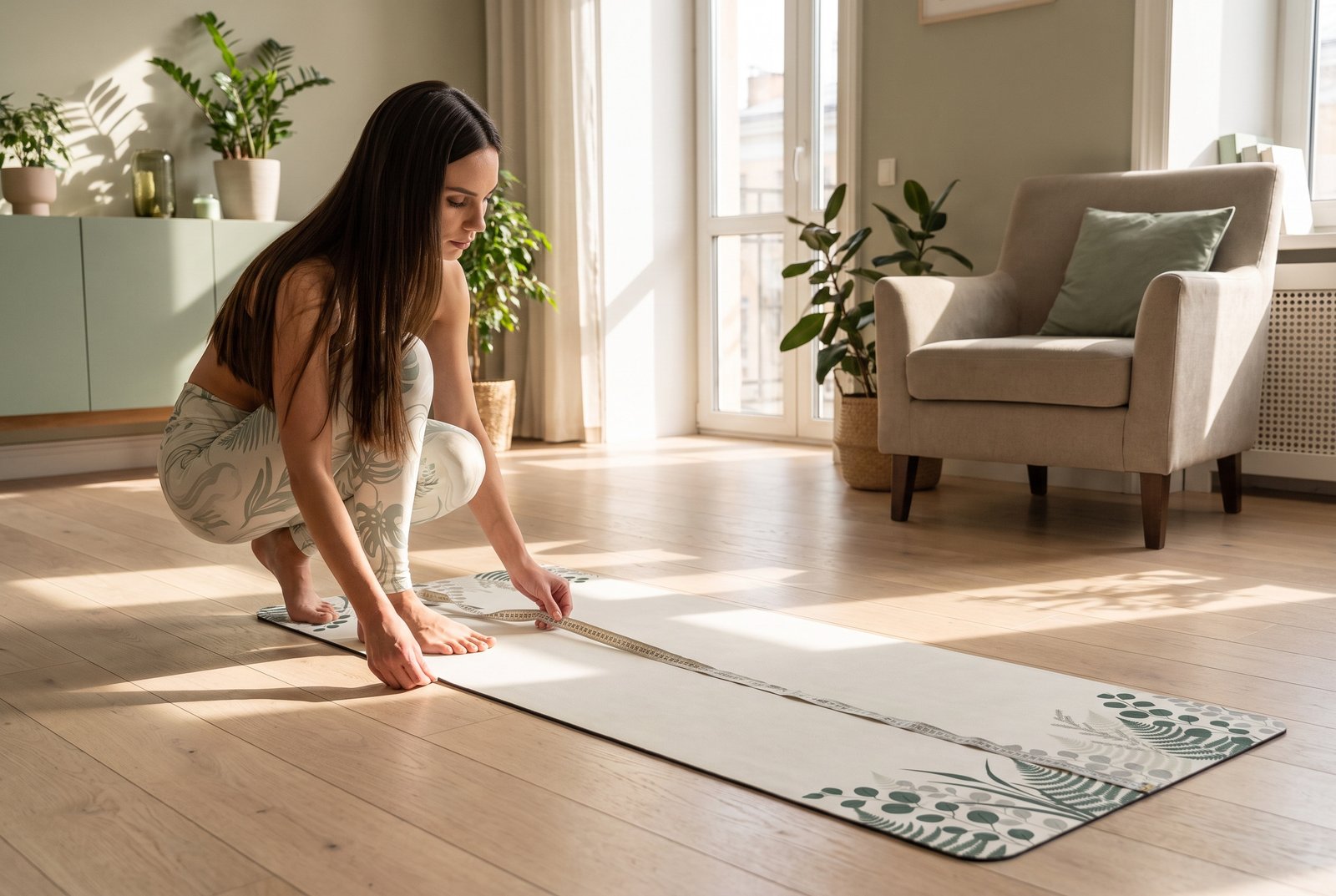
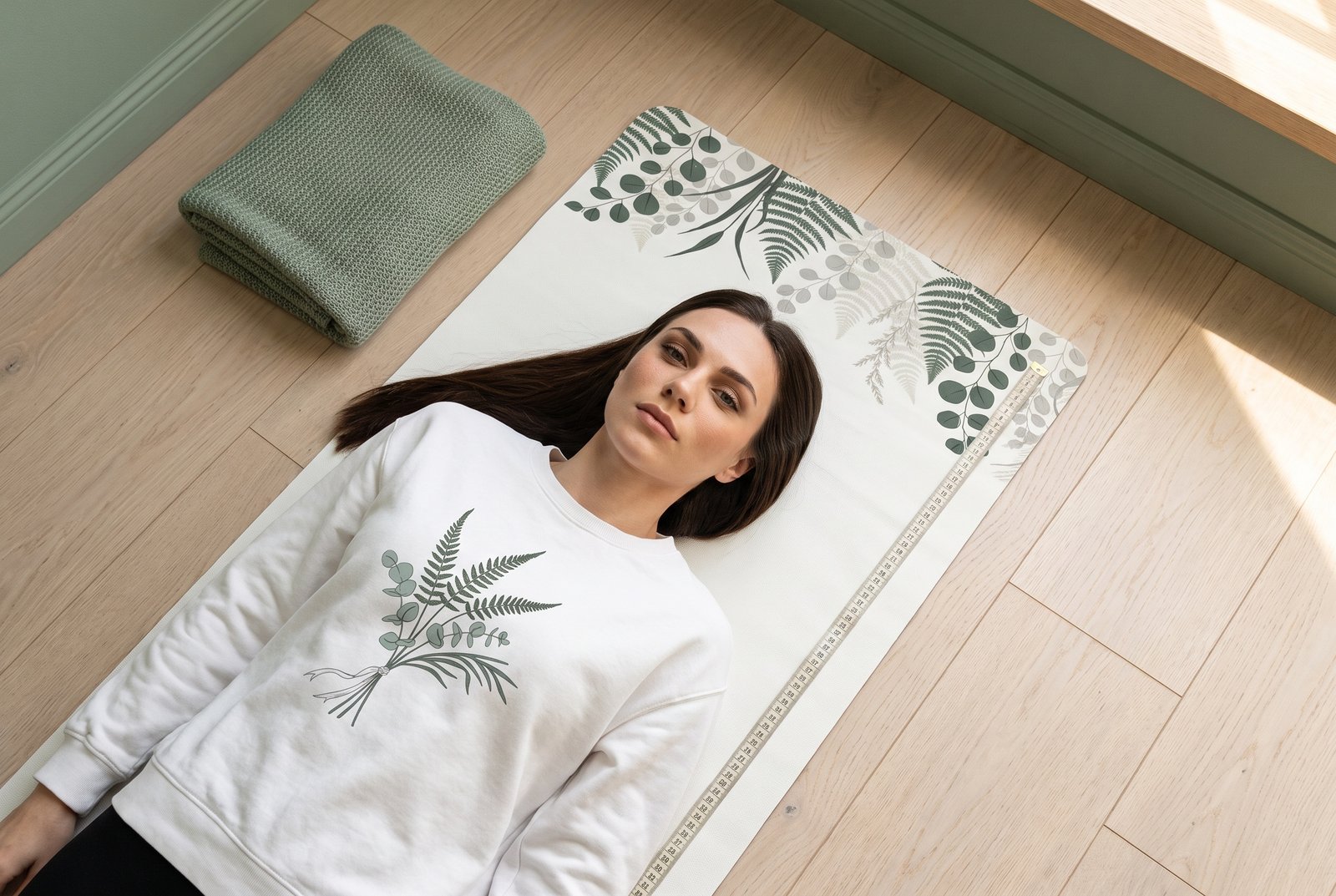
Lie on the floor and measure crown to heel. That’s your working number, and it’s usually a centimetre or two under your standing height. Then add one hand span, roughly 18 to 22 cm for most adults, at the top and at the bottom.
That gives you the length at which you stop thinking about the mat. Your fingertips stay on it in a wide-arm stretch and your heels stay on it in savasana. You can shuffle forward or back without checking. For someone 173 cm tall, the generous figure lands near 210 cm.
Almost nobody buys that. The practical minimum is your lying height plus about 5 to 10 cm, which is why a standard 183 cm mat works for most people under roughly 180 cm. At 173 cm (5 ft 8) you have a 10 cm margin and it’s genuinely fine. At 180 cm (5 ft 11) you have 3 cm, which disappears the moment you set up a lunge slightly off-centre. At 183 cm (6 ft) a 183 cm mat means something is always off the edge. At 188 cm (6 ft 2) you want 200 cm minimum, and 216 cm if your room allows it.
One trap: listings in inches. A 68-inch mat is 173 cm, not 183. Convert before you buy.
The sizes that actually get manufactured
Mat makers cluster around a handful of dimensions, and knowing them stops you hunting for a size that doesn’t exist.
| Size | Also listed as | Suits lying height up to | Rolled footprint | Trade-off |
|---|---|---|---|---|
| 173 × 61 cm | 68 × 24 in | ~165 cm | 61 cm tall, 11–13 cm across | Shorter than most people expect |
| 183 × 61 cm | 72 × 24 in | ~178 cm | 61 cm tall, 12–14 cm across | The default; tight above 178 cm |
| 180–185 × 66–71 cm | 26–28 in wide | ~178 cm | 66–71 cm tall | Heavier; will not stand in a narrow cupboard |
| 200 × 66 cm | 79 × 26 in | ~190 cm | 66 cm tall, 14–16 cm across | Needs 2.2 m of clear floor |
| 216 × 66–80 cm | 85 in long | 190 cm + | Bulky, often 4 kg + | Hard to store, hard to carry |
| 180 × 61 cm at 1–1.5 mm | Travel / folding | Any, as a layer | Folds to roughly A4, 1–1.3 kg | Little cushioning on hard floors |
Published weights for 5–6 mm natural rubber mats at 183 cm typically sit between 2.5 and 4 kg, and the wide and long versions climb from there. If you carry your mat anywhere, weight is a size decision too. A 216 cm rubber mat is a thing you own, not a thing you take on the bus.
Width does more for floor stretching than for standing flow
In a standing sequence, your feet rarely leave a 61 cm corridor. Warrior II is the exception, and most people just angle the back foot on the edge. For vinyasa and sun salutations, standard width is adequate.
Floor work is the opposite. Supine twists, a reclined figure-four, side-lying leg lifts, anything where your arms go out in a T — those move you sideways across the mat, not along it. On 61 cm your hand lands on the floor and the whole shape loosens. At 66 to 71 cm it mostly doesn’t. At 80 cm it never does.
If most of your practice is the sort of thing in our hamstring routine for sitting all day (supine, slow, one leg at a time), buy width before you buy length. This is also the honest answer to best size yoga mat for men: it’s rarely length. The 66 to 71 cm width is the one that helps, because shoulder span is what runs out first.
Two standard mats side by side give you 122 cm of width for less than most single wide mats cost. They shift apart, and the seam is annoying under your spine. But if you already own one mat, buying a second cheap one is the better value move. For plus-size practice the same logic applies: width and a published weight limit matter more than brand, and a wide 80 cm mat or a doubled-up pair beats a premium 61 cm one.
What size yoga mat for Pilates
Pilates mats are built around spinal articulation — rolling like a ball, teasers, anything where vertebrae press into the floor one at a time. Published Pilates mat dimensions are typically 180 × 60 cm at 8 to 15 mm, noticeably thicker than a yoga mat, and some are only 100 × 60 cm because the work stays in a small footprint.
The catch is that 10 mm of foam is unstable under a standing balance. If you do both disciplines, the usual compromise is a 6 mm mat at 183 × 66 cm plus a folded blanket under the spine for mat-work days. That’s cheaper than owning two mats, and it stores in the same cupboard.
Thickness and size are separate decisions and get confused constantly. The best size yoga mat mm question is really a thickness question — we went through it properly in 3 mm vs 5 mm vs 6 mm. Short version: thinner for balance, thicker for knees, and 5 mm is the common middle.
Measure your floor with tape before you buy anything
This is the step that saves the money. Take masking tape and mark out the actual rectangle on the floor where you intend to practise. For a 183 × 61 cm mat, tape 183 × 61. Then stand in it and do a sun salutation, a Warrior II, and lie down with your arms out.
You need the mat footprint plus roughly 30 cm of clear space at the front for your hands in down dog, and enough overhead height to reach up without touching the ceiling light. Check what’s at the edges: a radiator at skirting height, a door that opens inward, the lip of a rug that will catch the mat corner.
If 2.2 m of clear floor doesn’t exist in your home, a 200 cm mat is the wrong purchase regardless of your height. A 183 cm mat placed diagonally across a small room often gives you more usable space than a longer mat jammed against a wall. Our notes on building a home stretching corner under 200 go through the clearances in more detail.
Storage is a dimension too
A rolled mat is as tall as the mat is wide. A 61 cm mat stands in most wardrobes and behind most doors. A 71 cm mat doesn’t fit a lot of fitted cupboards, and a 216 cm mat rolls to 15–18 cm across, which is too fat for a slim gap beside a bookcase.
Before buying wide or long, measure the place it will live. A mat that lives leaning against a wall in the hallway gets used. A mat that has to be wrestled out of a cupboard gets abandoned by week three, and if you’ve abandoned a routine before, you already know the friction is the problem, not the motivation.
For travel, a 1 to 1.5 mm folding mat at around 1 kg is designed to sit on top of a studio mat, not on a hotel room floor. On tile or wood it offers essentially no cushioning. A hotel towel under your knees is free and, for a week away, often enough.
Beginners, and when size is not the issue
If you’re starting out, buy 183 × 61 cm at 5 mm and spend nothing more until you’ve practised twenty times. By then you’ll know whether your hands run off the front or your elbows run off the sides, and that tells you which dimension to upgrade. Our full mat-choosing guide covers material and grip.
And if your knees hurt on a 6 mm mat, or you get pins and needles down one leg in a seated forward fold, or pain persists after a session rather than easing — that’s not a sizing problem. See a physiotherapist. No mat dimension addresses nerve symptoms or joint pain that doesn’t settle.
Under 178 cm, practising in a spare room: a 183 × 61 cm mat is enough. Put the money into thickness and grip instead of extra centimetres.
180 cm and over: go to 200 cm long if your taped-out floor space allows 2.2 m, and 216 cm only if you have a wide storage gap. Otherwise accept that your heels sit on the floor in savasana and put a folded blanket under your head instead.
Mostly floor stretching, supine work or Pilates mat work: buy width, 66 to 80 cm, before length. If you already own a standard mat, lay a second cheap one alongside it and spend nothing.
Small flat, mat lives behind a door: keep it 61 cm wide so it stands upright in the gap, and tape the rectangle on the floor before you order anything.
Written with Elena, our AI stretch guide, and checked against our editorial and safety rules before publishing. General movement guidance, not medical advice. Photographs are AI-generated illustrations.


