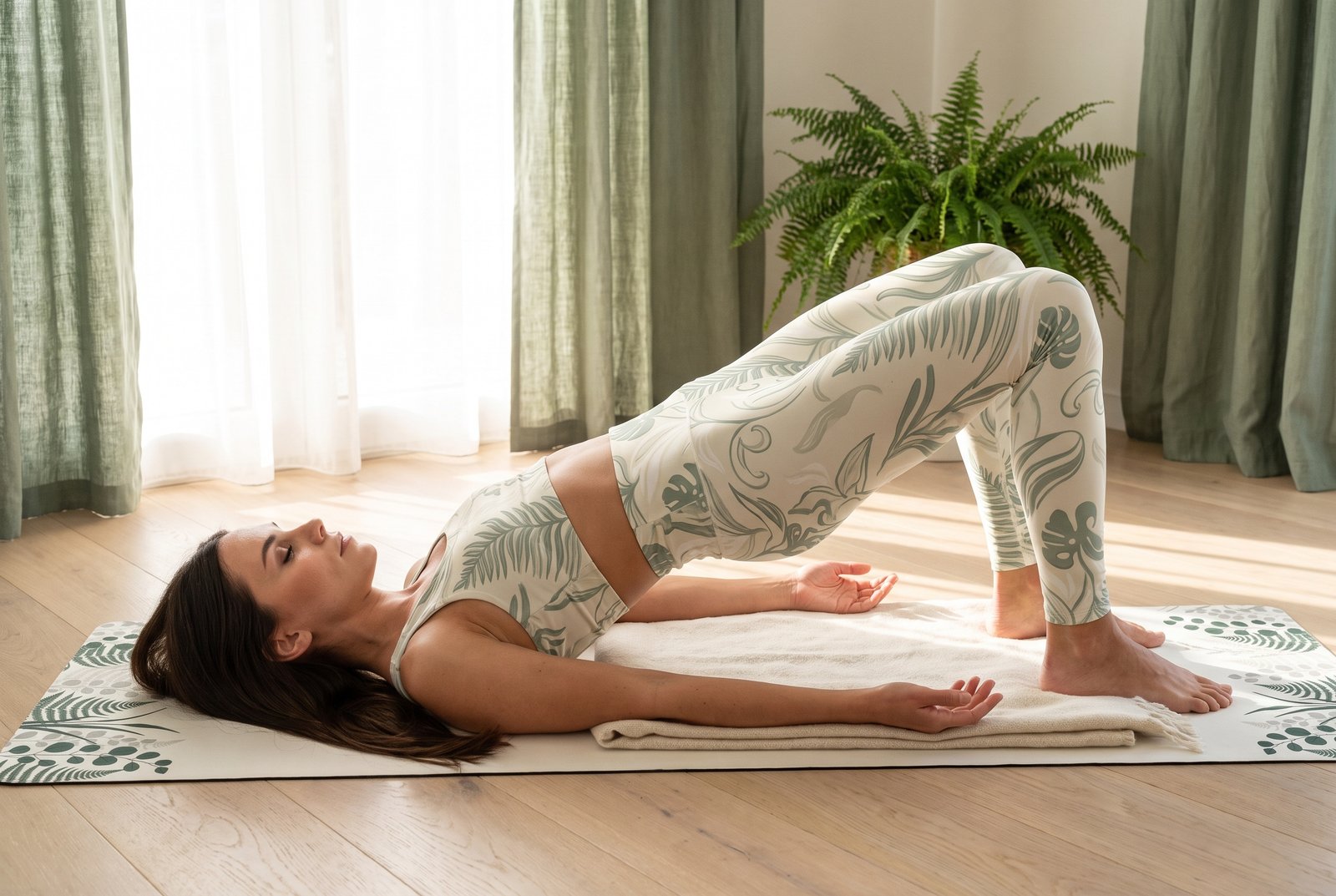
You rolled the mat out, lay down for a supported twist, and were checking your phone inside two minutes. The pose was supposed to last five. Nothing hurt, nothing burned, and that was somehow the problem — without a prop under you doing the holding, your body kept working, and a muscle that’s still working can’t let go.
That’s the whole argument for restorative props. Their job is to hold the shape so you don’t have to.
Is restorative yoga good for beginners?
It’s one of the few styles where being new isn’t a disadvantage. There’s no balance to lose and no sequence to memorise, and no chaturanga anywhere. A typical restorative session is four to six shapes held three to ten minutes each, which means a 40-minute practice might contain five poses total.
The catch nobody mentions: beginners usually under-prop, not over-prop. If a supported forward fold has you hovering two centimetres above the bolster, your hip flexors and neck are holding you there for five minutes. Add a folded blanket. Add another. The correct amount of support is the amount that lets you stop.
If you have a disc issue, recent surgery, pregnancy, or pain that wakes you at night, get a physiotherapist to look at your specific shapes before you hold anything for ten minutes. Long passive holds are gentle, but they’re still load, and load over time is exactly what irritated tissue responds to.
Does restorative yoga count as exercise?
Honestly, no — not in the cardiovascular or strength sense. Your heart rate goes down, not up. Nothing gets stronger. If your weekly plan is restorative yoga and nothing else, you’ve got a recovery practice and no training.
What it does count as is the thing you’re most likely to actually do on a Tuesday at 21:40, which is worth more than the perfect routine you abandon. Pair it with something that loads tissue, say a hamstring routine for sitting all day two or three times a week, and the pairing works. Restorative on its own is rest with better scaffolding.
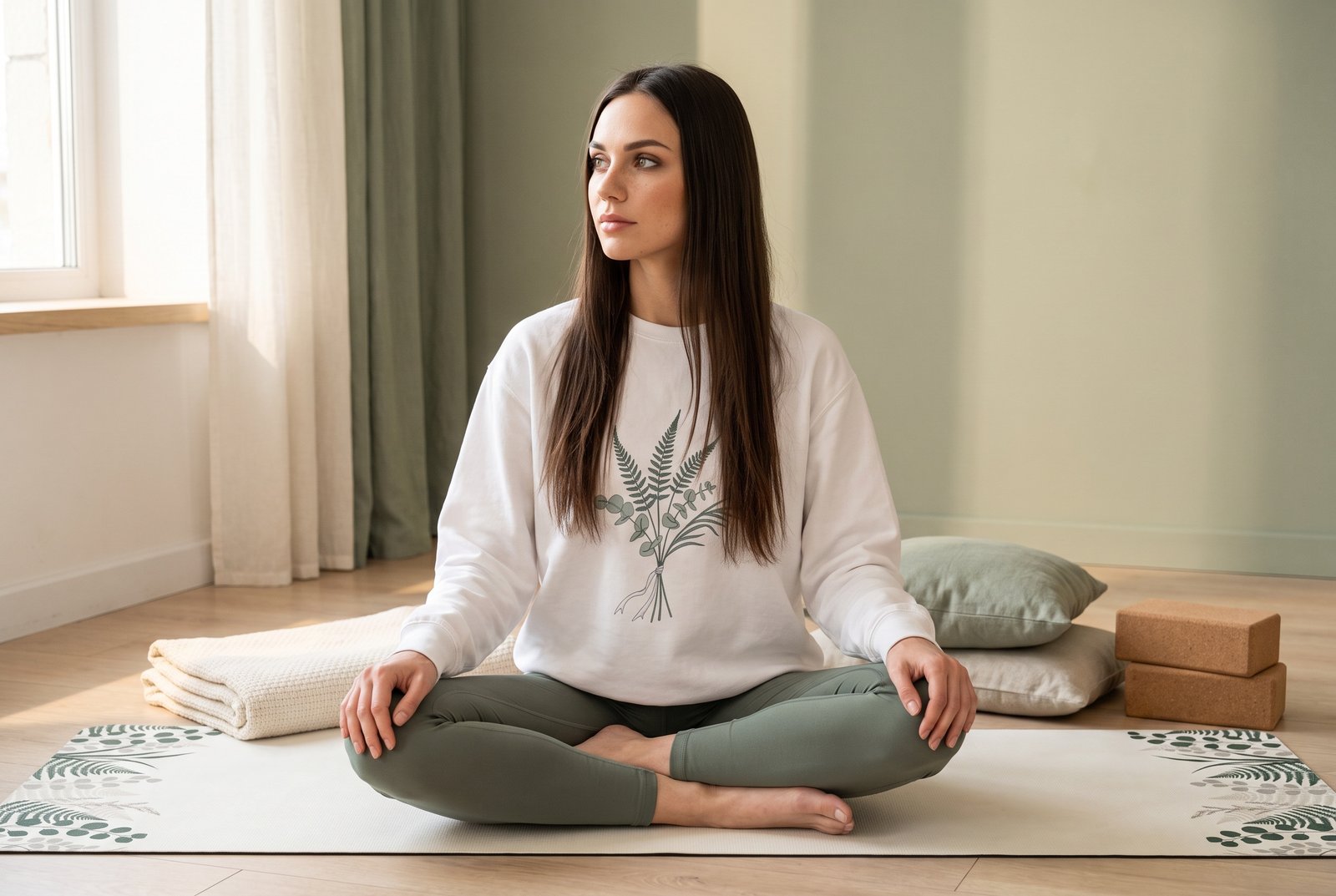
The four props, and what each one is actually for
The bolster: fills space so gravity has nothing to pull
A bolster’s job is to occupy the gap between your torso and the floor. Under the knees in a supine rest it flattens the low back. Under the chest in a prone fold it removes the need for abdominal bracing. Lengthwise along the spine it opens the front of the ribs without hinging your lumbar spine.
This is the prop with no honest substitute at full size — more on that below.
The blanket: height, weight, and the only prop that also warms you
Folded, a wool or cotton blanket is an adjustable block. Rolled, it’s a small bolster. Draped, it keeps you from getting cold, which matters because body temperature drops in a long hold and shivering isn’t relaxation. Published dimensions for the classic cotton “Mexican-style” practice blanket cluster around 200 × 140 cm, which folds into a firm pad roughly 50 × 35 cm and about 6 cm tall.
The block: raises the floor
Cork and foam blocks are most commonly listed at about 23 × 11 × 7 cm, giving you three distinct heights depending on the face you rest it on. In restorative work a block rarely takes body weight. It props a bolster at an angle, supports a forearm, or sits under a knee that won’t reach the mat.
The eye pillow: the cheapest large effect
Gentle weight over closed eyes and light exclusion. Listed sizes are usually around 23 × 11 cm with 200–300 g of flaxseed or buckwheat. It’s the prop most people skip, and the one that most reliably changes whether a ten-minute hold feels long.
What to buy, what to raid from the linen cupboard
The table below sets out specifications as published by makers alongside the household equivalent. None of it is test data. We haven’t measured these against each other.
| Prop | Typical published spec | Free substitute | Honest verdict |
|---|---|---|---|
| Rectangular bolster | ~65–70 cm long, 25 cm wide, 15 cm deep; cotton or kapok fill, firm | Duvet folded in thirds and rolled tight, tied with a belt | Buy this one. Substitutes compress within minutes |
| Blanket | ~200 × 140 cm, cotton or wool, 1.3–2 kg | Any dense wool blanket you own; a folded bath towel for height | Substitute is genuinely fine. Fluffy fleece is not — it collapses |
| Block | 23 × 11 × 7 cm, cork ~1.1 kg or EVA foam ~250 g | Two hardback books, or a tightly folded towel | Books work. Buy cork only if you also do standing poses |
| Eye pillow | ~23 × 11 cm, 200–300 g flaxseed, washable cover | Long sock filled with rice, knotted; or a folded hand towel | Sock of rice is close. The pillow is nicer, not necessary |
| Mat | 5–6 mm for floor work; 3 mm for standing grip | Carpet, or a folded blanket on a rug | Carpet is fine for restorative. Hard floor is not |
Restorative yoga bolsters: the one worth buying properly
Three of the four props have good free stand-ins. The bolster doesn’t, and the reason is structural. A bolster has to resist the weight of a torso for ten minutes without losing more than a centimetre or two of height. Rolled duvets, sofa cushions and pillows are designed to compress. That’s their job.
Firmness and recovery matter more than cover fabric. When comparing listings, look for stated fill (cotton batting and kapok are described as firmer, polyester fill as softer), a removable washable cover, and a carry handle if you’ll be moving it between rooms. Rectangular shapes give a broader, flatter surface. Round shapes give more lift through a smaller contact area, which some people find too much under the knees.
Yin yoga props: same kit, different job
People search for yin yoga props and restorative props as if they were separate shopping lists. The kit overlaps almost entirely: bolster, two blocks, two blankets. The intent is what differs.
In restorative, props remove sensation so the nervous system settles. In yin, props meter sensation: you sit on a folded blanket in a seated fold so you can reach a tolerable stretch and stay there three to five minutes. Yin wants you at roughly a four out of ten and no higher. If you own a restorative kit you own a yin kit. Blocks earn their keep more in yin, where they prop knees in dragon and butterfly.
A four-pose sequence you can run tonight
- Supported reclining rest — bolster under knees, blanket over you, eye pillow on. 8 minutes.
- Side-lying twist — bolster between knees, arms wherever they fall. 5 minutes each side.
- Supported forward fold — sit on a folded blanket, bolster across your shins, fold onto it. 5 minutes.
- Legs up the wall or legs on a chair seat — blanket under the hips if the low back complains. 7 minutes.
Set a timer per pose rather than one for the whole session, so you’re not doing arithmetic instead of resting. If you want a guided version, searching restorative yoga with props on YouTube turns up plenty of full-length classes, and many teachers publish free sequence PDFs that name every prop height. Use a free online class before buying a prop kit. You’ll learn which shapes you actually return to, which tells you what to buy.
Mats, floors and where this lives
Restorative practice happens on your back for 30 minutes, so cushioning beats grip. If you’re choosing between thicknesses, the case for 5–6 mm is strongest here — see 3mm vs 5mm vs 6mm. On carpet, you may not need a mat at all.
Storage decides whether the routine survives. A bolster shoved in a wardrobe is a bolster you stop using. If you’re setting up a permanent spot, the home stretching corner piece covers the layout, and the blanket guide goes deeper on wool versus cotton.
If you have never done a restorative session: do nothing but the four-pose sequence above with a duvet, two books and a bath towel. Three sessions in, you’ll know whether to spend anything.
If you already practise weekly and keep rebuilding a duvet roll: buy one firm rectangular bolster, around 65 × 25 × 15 cm, with a washable cover. Keep using household blankets and books for the rest.
If you are choosing between a full prop kit and single items: buy singly. Most kits bundle two blocks and a strap you’ll barely touch in restorative work.
If a held pose produces numbness, tingling, or pain that lingers after you come out: stop holding it and see a physiotherapist before you adjust the props.
Written with Elena, our AI stretch guide, and checked against our editorial and safety rules before publishing. General movement guidance, not medical advice. Photographs are AI-generated illustrations.


