
You’re in a wide-legged forward fold, palms reaching for the floor a good ten centimetres away, so you slide a hardback under each hand. One of them has a glossy dust jacket. It shoots sideways across the boards and you come down on your wrists. Or the stack of three paperbacks under your hip in a supported bridge fans out slowly, like a deck of cards.
Books do work. They work well enough that buying props first is often the wrong order of operations. But they fail in specific, predictable ways, and it helps to know which ones before you’re upside down. Everything below compares published manufacturer specifications, not our own testing. We haven’t measured these blocks ourselves, and any brand that gives you a density figure is telling you more than one that gives you a colour swatch.
What yoga blocks are used for, in one paragraph
A block does three jobs: it brings the floor up, it stops a joint hanging at the end of its range, and it gives you something to press into. Bringing the floor up matters in forward folds, triangle and half moon. Propping matters in supported bridge, reclined butterfly and any restorative shape you hold for two minutes or more. Pressing matters between the thighs in bridge or between the palms overhead, where the block becomes a target for tension rather than a support.
The design detail that makes a block a block rather than a brick-shaped object is that one block gives you three different heights. A standard block published at 23 × 15 × 10 cm (9 × 6 × 4 in) lies flat for 10 cm, sits on its long edge for 15 cm, and stands on end for 23 cm. That’s a 10/15/23 ladder from a single object, and it’s the whole reason people end up with two.
Books work for about a month. Here’s what breaks
Four things, in the order you’ll meet them.
- The height you need is never the height you have. A paperback is roughly 2 cm at the spine, a standard hardback 3–4 cm. To reach 15 cm you’re stacking four or five, and a five-book stack has four sliding interfaces.
- Covers are laminated. Laminate on laminate is slippery, and laminate on a sweaty palm is worse.
- Spines are not flat. Stacked books tilt, and the tilt is always toward the direction you’re already leaning.
- Sharp corners. In a supported bridge the block sits under the sacrum for a minute or two, and a hardback corner under bone is a different experience from a chamfered cork edge.
None of that matters for your first four weeks of a routine, when the real question is whether you’ll still be doing this in March. Spend nothing, stack books, and see. If you want a structure to test it against, the five-minute morning routine is short enough that props barely matter.
Cork vs EVA foam vs books, by published specs
Figures below are the ranges brands typically publish for standard-size blocks. Always read the specific listing: weight and density vary more between brands than between materials.
| Option | Typical published size | Typical listed weight | Heights you get | Surface and edges | Job it does best |
|---|---|---|---|---|---|
| Cork (agglomerated, often recycled) | 23 × 15 × 10 cm | Commonly around 1–1.3 kg each | 10 / 15 / 23 cm | Slightly tacky when dry, chamfered edges, no meaningful compression | Weight-bearing: hands in folds, standing poses, anything you press into |
| EVA / high-density foam | 23 × 15 × 10 cm | Commonly around 200–400 g each | 10 / 15 / 23 cm | Soft-matte, rounded edges, compresses under load | Restorative propping, travel, studios buying in bulk |
| Recycled-foam or “eco” soft blocks | Varies; some flatter at 7–8 cm | Varies widely — check listing | Often only 2 usable | Softest; can bow under a shoulder stand | Under knees, under the head, seated support |
| Stack of books | 2 cm paperback, 3–4 cm hardback | 0.4–1 kg per hardback | Whatever the shelf allows | Slippery laminate, hard corners, tilts | Seated hip lift, one-off height under a hand, trialling a habit |
Why cork yoga blocks, and are yoga blocks hard or soft
Cork is the answer when your body weight goes through the block. It doesn’t squash, so the height you set is the height you get, and agglomerated cork has a faint grip that laminate and slick foam don’t. The trade-offs are published plainly: it weighs roughly three to five times what a foam block weighs, it costs more to ship, and it’s genuinely hard against bone.
Foam is the answer when the block is under something soft or under something for a long time. Firm where you push, soft where you rest is the whole rule. If you want one material for everything, most people find firm more forgiving than soft, because a soft block under a hand in half moon is a wobble you can’t correct. For long restorative holds a folded blanket beats both — see what to look for in a restorative blanket.
What changes in three positions
Forward fold, standing or wide-legged
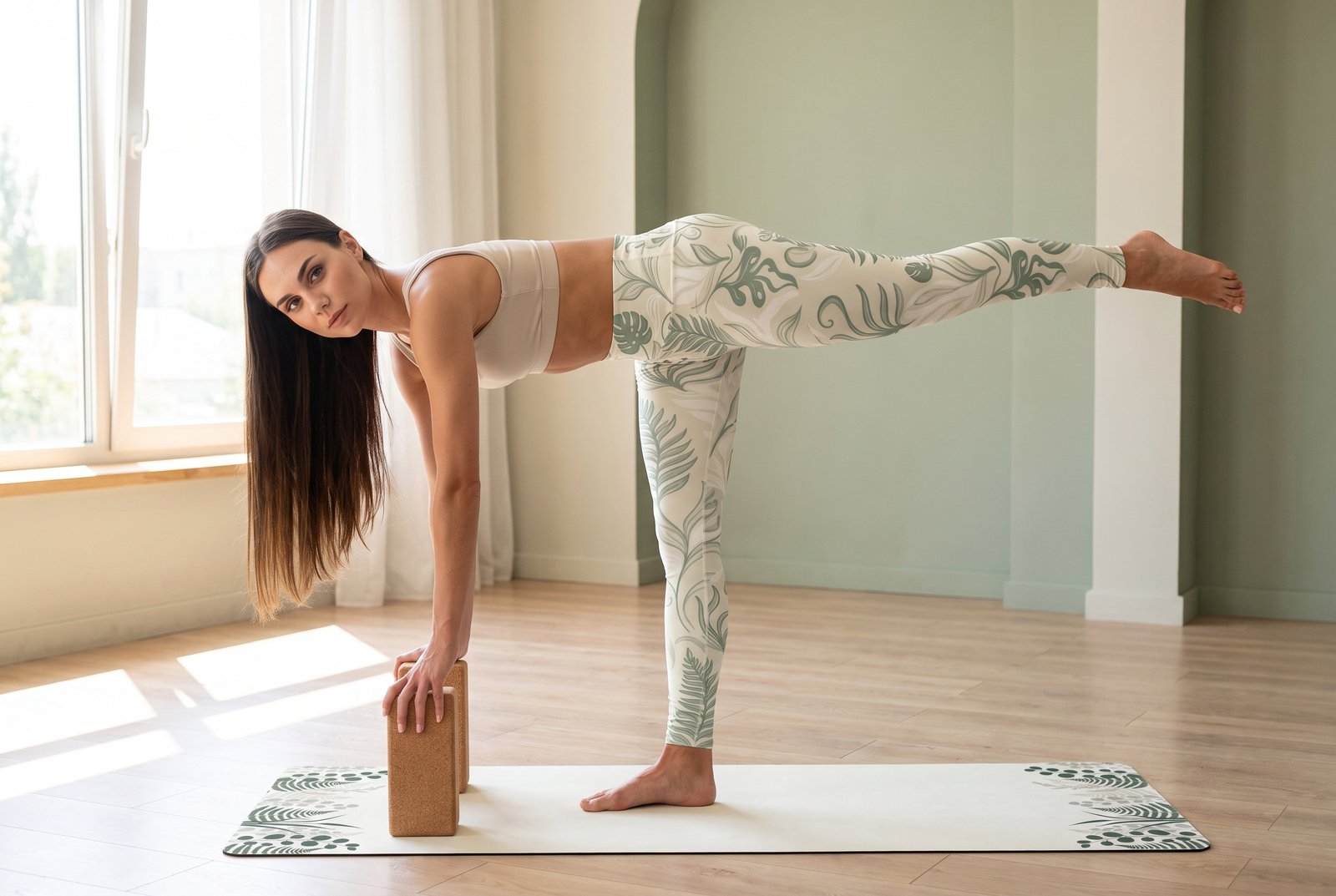
Hands on two blocks on end (23 cm) lets you keep a long spine instead of rounding to chase the floor. Books can do this height, but each hand is loading a stack sideways. A single cork block per hand is the one place the material difference is not subtle.
Low lunge
Blocks either side of the front foot at 15 cm take load out of the back knee and let the hips settle. Foam is fine here — you’re resting hands, not pressing hard. What you actually want underneath is enough mat; if your knee complains in lunges, mat thickness matters more than block material.
Supported bridge
Block flat (10 cm) under the sacrum, held one to three minutes. This is where books lose outright: corners, tilt, and a stack that shifts as you breathe. Foam is kinder than cork here. If a supported bridge produces pins and needles, tingling down a leg, or pain rather than stretch, come out of it and see a physiotherapist rather than adjusting the prop.
Yoga blocks or bricks, and the block vs foam roller question
The naming is inconsistent. Some brands call the 23 × 15 × 10 cm standard a brick and reserve “block” for a flatter, wider slab; others use the words interchangeably. Ignore the noun and read the three dimensions. If a listing gives you no dimensions, treat that as the answer.
A foam roller isn’t an alternative. Rollers are typically published at 15 cm diameter and 30–90 cm long, curved by design, and meant to move under you. A block is meant to stay put. Owning one doesn’t replace the other.
What size, how many, and where to buy
Two standard blocks is the useful default, because the symmetrical poses want a pair. One is enough if you mostly do seated and restorative work. Flatter blocks around 7–8 cm suit people who only need a small lift for sitting cross-legged — and for that, a folded blanket or a firm cushion does the same job for nothing.
Searching “yoga blocks near me” in the UK mostly turns up sports chains and supermarket seasonal aisles; Target is US-only, and Amazon listings are where you’ll find bulk packs of foam for studios. Whatever the source, the checklist is the same: stated dimensions, stated weight, stated material, chamfered edges. For beginners, a pair of foam blocks plus a blanket covers more ground than one premium cork block, and if you’re building a whole setup, sequencing what to buy first saves more than choosing the right material does.
If you started stretching in the last month: keep the books. Stack hardbacks, not paperbacks, put a tea towel over any glossy dust jacket, and only buy blocks once the habit has survived four weeks.
If your hands take weight in folds, triangle or half moon: two cork blocks at 23 × 15 × 10 cm, listed weight around 1 kg each. Firmness and edge grip are the specifications that matter; colour isn’t one.
If your blocks mostly go under hips, knees and sacrum for long holds: high-density EVA foam, and put a folded blanket on top. Cork is needlessly hard against bone for two-minute holds.
If tight hamstrings are the actual problem: props raise the floor, they don’t change range. Work the desk-sitter hamstring routine, and if one leg is consistently different or anything travels below the knee, see a physiotherapist before adding props.
How this comparison was made: we compared manufacturers’ own published specifications, not our own testing. Where we sell something ourselves we say so. Photographs are AI-generated illustrations featuring Elena, our AI guide.


