

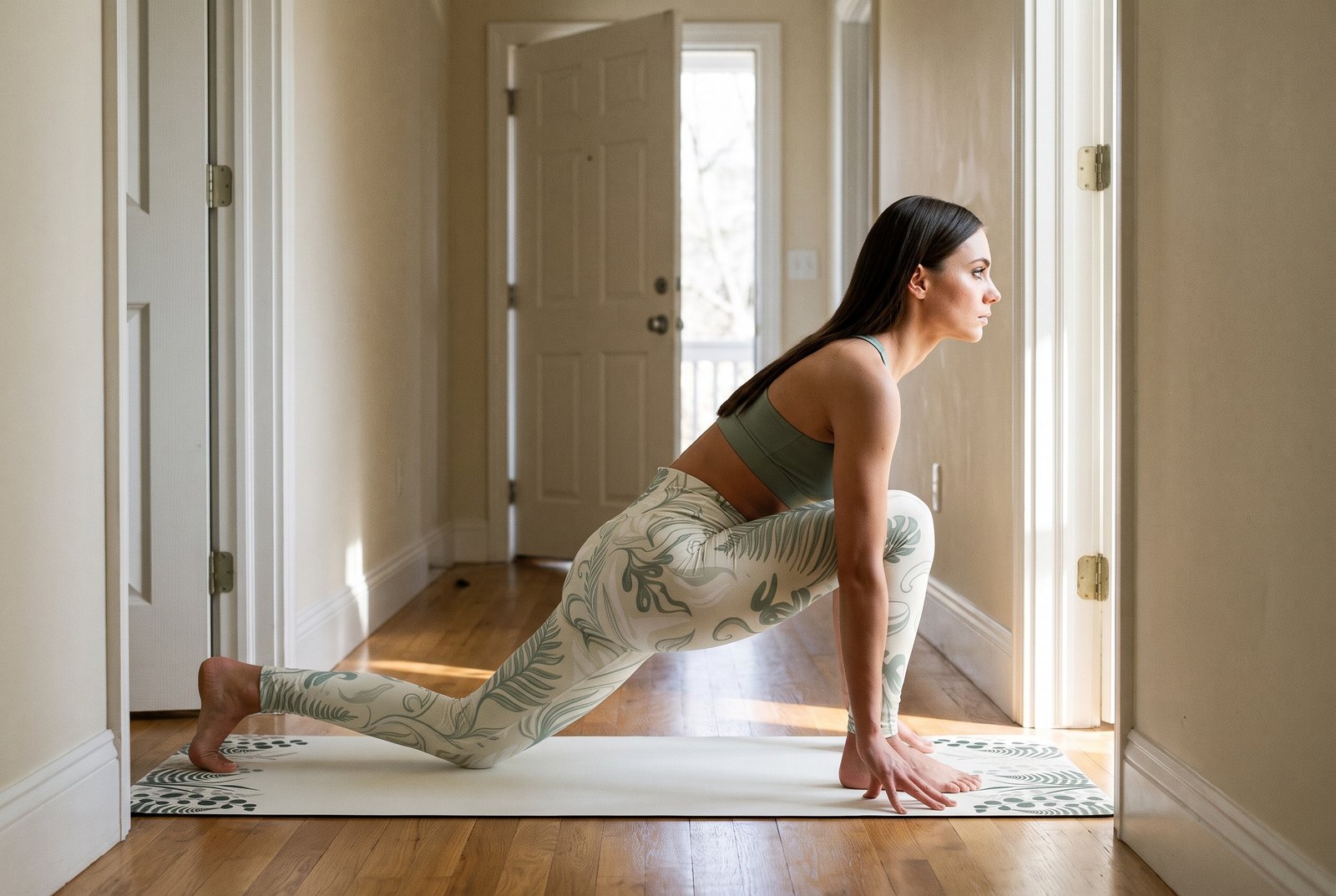
How we make money here: stretching.shop makes the printed pieces in this shop ourselves. Anything on this page marked Recommended gear is made by someone else and sold by a retailer, and we may earn a small commission if you buy through our link at no extra cost to you. We recommend gear we would use, and we say when a cheaper option is the better buy.
Thicker means kinder to the body. That’s the assumption behind most of these purchases, and it’s why a lot of people end up wobbling through a standing stretch on 15mm of foam and blaming their ankles.
The two products aren’t the same, though the names get used interchangeably in shops and listings. There’s no standard and no governing definition, and plenty of mats are sold under both labels at once. What separates them in practice is published thickness, surface material and the movements they were designed around.
Is a yoga mat and an exercise mat the same thing?
No, not usually, although the overlap is real. Look at manufacturer listings and a pattern appears: mats sold as yoga mats cluster between 3mm and 6mm thick, most commonly 173cm × 61cm, in PVC, TPE, natural rubber or cork. Mats sold as exercise, fitness or workout mats are typically 8mm to 15mm, often NBR foam, often with eyelets and a carry strap.
Gym mats are a third thing again. Tumbling and crash mats run 25mm to 50mm and are built for impact, not for holding a shape.
So the difference between a yoga mat and an exercise mat is mostly about what the designer assumed you’d be doing. Yoga mats assume weight-bearing hands and feet, often sweaty, often in positions held for a minute. Exercise mats assume a spine, hips and elbows pressed into the floor during crunches, planks and knee-heavy work.
Yoga mat vs exercise mat: the published specifications side by side
These figures come from reading published product specifications across the category, not from any testing on our part. Thickness is usually listed in millimetres in Europe and in fractions of an inch in the US, which is where the confusion starts: 1/4 inch is roughly 6mm and 1/2 inch is roughly 12mm, and those two numbers behave very differently underfoot.
| Type | Typical published thickness | Typical size | Common material | Designed around |
|---|---|---|---|---|
| Travel yoga mat | 1–2mm | 173 × 61cm | Natural rubber, PU top | Folding into a suitcase |
| Standard yoga mat | 4–6mm | 173–183 × 61–66cm | PVC, TPE, rubber, cork | Standing and floor shapes, grip |
| Exercise / fitness mat | 8–15mm | 183 × 61cm, some 180 × 120cm | NBR or EVA foam | Supine and kneeling work, joints |
| Large “workout” mat | 6mm (1/4″) or 12mm (1/2″) | Around 183 × 122cm (6ft × 4ft) | Foam core, textured top | Moving around, not staying put |
| Gym / tumbling mat | 25–50mm | Varies widely | Foam, vinyl cover | Impact absorption |
| Carpet plus folded blanket | Effectively 10–30mm where you fold it | Your floor | Wool or cotton | Whatever you point it at |
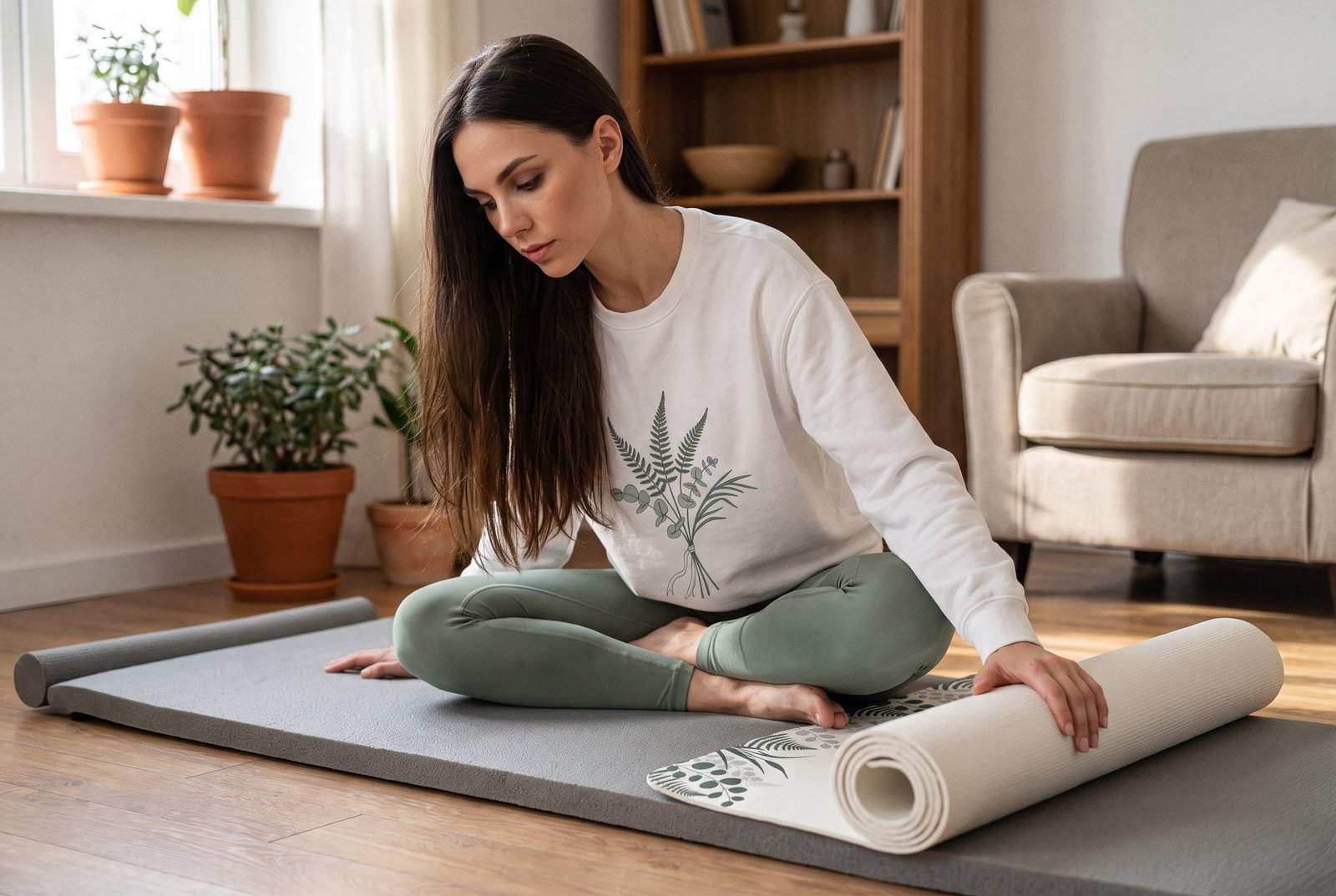
Why thicker is not automatically better
Balance is built on information. Your foot reads the floor through pressure on the heel, the ball and the outside edge, and a soft surface blurs that reading. On 15mm of foam, the edges of the foot sink unevenly and the ankle spends the whole hold making small corrections.
You feel it most in anything standing on one leg, in a lunge with the back heel down, or in a wide-stance forward fold. Soft foam turns a stretch into a balance drill, and the stretch is the part you came for.
There’s a second cost. A thick foam mat compresses under a planted hand and then slowly rebounds, so a long hold drifts. Most people read that drift as tight hamstrings. It’s the mat.
Where the thick mat genuinely wins
Kneeling. Any time a kneecap, an elbow, a hip bone or the back of the skull is the point of contact with a hard floor, extra foam is a straightforward comfort gain. Supine hip work, side-lying leg lifts, anything on all fours — a 10mm NBR mat is pleasant in a way a 4mm rubber mat is not.
But the cheaper fix is often better. A folded wool blanket under the knees gives you 20–30mm exactly where you need it and nothing where you do not, which is the opposite of how a thick mat distributes padding. If you already own a dense blanket, you’ve already solved the kneeling problem, and our notes on choosing a blanket for restorative work apply directly.
Same logic for the cold-floor problem. A mat is not insulation. A blanket is.
Grip is the real difference, not thickness
Here’s the attribute most comparisons skip. NBR and EVA foam have a closed, slightly slick surface. Natural rubber, PU-topped mats and cork are specified for traction, and some rubber mats actively grip better once your palms are damp.
Anything with weight through the hands, like downward dog, a low lunge with hands down or a seated twist where you push the floor away, cares more about surface than millimetres. A hand that slides 2cm mid-hold ends the hold.
Choose the surface for what your hands do, then choose thickness for what your knees do. Getting that order right settles most of the yoga mat or exercise mat question before you’ve compared a single price.
Gorilla yoga mat vs exercise mat, and other wide-mat questions
The large-format mats run roughly 183 × 122cm and get sold as premium or extra-large exercise mats. They answer a different complaint: people roll sideways off a 61cm mat during dynamic work. If you follow videos with lateral movement, that width is useful.
For stretching, width is rarely the constraint. Length is. If you are over about 180cm tall, a 173cm mat leaves your head or heels on the floor in every supine shape. Look for 183cm before you look for anything else.
Read the thickness on those wide mats carefully. A 1/4-inch version behaves close to a cushioned yoga mat. A 1/2-inch version behaves like foam, with the balance trade-off that comes with it.
What the yoga mat vs exercise mat debate on Reddit keeps circling
The recurring split in forum threads is between people who do mostly floor work and people who do mostly standing work, and both groups are right about their own mats. The disagreement isn’t about the products. It’s about the routine.
So answer the routine question first. Over a normal week, what proportion of your stretching happens standing, and what proportion happens on your back, your front or your knees? If floor work is more than about 70% of your time, the exercise mat is the honest choice — with one caveat.
The caveat: mostly-floor doesn’t mean only-floor. Most desk-driven routines include at least one standing calf or hip flexor stretch, and a hamstring sequence for people who sit all day usually has a standing element somewhere. A 5–6mm yoga mat handles both ends. A 12mm foam mat handles one.
The landing, for mostly-floor stretching
A 5mm or 6mm mat with a genuinely grippy top, plus a folded blanket for the kneeling and the bony bits. That combination covers more of a home stretching week than either mat type alone, and the thickness reasoning is set out in more detail in our comparison of 3mm, 5mm and 6mm.
Buy the exercise mat instead if your floor work is near total (spinal rolls, supine hip openers, prone back work) and you’re untroubled by balance holds. Buy nothing yet if you have carpet, a blanket and a routine you haven’t actually kept for two weeks. The mat isn’t what broke the last attempt.
If a stretch produces sharp pain, pins and needles, or an ache that’s still there the next morning, that isn’t a surface problem. See a physiotherapist before you change equipment — numbness, nerve-type symptoms down a limb, and joint pain that doesn’t settle all need assessing by someone who can watch you move.
For everything else, there’s a reasonable chance the best mat is the one currently rolled up behind a door, and the fix is a five-minute routine you will actually open it for.
Mostly floor work, some standing: a 5–6mm yoga mat with a grippy rubber or PU top, plus a folded blanket for knees and elbows. Check the length is 183cm if you’re tall.
Almost entirely on your back or knees, no balance holds: a 10–15mm NBR exercise mat is the more comfortable buy, and usually the cheaper one.
Carpeted room, blanket in the cupboard, routine abandoned twice: spend nothing for three weeks. Stretch on the carpet, fold the blanket under your knees, then buy based on what annoyed you.
Hands sliding mid-hold: this is a surface problem, not a thickness problem. Replace the mat for traction, not for foam.
How this comparison was made: we compared manufacturers’ own published specifications, not our own testing. Where we sell something ourselves we say so. Photographs are AI-generated illustrations featuring Elena, our AI guide.


