

How we make money here: stretching.shop makes the printed pieces in this shop ourselves. Anything on this page marked Recommended gear is made by someone else and sold by a retailer, and we may earn a small commission if you buy through our link at no extra cost to you. We recommend gear we would use, and we say when a cheaper option is the better buy.
You’re four breaths into downward dog, the heels of your hands start creeping forward, and by the fifth breath you’re doing a slow, undignified split on the floor. So you widen your fingers, press harder, and give up on the pose. Then you blame the mat, or worse, blame yourself for having “weak wrists.”
Most mat slip isn’t a strength problem, and it isn’t a price problem. It’s a surface and moisture problem, and two of the three best fixes cost nothing. Here’s what’s actually happening, what to try first, and only then how grip socks, grip towels and a new mat compare on published specifications.
Why is my yoga mat slipping? There are two different slips
Before you buy anything, work out which slip you have. The solutions are opposite.
- You slipping on the mat. Hands slide in down dog, feet slide back in plank, the mat stays put. This is a top-surface and sweat problem.
- The mat slipping on the floor. The whole thing creeps across the boards or wrinkles on carpet. This is a bottom-surface, weight and flooring problem.
People buy a grip towel for the second problem and stay frustrated, or a heavier mat for the first and stay just as frustrated. Diagnose first.
Are yoga mats slippery when they are new? Usually, yes
Almost every mat is at its worst on day one. PVC and TPE mats come off the line with a manufacturing residue on the surface; plenty of brands say so in their own care instructions and recommend a wipe-down before first use. Natural rubber mats often have a light film and a strong smell that fades over the first few weeks of use.
So the honest answer to “are yoga mats non slip” is: the marketing says non-slip, the care label admits the mat needs breaking in. A mat that’s slick on day one can be perfectly grippy by week three, which is a good reason not to replace it in week one.
The exception is the cheap, smooth, shiny 4mm PVC mat sold in supermarkets. Those tend to stay slick when wet because the surface is closed and glossy, with no open texture for moisture to sit in. No amount of breaking in changes the surface geometry.

Why is my Lululemon yoga mat slipping?
This one comes up constantly, and it’s a question about materials rather than quality. The well-known reversible mat is published at 5mm, with a polyurethane top layer bonded to a natural rubber base. Polyurethane grips by absorbing moisture, which is why it feels almost sticky under damp hands and dead once it’s saturated or coated.
Two things kill it. Body oils, hand cream and lotion clog a polyurethane surface faster than anything else, and once clogged it can’t absorb. Oil-based cleaners and essential oils leave a film that does the same. The manufacturer’s own care guidance for PU mats is a damp cloth and water, no oils, no soaking. If yours has gone slick after a few months, the surface is more likely dirty than worn out.
The other cause: you’re on the rubber side. The natural rubber face of a reversible mat is meant as the floor-contact side, and it isn’t the grippy one for sweaty palms.
How to fix a slipping yoga mat: the free fixes, in order
- Clean it properly. Damp cloth, water, a drop of washing-up liquid if the mat is PVC or TPE, then a second pass with plain water and air dry flat, out of sunlight. Don’t soak an open-cell mat.
- Break it in. Use it. For natural rubber, some brands suggest a coarse salt rub, or just a fortnight of practice to shift the factory film.
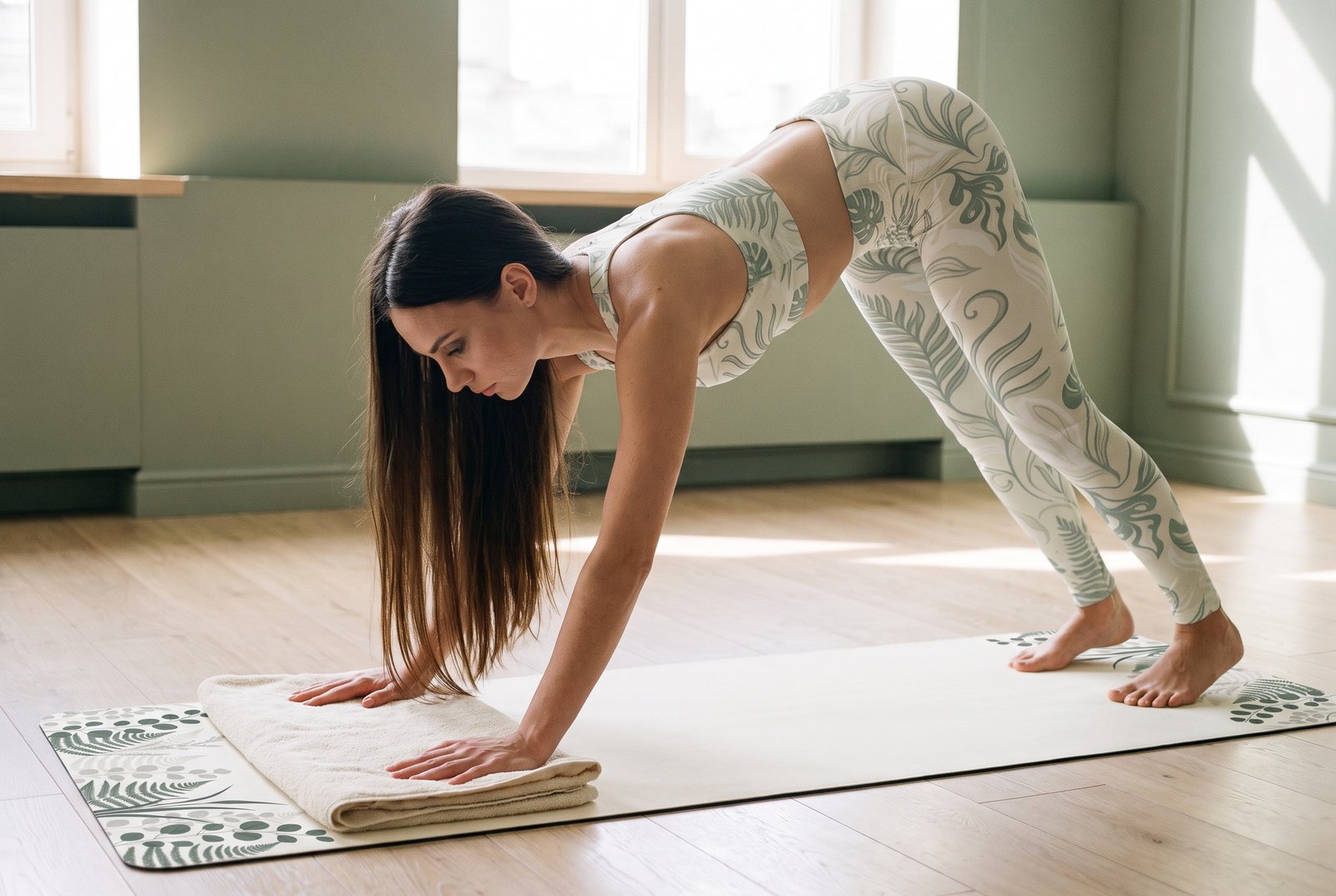
- Use a damp hand towel under your palms. A small flannel, wrung out so it’s damp rather than wet, placed where your hands go. It’s the most effective free fix for slippery hands, and it works on almost any mat surface.
- Dry your hands before you start, not during. Sweat begins before you notice it. Ten seconds with a towel at the top of the practice buys you the first three sun salutations.
- Change the load, not the friction. In down dog, press the base of the index finger down, pull the mat towards you with your fingertips, and shift weight back towards the hips. Hands slide forward when the shoulders are stacked too far over the wrists.
Try all five for a week before spending money. If your wrists, shoulders or hamstrings hurt rather than simply work hard, that’s a conversation for a physiotherapist, not a shopping decision.
Yoga mat slipping on floor: fix the bottom instead
A mat that slides across laminate, polished concrete or tile is usually light, thin or dusty underneath. Three things help, cheapest first.
Mop the floor. Fine dust acts like ball bearings under a rubber base, and a damp mop costs nothing. Then check the mat’s underside material: closed-cell TPE and foam skate on hard floors, natural rubber doesn’t. Published mat weight is a useful proxy here, because a mat under roughly 1kg has little to hold it still.
On carpet the opposite happens. The mat doesn’t slide, it wrinkles and bunches, and your foot lands on a fold. A thinner, stiffer mat behaves better on carpet than a soft 6mm one, which is the trade-off we go through in our guide to 3mm vs 5mm vs 6mm thickness.
Grip socks vs grip towel vs a new mat, on published specs
All three are sold as the answer to “yoga mat slip free”. They solve different halves of the problem.
| Option | Which slip it addresses | Typical published materials and specs | Honest limits |
|---|---|---|---|
| Damp flannel under hands | Hands only | Cotton, whatever you own | Moves in flowing sequences; covers no more than two hand positions |
| Grip socks | Feet only | Cotton or cotton blend with silicone dots; sold in shoe-size ranges, often five-toe or closed-toe | Do nothing for hands; silicone dots can feel unstable on carpet; stitching wears at the ball of the foot |
| Grip towel (yoga mat slip towel) | Hands and feet, full length | Microfibre, commonly listed around 61 x 183cm to match a standard mat; many specify silicone or PVC nubs on the underside | Most work best damp, not dry; must be washed after sweaty sessions or it turns slick; adds a laundry step |
| Slip cover / mat topper | Hands and feet, plus protects the mat | Microfibre or cotton sleeve that wraps the mat | Can shift as a layer; same damp-to-work behaviour as a towel |
| Rubber or cork mat | Both, at source | Natural rubber base, usually 4–5mm, with a raised texture or cork top; heavier than foam, commonly stated on spec sheets in kilograms | Highest cost; rubber has a smell for the first weeks; latex is a consideration for some people |
Best yoga mat for slippery hands, and for slippery floors
These aren’t the same mat. For slippery hands, buy for the top surface: cork, open-cell natural rubber, or a textured rubber face rather than a glossy one. Cork gets grippier as it gets damp, which suits warm rooms and sweaty palms. Open-cell rubber grips well but absorbs, so it needs regular cleaning.
For slippery floors, buy for mass and base material. A heavier rubber-backed mat stays where you put it; a light foam mat never will. Published weight and base material are the two numbers worth comparing on a spec sheet, and we run through the rest of the specification list in how to choose a yoga mat.
We have not tested any of these ourselves, and you should treat any article claiming a definitive grip ranking with suspicion unless it says how it measured. What we can do is compare what manufacturers publish, which is what the table above does.
Yoga mat slip-on shoes, and other things that will not help
Two different searches collide here. If you mean shoes with a “yoga mat sole”, that’s a footwear cushioning term and has nothing to do with mat grip. If you mean wearing slip-on shoes on your mat: don’t. Street soles carry grit that scores the surface, and any shoe removes the foot feedback that keeps you balanced.
Also unhelpful: baby powder, hairspray and more pressure. Powder makes it worse on rubber and PU, hairspray leaves a film you then have to clean off, and pressing harder just loads your wrists. If grip fails in one pose only, the fix is usually alignment. A short, repeatable sequence is easier to correct than an hour-long class, which is why we keep pointing people at the five-minute morning routine.
If your hands slide but the mat stays put: clean the mat with water and a cloth, then practise with a damp flannel under your palms for two weeks. If that solves it, you’ve saved the cost of a mat. If it only half solves it, a microfibre grip towel is the next step, not a new mat.
If the whole mat skates across the floor: mop the floor, then check your mat’s published weight and base material. A rubber-backed mat is the durable answer; a non-slip rug underlay from a hardware shop is the cheap one, and it often works just as well.
If you are on a polyurethane-topped mat that has gone dead: stop using oil-based sprays, wipe it with a damp cloth only, and dry it flat. Clogged is far more common than worn out.
If slipping comes with wrist, shoulder or knee pain: deal with the pain first. Book a physiotherapist and ask which load-bearing positions are sensible for you right now, then choose equipment around that answer.
How this comparison was made: we compared manufacturers’ own published specifications, not our own testing. Where we sell something ourselves we say so. Photographs are AI-generated illustrations featuring Elena, our AI guide.


