

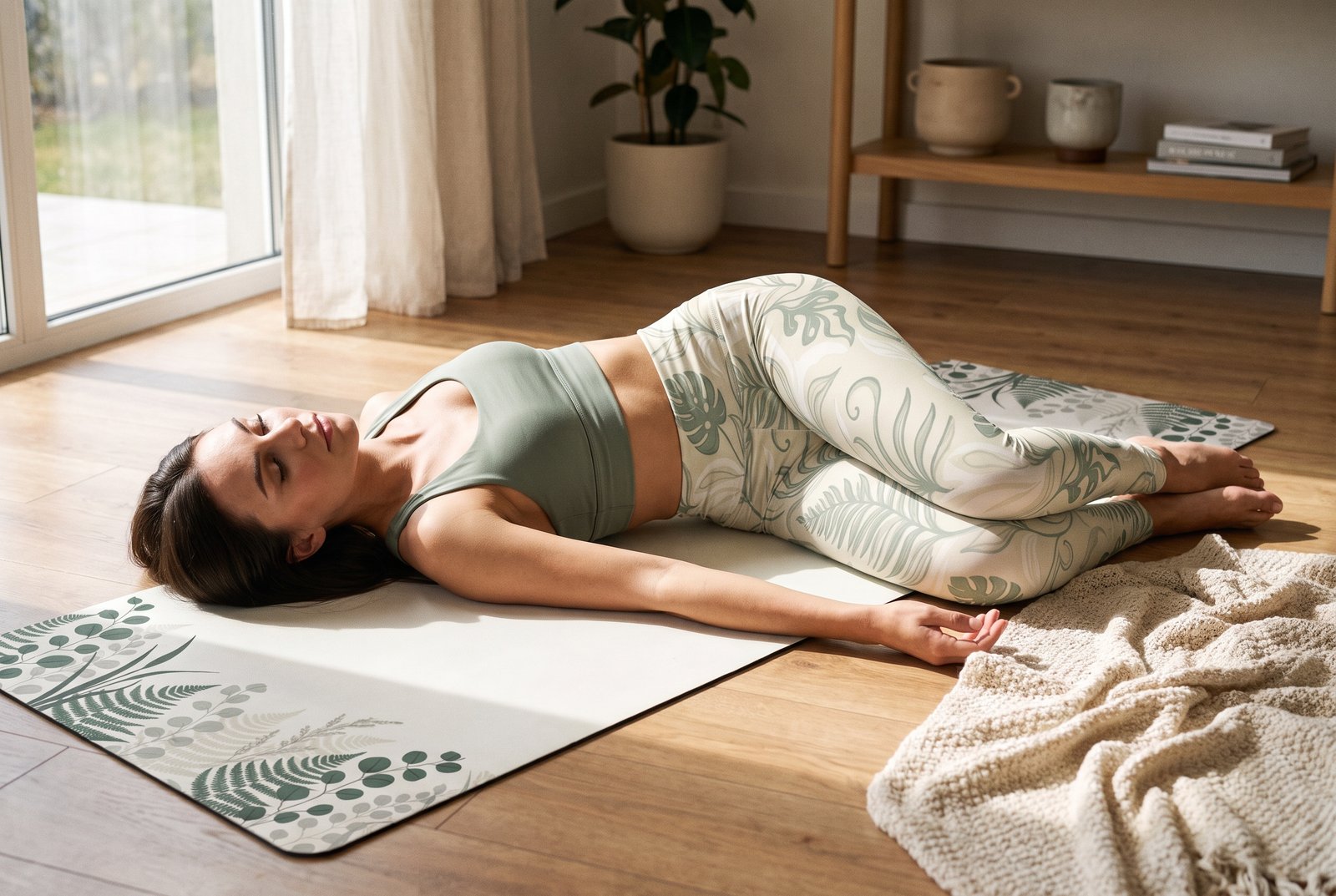
Most people meet somatic stretching in a 40-second video: someone on a sheepskin rug, moving perhaps two centimetres, captioned “release stored trauma from your hips.” Then comes the living room attempt — cold floor, nothing much felt, mild embarrassment, phone checked at the two-minute mark. The routine lasts three days.
That failure is not a discipline problem. The video left out what the movement is actually for, which makes it impossible to tell whether you are doing it right.
What is somatic stretching, plainly
Somatic stretching is slow movement done to gather information about sensation, rather than to increase range. The unit of work is attention, not angle. You move a small distance, slowly enough to notice what changes, and then you move back.
The broader field is called somatic movement or somatic practice, and stretching is only one corner of it. In most methods the movement is small, repeated a handful of times, and done lying down so the floor holds your weight instead of your muscles. A common pattern is pandiculation: contract a muscle deliberately, release it slowly over several seconds, then pause and feel the aftermath. If you have ever watched a cat get up from a nap, you have watched pandiculation.
The defining question is not “how far can I go” but “what do I notice” — and that single swap changes everything about how a session is paced.
Which also answers what somatic stretching means in practice. It means you are allowed to do less, as long as you are paying closer attention while you do it. A four-centimetre pelvic tilt done with full attention counts. A deep forward fold done while mentally writing emails does not, by this method’s own standards.
Somatic tension, and that word “expansion”
Somatic tension describes muscular holding that has become a habit rather than a response. The jaw that stays slightly clenched at the desk. The shoulders that sit two centimetres higher than they did at 9am. Thomas Hanna, who popularised the word somatics in the 1970s drawing on Feldenkrais and Alexander work, called the loss of conscious contact with those muscles sensory-motor amnesia.
The mechanism claimed is simple enough: you cannot release a contraction you have stopped noticing. So the work is aimed at noticing first.
Somatic tension is a description of a habit, not a diagnosis — if something is sharp, radiating, numb or worsening, that is not habitual holding and it needs a physiotherapist, not a floor session.
“Somatic expansion” is murkier. It is not a technical term in any of the founding methods. It circulates online to describe the feeling of breadth across the ribs or back after slow work, which is a real enough sensation and a perfectly nice thing to want. It does not mean tissue has lengthened or anything has been structurally changed. Treat it as a description of how you feel, not a claim about your anatomy.
How it differs from a hold-and-count stretch
Static stretching has a published shape: commonly cited guidance is a 10 to 30 second hold, taken to the point of mild tension, two to four repetitions per muscle group. You count, you breathe, you come out. The intent is tolerance to lengthening.
Somatic work has no count in that sense. Comparison below is drawn from how each method is described in its own published material, not from anything we have put on a stopwatch.
| Approach | Typical time per position | Intensity aimed at | What you track | Usual stated goal |
|---|---|---|---|---|
| Static hold-and-count | 10–30 seconds, 2–4 rounds | Mild tension, clearly felt | The clock and the end range | Range of motion |
| Somatic / slow attention work | 5–8 slow repetitions, 20–60 seconds of movement plus a pause | Almost none — well short of stretch | Sensation changing as you move | Awareness, reduced habitual holding |
| Dynamic mobility | 8–12 controlled reps | Moderate, warming | Control through the arc | Preparation for activity |
| Restorative yoga | 3–10 minutes, fully propped | None by design | Breath and settling | Rest, downshift |
If you finish a somatic session feeling the way you do after a proper hamstring stretch, you went too hard — the sensation you are after is closer to “that side moves more easily now.” Both have a place. For range at the back of the legs after a day in a chair, a deliberate hamstring routine does a job that slow attention work does not pretend to do.
What does somatic stretching do
Honestly: less than the captions promise, and possibly enough to be worth 15 minutes.
What is plausible and modest — you become better at detecting where you are holding, your breathing often slows because the pace demands it, and you build a habit of lying on the floor at the end of a day. People frequently report feeling calmer and moving more freely afterwards. That is a report, not a measurement, and I am not going to dress it as one.
What is not established: that slow movement releases stored emotion from specific tissue, resets the nervous system, or drains lymph in some measurable way. You will see those claims made with great confidence and no figures attached. Be suspicious of any version that promises a specific outcome in a specific number of days.
Somatic work is a way of paying attention, not a treatment — and nothing here replaces assessment of a joint or nerve that is behaving badly.
Trauma, and the part that needs a person in the room
“Somatic exercises to release trauma” is one of the most-searched versions of this question, so it deserves a straight answer. There are clinical approaches that work with body sensation as part of trauma treatment — Somatic Experiencing and Sensorimotor Psychotherapy are the two most often named — and they are delivered by trained practitioners over a course of sessions, with the capacity to slow down or stop when someone becomes overwhelmed.
A video is not that. A video cannot see you.
If slow floor work brings up distress, shaking you cannot settle, or a flood of memory, stop and speak to a GP or a qualified therapist. Floor stretching is a reasonable way to spend a quiet evening; it is not trauma treatment, and anyone selling it as such is overreaching.
What a session looks like on the floor
Here is a 15-minute shape you can run tonight. Lie on your back, knees bent, feet flat, hands resting on the floor.
- Two minutes doing nothing. Find three points of contact you can feel clearly — perhaps the right shoulder blade, the left heel, the back of the skull.
- Pelvic tilt, 6 reps. Arch the low back a few centimetres, then flatten it. Take roughly 8 seconds in each direction. Pause for two breaths between reps.
- One-sided reach, 5 reps each side. Slide one arm along the floor overhead while the same-side ribs lengthen. Slow enough that you could stop at any point.
- Side bend lying down, 5 reps each way. Walk both heels toward one hip so the body makes a shallow C. Hold two seconds at the far point, then return more slowly than you went out.
- Head turn, 8 reps. Turn to look left, let the eyes lead, come back to centre. Notice whether one side travels further without forcing it.
- Two minutes doing nothing again. The comparison with step one is the whole point of the session.
If you want something brisker in the mornings and this as the evening counterweight, the five-minute morning routine pairs with it well.
The only kit worth having
Two things: a surface that does not punish bone, and a layer that keeps you warm when you stop moving. That is it.
Because sessions involve lying still for several minutes, body temperature drops, and cold is the single most common reason people quit this sort of work early. A wool or cotton blanket over the hips and feet fixes it for nothing if you already own one — see the notes on blanket weight and weave if you are choosing deliberately.
If you have carpet and a folded duvet, you already have a better surface for somatic work than a 3mm travel mat, and you should not buy anything. A thin mat is built for grip during standing postures; it does almost nothing for the back of the skull or a bony sacrum. Where a mat does earn its place is on hard floorboards, and there the thickness question matters more than the brand — the 3mm versus 5mm versus 6mm comparison sets out what published specs actually differ on.
Somatic practice has no required props, no certification to begin, and no equipment category of its own. The marketing around it exists because stillness is hard to sell any other way.
If you have abandoned this once already: run the 15-minute shape above three evenings this week, with a blanket over your legs, and judge it only on whether step six feels different from step one. Do not judge it on flexibility.
If you came looking for trauma release: gentle floor work is fine to do, but get the actual support from a qualified therapist. Stop the session if distress rises rather than settles.
If you want more range in your hamstrings or hips: this is the wrong tool. Use a structured stretching routine with holds and progression, and keep somatic work for the wind-down.
If anything is sharp, numb, radiating down a limb or worse after a week: book a physiotherapist. Attention is useful; it is not an assessment.
Written with Elena, our AI stretch guide, and checked against our editorial and safety rules before publishing. General movement guidance, not medical advice. Photographs are AI-generated illustrations.


