

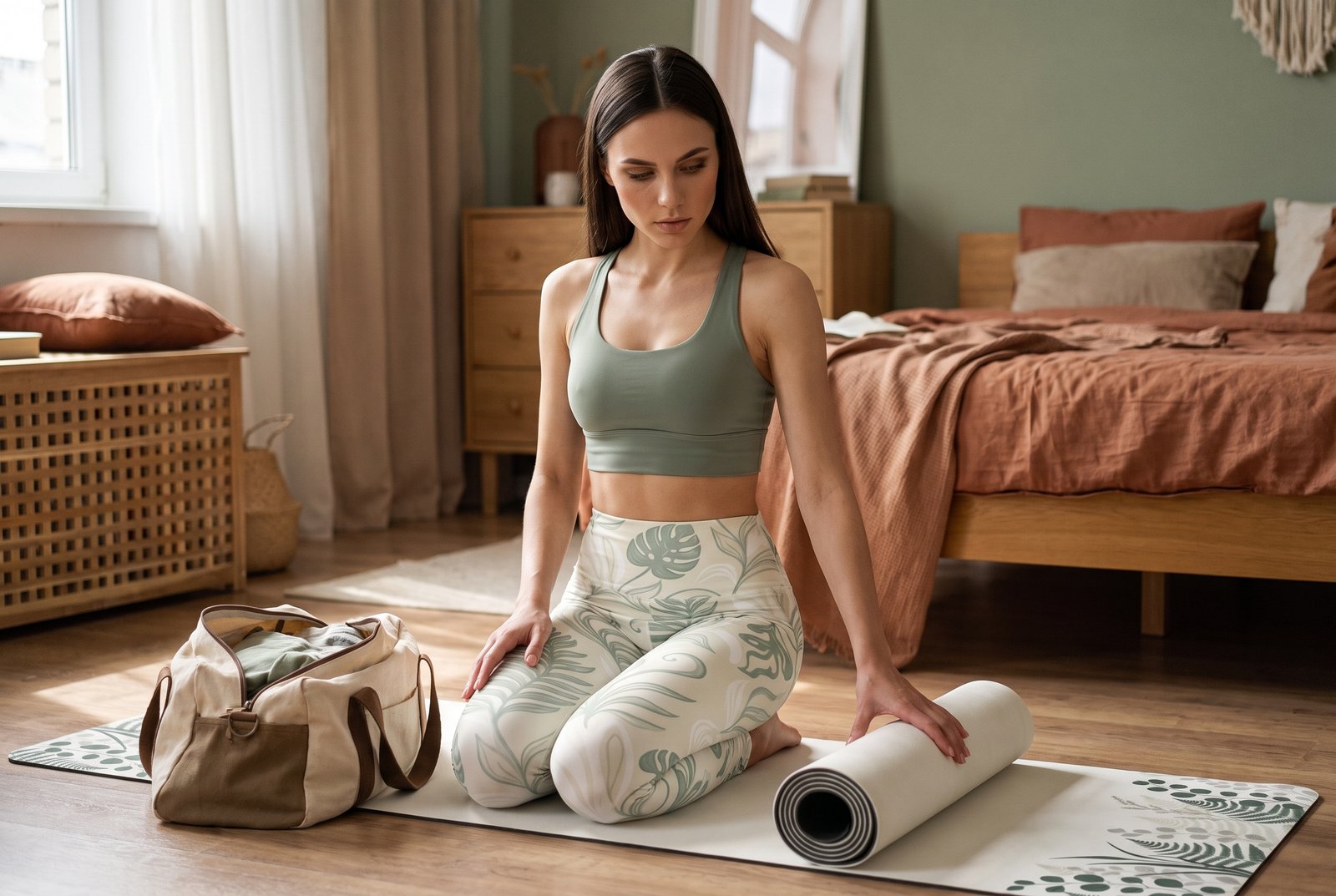
A 1.5 mm travel mat is not a thin yoga mat. It’s a grippy sheet with a little bite to it, and treating it like a mat is how people end up kneeling on a hotel floor wondering why their knees hurt more than they did at home.
That’s the trade in one sentence. The rest of this piece is the detail underneath it: what manufacturers publish, what the numbers mean on tile versus carpet, and the case for not buying one at all.
What is a travel yoga mat, exactly
A travel mat is made thin enough to fold rather than roll, usually between 1 mm and 3 mm thick, usually under 1.6 kg. Most are the same length and width as a standard mat — around 180 cm by 61–66 cm — so you lose depth, not footprint. Many are rubber or TPE, which means they tolerate being creased flat for a week without holding a permanent ridge.
The folding is the whole point, and the folding is also the whole compromise. A mat you can fold into quarters and slide down the side of a cabin bag has to be too thin to offer meaningful cushion. Those two things are the same property described twice.
Some brands sell a “travel” mat at 3 mm that still rolls rather than folds. Those are better under the knees and worse in a suitcase. Both exist, they’re not interchangeable, and the word “travel” on the label tells you nothing until you read the millimetres.
Can you bring a yoga mat on a plane?
Generally yes, but the honest answer is that it depends on the airline, not on the mat. Cabin baggage rules are set per carrier and change, so check your airline’s published allowance before you fly rather than trusting a forum post from three years ago.
In practice there are two routes. A rolled mat carried over the shoulder is sometimes treated as a personal item and sometimes counted against your one cabin bag, which is where arguments at the gate come from. A folded mat inside the suitcase avoids the question entirely.
If you’re searching travel yoga mat for suitcase, that second route is what you actually want: something that folds to roughly A4-ish dimensions and lies flat under your clothes. A folding mat is a luggage decision before it is a yoga decision.

Published thickness against published weight
The figures below are manufacturers’ own published specifications, gathered from their spec pages, not measurements of our own — we haven’t tested or weighed any of these. Specs get revised, so confirm before you buy.
| Option | Published thickness | Published weight | Packs by |
|---|---|---|---|
| Jade Voyager | 1.6 mm | approx. 0.7 kg | Folding |
| Manduka eKO SuperLite | 1.5 mm | approx. 0.9 kg | Folding |
| Liforme Travel Mat | 2 mm | approx. 1.6 kg | Rolling (supplied bag) |
| Jade Travel (3 mm line) | 3 mm | approx. 1.4 kg | Rolling |
| Typical home mat | 5–6 mm | 2.2–3.4 kg | Rolling, lives in one room |
| Hotel bath towel, folded in four | roughly 10–20 mm, measure yours | Nothing you carry | Already in the bathroom |
Read the first and last rows together. You can spend real money to carry 0.7 kg of grip, and the padding still comes from something borrowed.
What 1.5 mm means for your knees on a hotel floor
On hotel carpet with underlay, 1.5 mm is fine for most standing work, and the floor does the cushioning. On tile, polished concrete or laminate, 1.5 mm is close to nothing. Low lunge, table top, any kneeling at all — the bony front of the knee meets a hard floor with a sheet of rubber in between.
This is the same arithmetic as at home, just with less margin. We went through it in more detail in 3 mm vs 5 mm vs 6 mm, and the short version holds: thickness buys knee comfort and costs stability.
The fix isn’t a thicker travel mat, it’s a folded towel under the knee. Keep the thin mat for grip and traction, and put four layers of towel where the pressure is. A spare blanket does the same job and better — see how we think about blankets for restorative work if you’re the sort who packs one.
If knee pain persists on padded surfaces, or you get sharp pain rather than pressure, stop improvising and see a physiotherapist. Floor padding is a comfort question, not a treatment.
Travel yoga mat or towel?
For two or three trips a year, the towel wins, and we are in the business of selling mats.
Here’s the case. Hotels supply towels. A towel on carpet gives you a clean surface and some padding, and the only thing you genuinely lose is grip in a sweaty standing sequence. If your away-from-home practice is a twenty minute morning routine and some hamstring work, grip is not your limiting factor.
A towel fails in exactly two situations: hot or sweaty practice, where cotton slides on hard floors, and hygiene-sensitive spaces like a shared gym carpet. If that describes your trips, a thin mat earns its keep. Buy a travel mat when you travel often enough that the mat gets used more than six or seven times a year, not because a packing list told you to.
Travel mat versus regular mat, and the Liforme question
People routinely ask whether a travel version can replace the home mat. Compare the published numbers and the answer is clear: Liforme lists its original mat at around 4.2 mm and its Travel Mat at 2 mm, and Jade lists Harmony around 4.7 mm against Voyager at 1.6 mm. These are not two versions of one product. They are a mat and an accessory.
The Jade Travel vs Voyager comparison is simpler than it looks. Voyager at 1.6 mm folds and weighs least; the 3 mm Travel rolls, offers roughly double the depth, and goes in checked luggage or a car. Pick by how you move, not by the name.
Forum threads land in the same place often enough to be worth repeating: the people who are happiest with a 1–2 mm mat are the ones who stopped expecting cushion from it. If you want one mat for everything, buy the proper one and leave it at home. Our guide to choosing a mat covers that choice properly.
Where to buy, and what to check first
Searching travel yoga mat near me usually turns up sports shops carrying one or two folding mats. That’s worth doing for one reason: you can fold the thing in the shop and see whether it creases or springs back. Open-grid foam creases badly. Natural rubber and better TPE usually recover within a day or two of being unpacked.
Three things to check on any product page before anything else. Published thickness in millimetres, published weight in kilograms, and whether the manufacturer says it folds or rolls. If a listing gives none of those, it isn’t describing a travel mat, it’s describing a colour.
Two or three trips a year: skip the travel mat. Use the hotel towel, fold a second one under your knees, and leave your 5 mm mat at home where it does the most good.
Away monthly or more, hard floors, sweaty practice: a 1.5–2 mm folding mat is worth the money, on the understanding that it supplies grip only. Pack it flat in the suitcase and budget a towel for kneeling.
Driving rather than flying: ignore folding mats entirely. A 3 mm rolled mat weighs about the same, feels far better under the knee, and the boot does not care.
Knee pain that outlasts the trip: padding is not the answer. Get it looked at by a physiotherapist before you add more layers.
Written with Elena, our AI stretch guide, and checked against our editorial and safety rules before publishing. General movement guidance, not medical advice. Photographs are AI-generated illustrations.


