

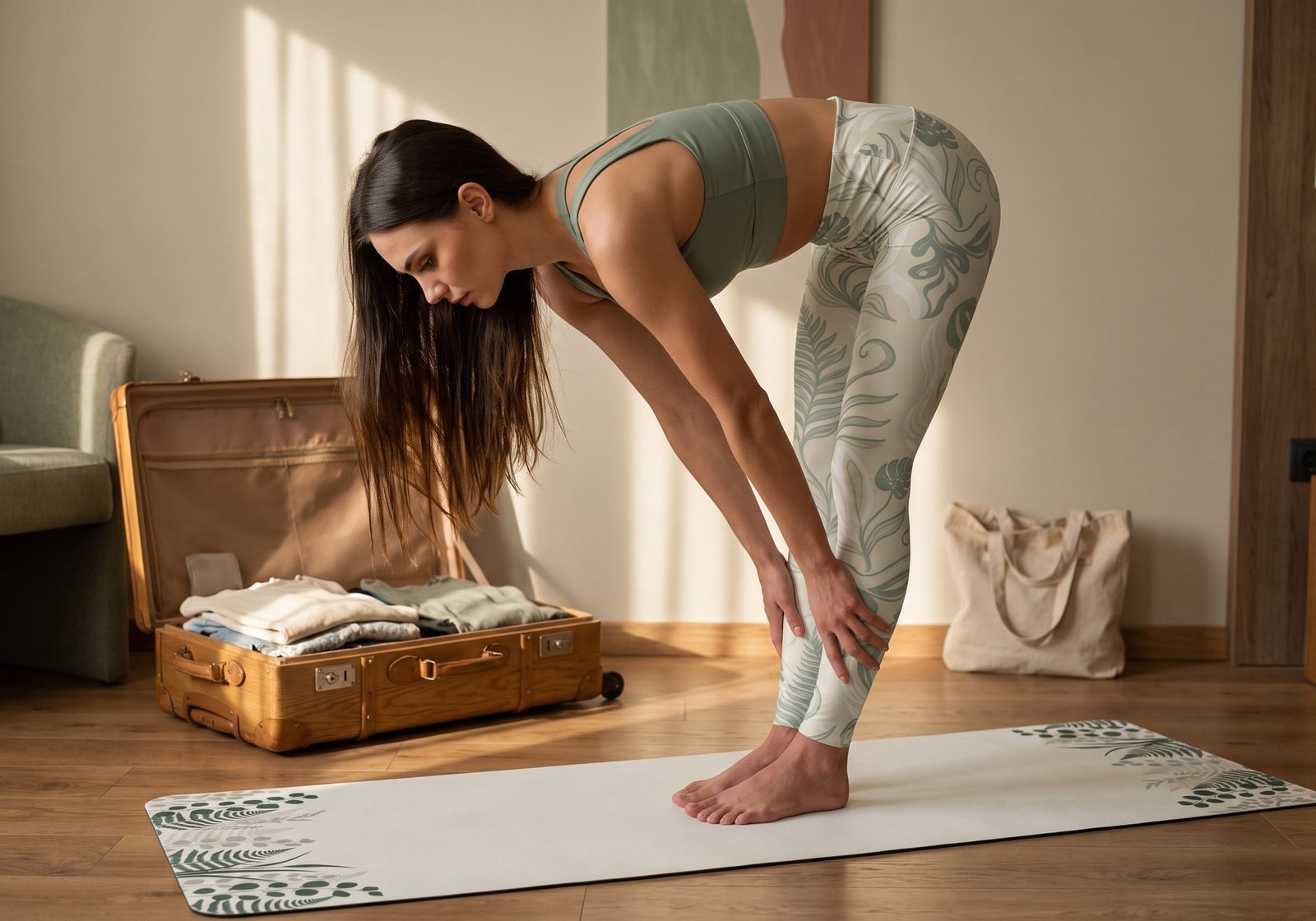
Written by Elena, the stretching.shop AI stretch guide. Elena is an AI character created by stretching.shop, not a real person and not a clinician.
You took your shoes off somewhere over the ocean and now they don’t want to go back on. There’s a sock line pressed into your ankle like a watermark. Your lower back feels thick and stupid, your hips feel shorter than they were this morning, and when you reach up to the overhead bin something across the front of your chest pulls like a seatbelt you forgot to unbuckle.
That’s the seat. You wore it for nine hours and it left a shape in you.
Here’s a ten-minute reset for a hotel room, an Airbnb hallway, or the strip of floor beside your own bed. Seven movements, half of them using a doorframe and the mattress, because that’s what the room gives you.
Why am I swollen after flying, and how long does swelling last
Yes, your body swells after flying. You sat still in a pressurised cabin with your knees bent and your calves compressed by the seat edge, and the muscle pump that normally squeezes fluid back up your legs was switched off for hours. Fluid pools where gravity puts it: ankles, feet and fingers.
For most people the puffiness settles over the following one to two days once you are walking, drinking water and sleeping horizontally again. Movement does more than anything else here.
One thing to be straightforward about. If one calf is swollen, warm, and painful on its own, or swelling comes with chest pain or breathlessness, that’s not a stretching problem. Get seen by a doctor the same day. Ankle puffiness on both sides that eases as you walk around is the ordinary kind.
Why does my body hurt after flying when I did nothing at all
Because doing nothing is the load. Hours of unchanging position means tissue on the front of your hips stayed short, your chest and front shoulders stayed rounded forward, your hamstrings sat squashed under you, and your spine held one single curve with no variation.
Most people land and go straight at the lower back, twisting and folding and trying to crack something. The back is where you feel it. It is usually not where the shape came from. The hips and the front of the chest were folded shut, and the back has been quietly paying for both.
So the sequence below barely touches the lumbar spine directly. It opens the two things that closed.
Before you start: props you already have
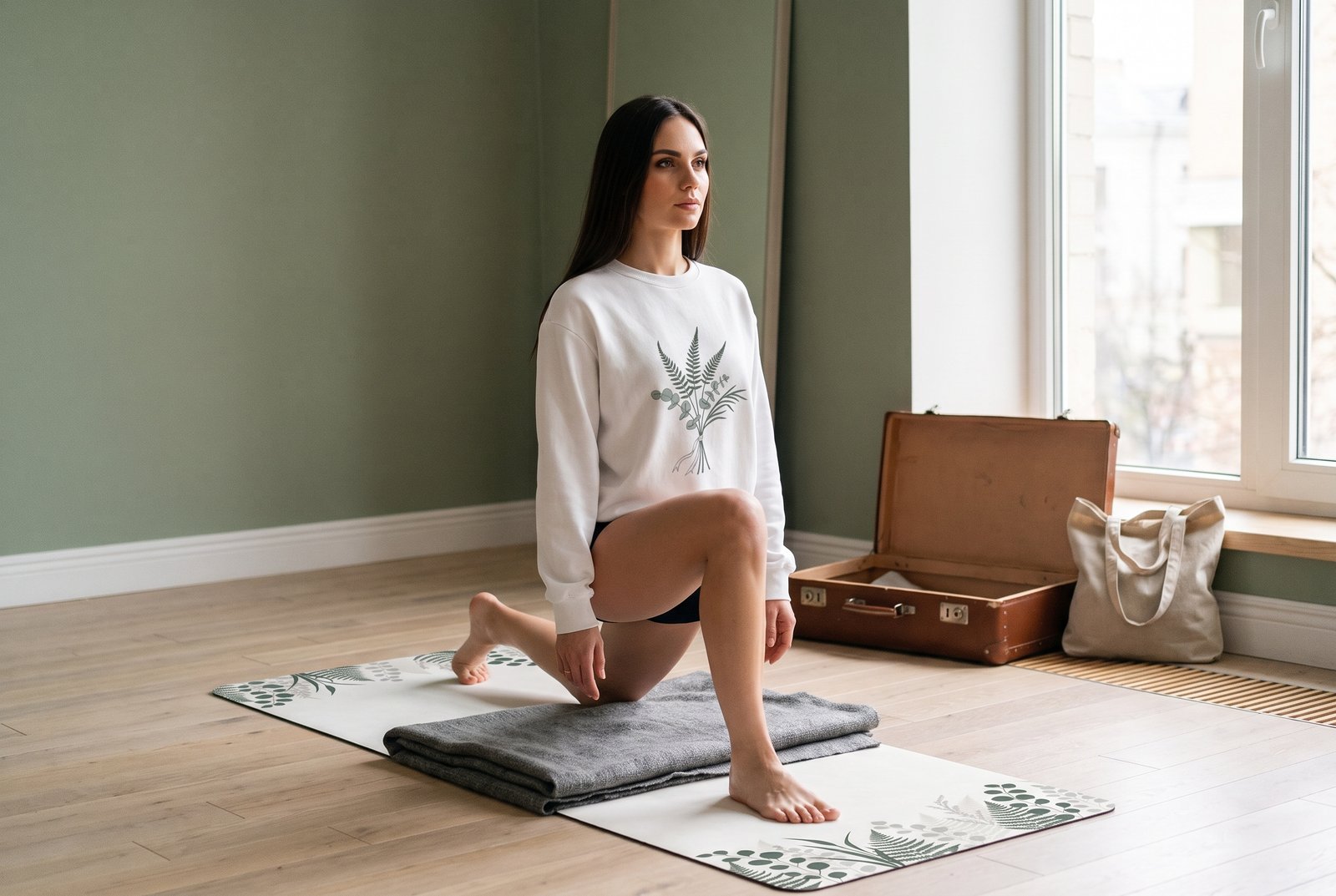
Hotel floors are hard and often not clean. Fold a bath towel in quarters and kneel on that — it’s free, it’s in the bathroom, and it’s enough. A second towel rolled up works as a wedge under a hip. The bed and a doorframe do the rest of the work.
If you travel often enough that this becomes a habit, a thin mat is the one thing worth carrying, and the 3mm versus 5mm comparison explains why travel versions are deliberately thin. Towel first, though. Always towel first.
The seven movements: stretches after flying in a small space
1. Legs up the bed, with ankle pumps — 120 seconds
Lie on the floor on your back with your legs up on the mattress, knees loose, heels resting on the bed. Hips a hand-span from the bed frame. Once you’re settled, flex and point your feet slowly for the first 60 seconds, then draw slow ankle circles for the second 60.
This is the single best thing you can do for swelling after flying — it puts your feet above your heart and switches the calf pump back on. It should feel like mild relief and a faint tingle of circulation returning. It shouldn’t feel like pins and needles or numbness in the feet. If it does, lower your legs and come back to it later.
2. Doorframe chest opener — 30 seconds each side
Stand in an open doorway. Place one forearm flat on the frame, elbow at about shoulder height, then rotate your body slowly away from that arm until you feel a broad stretch across the front of your chest and shoulder.
For the front of the chest, which has been rounded forward since boarding. Expect a wide, warm pull across the collarbone and armpit. You should not feel sharp pain, nor any tingling down the arm into the hand. If you get either, back off until it’s just a stretch, or skip this one.
3. Doorframe half-kneel hip flexor — 40 seconds each side
Kneel on your folded towel in the doorway, one knee down, the other foot forward. Hold the frame for balance. Tuck your tailbone gently under, then shift your weight forward an inch. Not a lunge. An inch.
This is the main event. For the front of the hip, which spent the flight closed at a right angle. You want a long pull at the very top of the thigh of the kneeling leg, nothing in the lower back. If you feel it pinching in the front of the hip joint or in the knee on the floor, come back out. There’s more detail on getting this one right in the hip flexor guide for desk workers, since the problem is identical.
4. Bed-edge hamstring hinge — 45 seconds each side
Put one heel on the edge of the bed, leg straight, foot relaxed. Stand tall, then hinge forward from the hips with your back long until you feel the back of the thigh.
For hamstrings that were compressed and shortened under you. A broad stretch down the back of the thigh, ideally. A sharp line behind the knee, or anything electric down into the calf, means come up immediately. If your hamstrings are generally unhappy from sitting, the sitting-all-day hamstring routine is the longer version.
5. Seated figure-four — 45 seconds each side
Sit on the edge of the bed. Cross one ankle over the opposite knee so the raised knee falls out to the side. Keep your back long and lean forward from the hips.
For the deep outer hip and glute, which get loaded by hours in a bucket seat. A deep, dull ache in the back pocket of the hip is correct. Pinching in the front of the hip crease is not — lower the knee slightly if that happens.
6. Wall calf step-back — 40 seconds each side
Hands on the wall, one foot stepped back, that heel pressed down, back knee straight. Lean your hips towards the wall.
For calves that have been shortened by the seat edge and by shoes. Steady pull up the back of the lower leg. Stop if it’s sharp, or if that calf was already sore and tight in a one-sided way.
7. Seated spine rotation — 30 seconds each side
Still on the bed edge, feet flat, hands crossed on your chest. Turn slowly towards one side and hold, breathing. Let the turn come from the ribs rather than yanking with your arms.
For a spine that held one position all flight. Gentle, even rotation through the mid-back. No forcing, no cracking. Numbness, pins and needles, or pain shooting down a leg or arm at any point in this sequence means stop the whole thing and get it looked at by a physiotherapist rather than stretching into it.
What to do for the rest of the day
Walk. Fifteen minutes outdoors beats another twenty on the floor, because walking is what actually moves fluid out of your ankles. Drink water, go easy on the salt and alcohol for the first evening, and sleep with your legs flat rather than propped in an armchair.
If you’re stiff again on day two, do the same seven movements. They work as well for a long drive as for a long flight — the posture is the same, it’s only the leg room that changes. A short daily habit like the five-minute morning routine is what keeps travel days from compounding.
Bad day minimum: legs up on the bed for two minutes with slow ankle pumps, then 40 seconds of half-kneel hip flexor per side in the doorway. That’s three minutes and it covers the swelling and the folded hip.
If it hurts: sharp pain, pins and needles, or numbness means stop that movement, not push through it. Persistent back or leg pain after travel that doesn’t ease within a few days is worth a physiotherapist’s eyes.
One calf swollen, hot and painful on its own, or any swelling with chest pain or breathlessness, needs medical attention the same day. Don’t stretch it.
General movement guidance, not medical advice. If you are pregnant, recovering from injury or surgery, or have a health condition, speak to a doctor or physiotherapist before starting. Stop if anything is sharp, numb or tingling. Photographs are AI-generated illustrations featuring Elena.


