

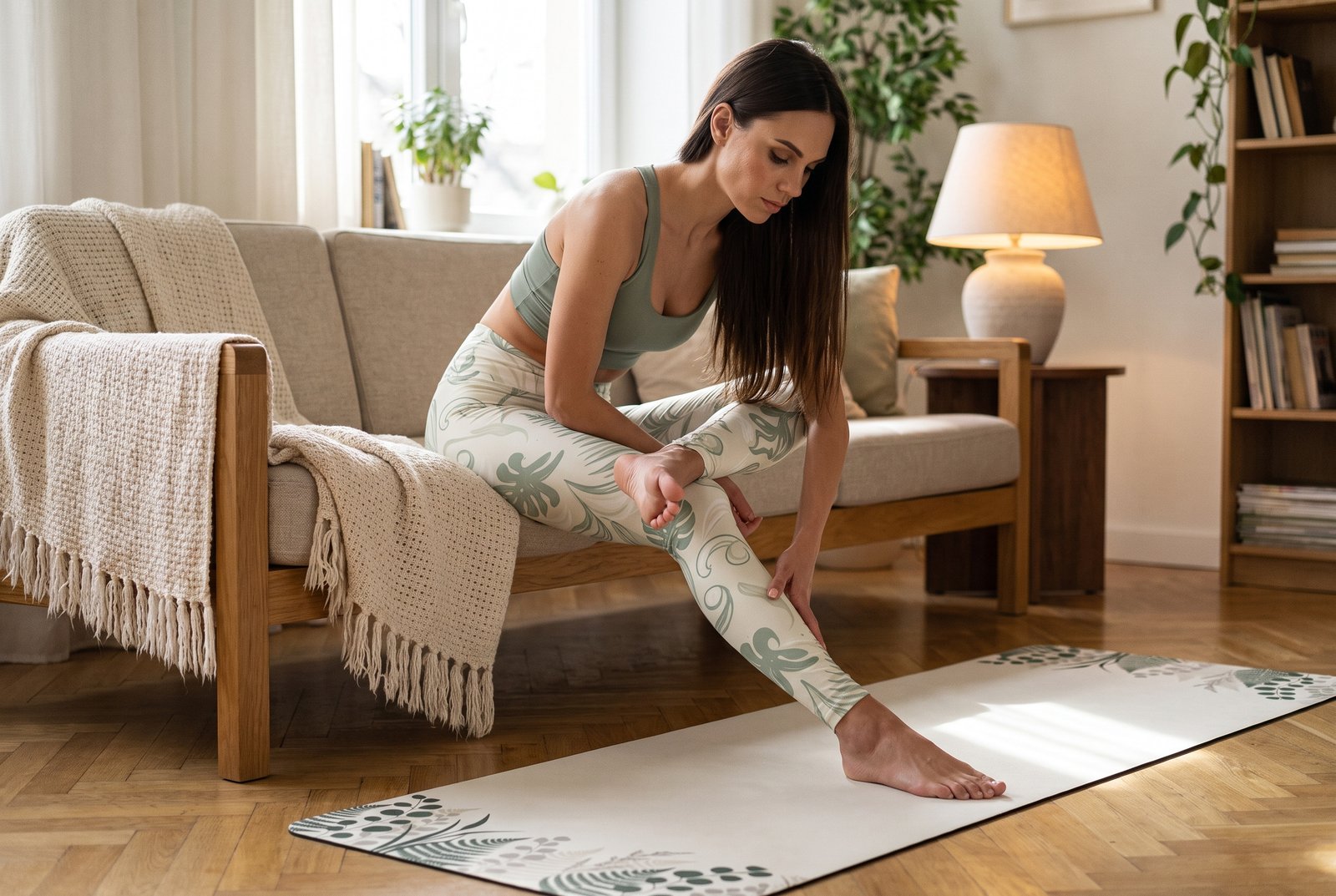
Written by Elena, the stretching.shop AI stretch guide. Elena is an AI character created by stretching.shop, not a real person and not a clinician.
It’s 9:40pm. The dishes are done, the second episode has started, and the floor is four feet away and might as well be in another building. That is the hour this routine is for.
Stretching on the couch works fine, as long as you stop sinking into it. That’s the whole trick. Soft cushions let your pelvis tip backwards and roll under you, which quietly cancels most hip and hamstring work before it starts. Sit on the front edge instead, or drop onto the floor in front of the sofa and use it as equipment.
Why the couch feels better than the floor, and why that’s a problem
The couch is more comfortable because it supports you in several places at once and asks nothing of your muscles. Hips, lumbar spine, shoulders — all propped. That’s genuinely restful, and there’s no point pretending otherwise.
But support and stretch pull in opposite directions. A stretch needs one end of the muscle anchored while the other end moves away. Cushions let both ends drift, so you feel vague pressure and no real lengthening.
People ask why stretching is uncomfortable at all. Part of it is honest sensation. A muscle at the end of its available length sends a strong, stretchy, slightly hot signal, and that’s the thing you came for. Part of it is that most of us only stretch when something already aches. Discomfort you can breathe through is fine. Sharp pain, pins and needles, or numbness is not part of it — come out of the position.
Related question that turns up a lot: is stretching on the bed bad? Not bad, but a mattress is softer than a sofa cushion, so it’s the worst surface for anything needing a stable pelvis. Gentle lying-down knee hugs and spinal twists in bed are fine. Hip flexor and hamstring work is not.
Set-up: front edge, feet flat, two props you already own
Sit on the front third of the cushion, both feet flat on the floor, sitting bones directly under you rather than behind you. If the sofa is deep, shove a cushion behind your back so the edge is reachable.
Props: a folded bath towel for under a knee, and a dressing gown belt or dog lead if you want something to loop around a foot. That covers everything below. If you end up on the floor in front of the sofa most evenings, a 5mm mat is kinder to a kneeling knee than carpet alone.
And in case you arrived from a different search entirely: this is not about stretch couch covers. A cover that grips does stop the cushion sliding mid-stretch, which is more credit than soft furnishings usually get here.
The seven
1. Neck side bend — 30 seconds each side
Sit tall on the edge. Tuck your right hand under your right thigh to pin that shoulder down. Tip your left ear towards your left shoulder and let it hang. For the upper trapezius and the side of the neck, which stiffens from holding a phone at chest height.
It should feel like a broad pull along the side of the neck. It should not buzz or tingle down the arm. If it does, ease off the head tilt.
2. Arm along the backrest — 40 seconds each side
Drape your right arm along the top of the backrest, elbow slightly bent, and turn your chest away to the left. For the front of the shoulder and the chest, which shorten when you sit rounded all evening.
A long pull across the front of the shoulder is right. A pinch deep in the shoulder joint is not — lower the arm until it stops.
3. Seated spinal rotation — 30 seconds each side, twice
Feet flat and parallel. Cross your arms over your chest, then rotate your ribcage to the right as far as it goes without the knees following. Hold, breathe, let it creep a little further on the exhale. For the thoracic spine, the bit that stops moving first when you sit.
Keep both sitting bones on the cushion — if one lifts, you’re twisting from the low back instead.
4. Figure-four glute stretch — 60 seconds each side
Cross your right ankle over your left knee so the right knee falls outward. Sit tall, then hinge forward from the hips with a flat back until you feel it. For the glutes and the outer hip, the classic hip stretches on the couch everyone already half knows.
A deep, broad ache in the back of the right hip is correct. Pinching at the front of the hip crease or pain inside the knee is not. Reduce the forward lean, or let the knee stay higher.
5. Single-leg hamstring — 45 seconds each side
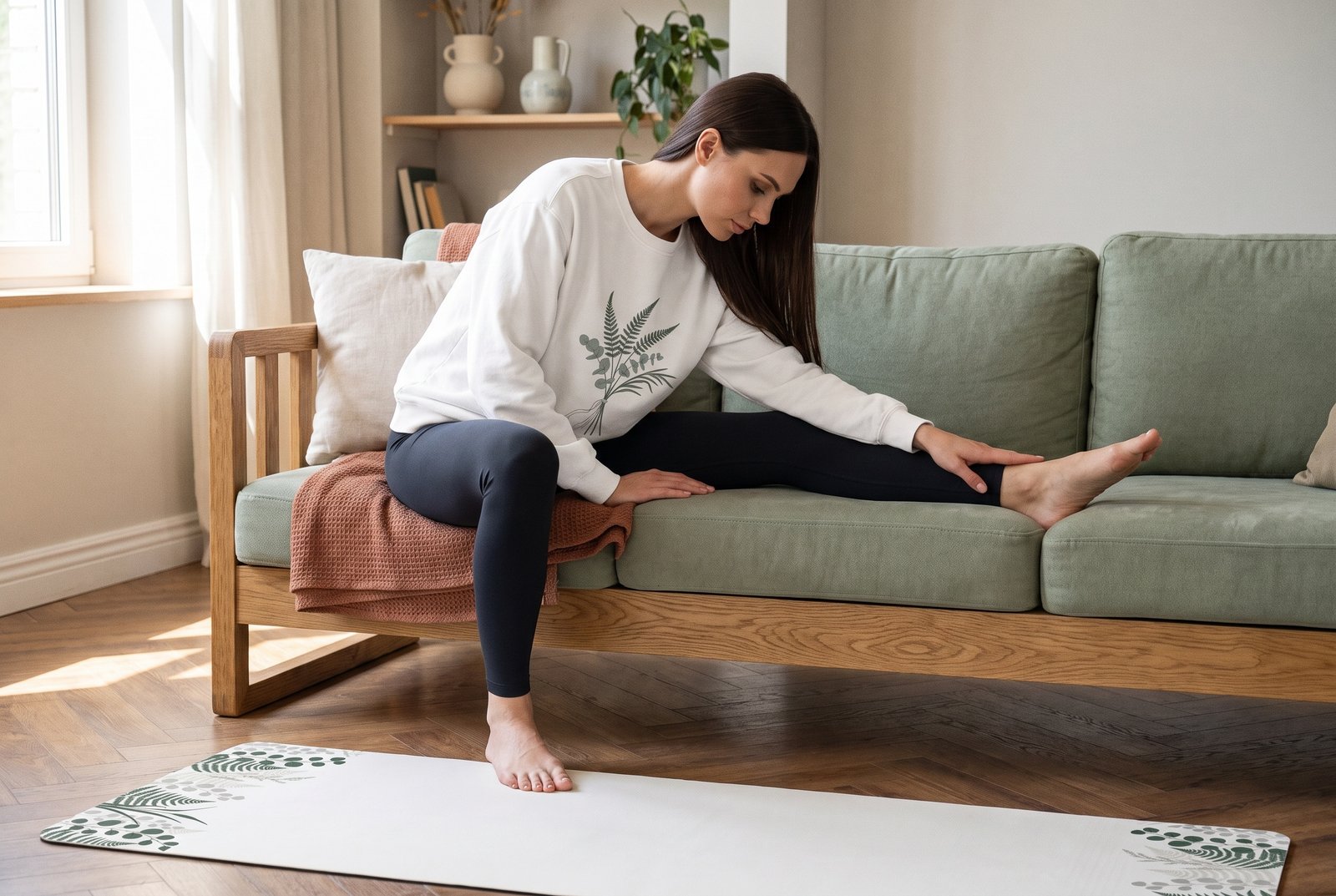
Slide forward, straighten the right leg with the heel on the floor and toes up, keep the left foot flat. Hinge forward from the hips, chest leading, back long. Loop the dressing gown belt under the foot if reaching is a stretch too far. For the hamstrings, which are the loudest complaint of a desk week — the longer version is in the hamstring routine for sitting all day.
Pull along the back of the thigh, yes. Electrical zing down into the calf and foot, no. That’s nerve, not muscle. Back off.
6. The couch stretch — 60 to 90 seconds each side
So, what is a couch stretch? It’s a kneeling quad and hip flexor stretch where the back shin runs up a vertical surface, which loads the quad far harder than a standard lunge. The sofa is the surface it was named after.
How to do the couch stretch: kneel on the floor facing away from the sofa, slide your right knee into the gap where the seat meets the base, shin up the front of the cushion, foot pointing at the ceiling. Towel under the knee. Left foot forward and flat. Stay hinged forward on your hands at first.
How long to hold the couch stretch: 60 seconds is a useful minimum, 90 to 120 if you can breathe normally the whole time. Then, if it’s easy, bring your torso upright and squeeze the right glute — that is the full version and most people are not there yet. More hip flexor options sit in the desk worker hip flexor set.
Expect a strong stretch down the front of the thigh and across the front of the hip. Pain in the kneecap itself or in the low back means come out — usually the hips drifted forward of the knee, or the back arched to escape it. Couch stretch benefits are mostly about the front of the hip regaining length after a day of sitting, not about forcing range in one go.
7. Ankles and shins — 20 seconds each direction, each foot
Back on the edge of the seat. Cross one ankle over the opposite knee and circle the foot slowly, then point and flex ten times. For the ankle joint and the small muscles of the shin, which get nothing all day inside shoes.
Should feel like a joint waking up. Should not click painfully.
Stretching out on the couch, properly
Once the seven are done, lie along the sofa and do nothing. If you came here from a crossword clue for “stretch out on the couch”, the answer you probably want is LOLL, and it’s better done after the figure-four than instead of it.
Things that are not an evening sofa job: hip or groin pain that wakes you at night, numbness or weakness in a leg, a knee that gives way, pain that got worse over weeks without a clear cause. Those belong with a physiotherapist who can put hands on the thing.
Bad day minimum: front edge of the cushion, figure-four for 60 seconds each side, then one couch stretch for 60 seconds each side. Four minutes, two muscle groups that actually needed it.
If it hurts: sharp pain, pins and needles, numbness or kneecap pain means come out of the position now, not in ten seconds. Reduce range by half and try again tomorrow. If it’s still there after a week of easier versions, get it looked at rather than stretched harder.
The one thing to remember: cushions are for resting on, edges are for stretching on.
General movement guidance, not medical advice. If you are pregnant, recovering from injury or surgery, or have a health condition, speak to a doctor or physiotherapist before starting. Stop if anything is sharp, numb or tingling. Photographs are AI-generated illustrations featuring Elena.


