

Thirty seconds bent over one hamstring in the hallway, trainers already laced, counting and feeling absolutely nothing give way. That’s static stretching dropped into the one slot where it does least for you. The fix is an order, not a new routine: move through range first, hold at the end of range later.
Here’s what each one actually is, what it feels like under your own ribs, and where it tends to sit in a practice done at home on a Tuesday night.
What is static and dynamic stretching, in plain terms
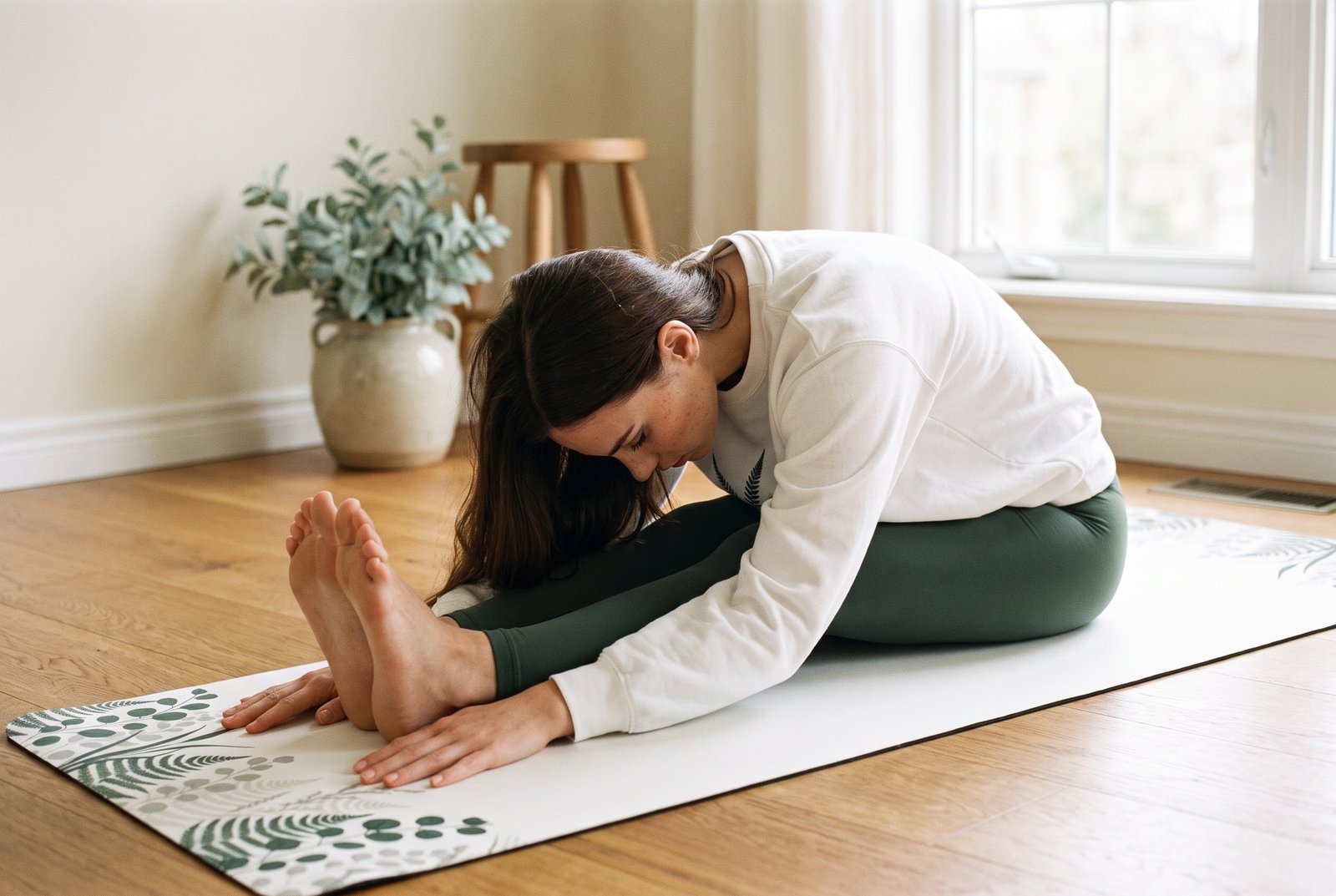
Static stretching means taking a muscle to a long position and staying there. A seated forward fold held for 40 seconds. A doorway chest stretch where your forearm stays flat and your body turns away. Nothing travels; the tension is constant and you breathe into it.
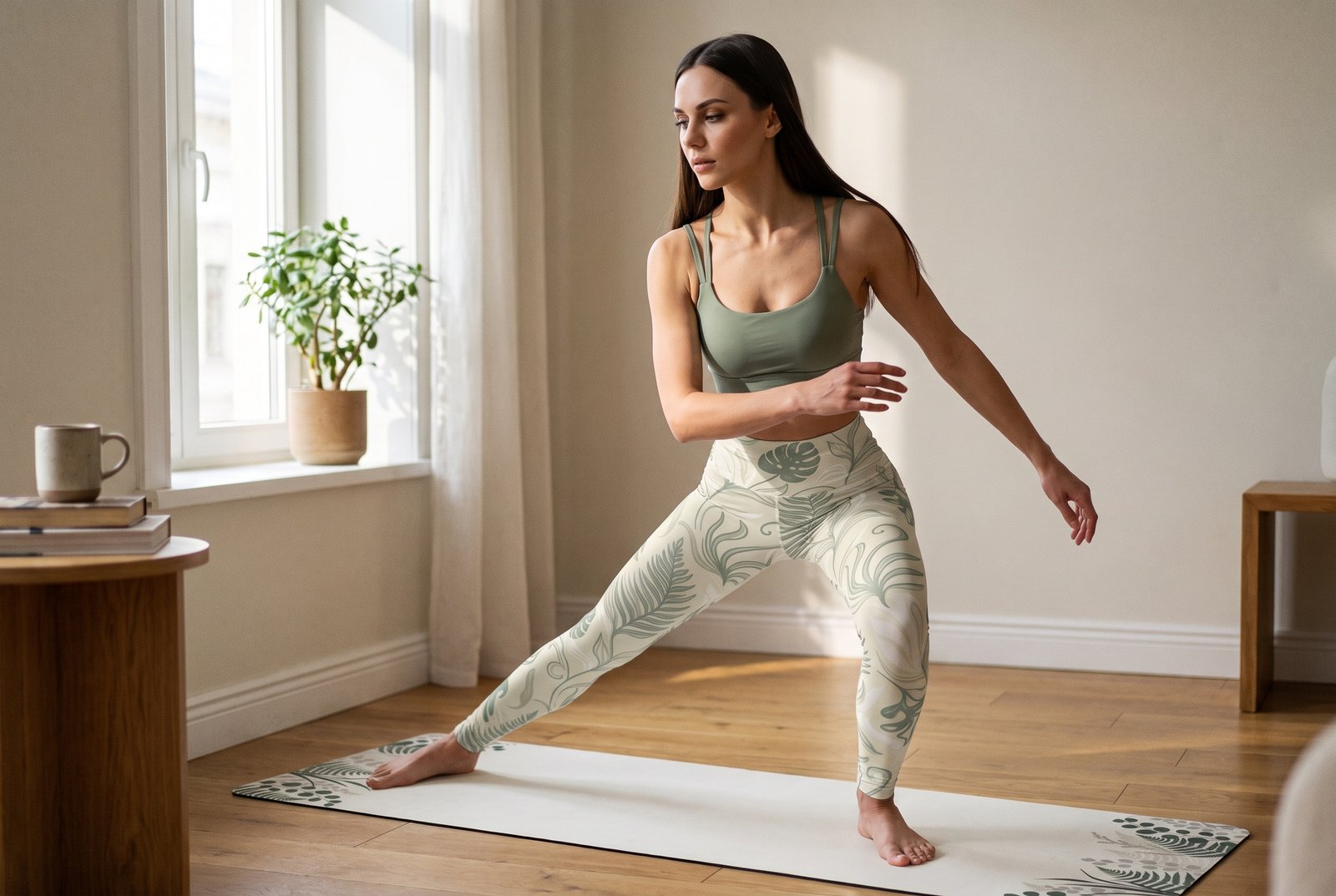
Dynamic stretching means moving a joint through its available range, repeatedly, under control. Leg swings front to back. Hip circles. Cat-cow. Walking lunges with a reach overhead. The position is never held — you arrive at the end of the range and leave again, usually 8 to 12 times per side.
The felt difference is the easiest way to tell them apart. Static feels like pressure that slowly fades; dynamic feels like warmth and lubrication. After two minutes of static work on one hamstring, that leg feels longer and slightly dopey. After two minutes of leg swings, both legs feel awake and the hip joint feels oiled rather than stretched.
One more distinction worth knowing: ballistic stretching, meaning bouncing at the end of range and forcing the rebound, isn’t dynamic stretching. Dynamic movement is controlled and stops where the range stops.
Static dynamic difference, side by side
| Attribute | Dynamic stretching | Static stretching |
|---|---|---|
| What you do | Move a joint through full range, repeatedly | Hold a lengthened position still |
| Typical dose | 8–12 reps per side, 5–10 minutes total | 20–60 second holds, 2–3 rounds per position |
| How it feels | Warm, loose, slightly raised heart rate | Steady pull that eases after 15–20 seconds |
| Usual slot | Before activity; as a standalone desk break | After activity; evenings; dedicated flexibility sessions |
| Breathing | Rhythmic, matched to the movement | Slow, long exhales |
| Kit needed | None — standing, 1m² of floor | None, though floor contact gets uncomfortable on hard surfaces |
| Common error | Swinging from momentum instead of control | Holding 5 seconds and moving on |
Neither column needs a purchase. Dynamic work is done standing, often with one hand on a worktop or doorframe for balance. Static floor holds are the only part where a surface matters, and a folded towel or duvet under the knees and sitting bones solves most of it for nothing. If you already own a mat, published thicknesses tell you most of what you need. Our breakdown of 3mm vs 5mm vs 6mm compares manufacturer specs rather than anything we’ve measured ourselves.
What’s better, static or dynamic stretching?
The question as asked has no answer, because the two do different jobs. Asking whether dynamic stretching is better than static is like asking whether a kettle is better than a fridge.
What’s fairly settled in coaching practice is the ordering. Long static holds immediately before explosive effort (sprinting, jumping, heavy lifting) tend to leave the muscle feeling soft and slow for a while afterwards, which is the opposite of what you want at the start line. Dynamic work raises tissue temperature and rehearses the exact ranges you’re about to use. So: dynamic before, static after or separately.
That’s a general pattern, not a rule about your body. If you have a specific injury history, a physiotherapist’s version of this order beats any article’s.
Static vs dynamic stretching before a workout and before running
Before a run, five minutes is enough: 10 leg swings forward and back per side, 10 side-to-side, 10 ankle circles each way, 8 walking lunges, 10 hip hinges with soft knees. Then start the first kilometre deliberately slow. That slow first kilometre is doing more warming than any stretch.
Before strength work, mimic the lift. Air squats to depth before squats. Band or bodyweight pull-aparts before pressing. Thoracic rotations before anything overhead.
Static stretching before running isn’t dangerous — it’s just mistimed. If a hip flexor genuinely feels locked and won’t let the leg travel back, one 20 to 30 second hold to take the edge off, followed by dynamic work, is a reasonable compromise. Keep pre-workout static holds short and few, then move.
Static vs dynamic stretching for flexibility
If the goal is range you keep (the splits, a flat forward fold, hands behind the back) then static holds and loaded end-range work are the main tools. Range changes slowly, over weeks of repeated exposure, not within a session.
A workable template: three positions, 2 rounds of 45 seconds each, four or five days a week, done warm. Done after a walk or a shower, not cold out of a desk chair. Our hamstring routine for sitting all day uses that structure and needs nothing but a wall and the floor.
Dynamic work still earns its place here. It’s how you reach the end of range in the first place and how you keep the new range usable. Dynamic opens the door; static work is what persuades the body to leave it open.
Is yoga static or dynamic stretching?
Both, depending on the class. A vinyasa flow is largely dynamic: you pass through lunges, folds and twists in time with the breath, holding for five breaths at most. Yin and restorative are firmly static, with holds running 2 to 5 minutes, often supported by bolsters and folded blankets.
Hatha sits in between, shapes held for 30 to 60 seconds with transitions in between. This is why “I do yoga” tells you very little about someone’s stretching. A person doing four flows a week and a person doing two yin classes a week are training almost opposite qualities.
Useful trick: treat your flow as the dynamic portion and park two or three long holds at the end, after the last standing pose. Most home practices already contain both — they just need the holds moved to the back. For long floor holds, support matters more than it does standing; a folded blanket under the hips changes a 3-minute hold from endurance into rest.
Static and dynamic stretches for football, and what the Reddit threads argue about
Football is the clearest case for the order, because the sport is sprints, cuts and kicks. A pre-match dynamic sequence usually covers open and closed gates for the hips, lateral lunges, A-skips, hamstring sweeps, and gradual build-up runs at 60, 80 and 95 percent. Long static hamstring holds go after the whistle, or on a separate evening.
Threads comparing static vs dynamic stretching tend to collapse into two camps: people insisting static stretching before sport causes injury, and people insisting stretching does nothing at all. Both overstate their case. The honest position is narrower: timing affects performance, and no stretching routine is a reliable injury shield.
A no-kit order you can run tonight
- Two minutes of general movement — stairs, brisk walk, marching on the spot.
- Five minutes dynamic: hip circles, leg swings, cat-cow, thoracic rotations, 10 reps each.
- Your activity, whatever it is.
- Three static holds, 45 seconds each: hamstring, hip flexor, chest or lats.
If evenings never happen, run steps 1 and 2 only and call it done. Our five-minute morning routine is built almost entirely from the dynamic half for exactly that reason. A routine you repeat badly beats a perfect one you abandon in week two.
See a physiotherapist if a stretch produces sharp or pinching pain, pins and needles, pain that travels down a limb, or if one side has felt restricted for more than two or three weeks without changing. Stretching harder into those signals isn’t the answer, and none of the above is medical advice.
If you stretch before a run and wonder why nothing loosens: swap the holds for five minutes of leg swings, hip circles and walking lunges, and move your static work to after the run.
If your goal is a flat forward fold or the splits: static holds are the main tool — three positions, 45 seconds, two rounds, four days a week, always on warm muscles.
If you have abandoned this before: keep only the dynamic five minutes for a fortnight. Add one 45-second hold at the end once the five minutes stop feeling like a decision.
If buying something feels like the first step: it isn’t. Both halves work barefoot on carpet with a folded towel under the knees.
How this comparison was made: we compared manufacturers’ own published specifications, not our own testing. Where we sell something ourselves we say so. Photographs are AI-generated illustrations featuring Elena, our AI guide.


