


How we make money here: stretching.shop makes the printed pieces in this shop ourselves. Anything on this page marked Recommended gear is made by someone else and sold by a retailer, and we may earn a small commission if you buy through our link at no extra cost to you. We recommend gear we would use, and we say when a cheaper option is the better buy.
“Eco TPE” on the label tells you almost nothing. It names a family of plastics that can be foamed soft or pressed firm, built in one layer or three, sold at 4mm or 8mm, and the word “eco” is a marketing decision rather than a specification. The same goes for “professional PVC” and “100% natural rubber”, which is usually a rubber core with something else bonded on top.
So the useful question isn’t which material is best. It’s which material family matches the floor you stretch on and the cupboard you keep the mat in. Everything below compares published specifications and standard industry descriptions, not anything we have tested ourselves.
Is TPE better than PVC? The short, unsatisfying answer
TPE is lighter and usually softer for the same thickness. PVC is denser and is generally listed with longer expected service life. Neither of those is “better” in the abstract.
A 6mm TPE mat at 183 × 61cm is commonly listed somewhere around 0.9–1.4kg. A 4mm PVC mat of the same footprint is often listed at 1.8–2.5kg, and 6mm PVC can be listed above 3kg. Roughly double the weight for the same floor coverage, which matters if the mat lives on a shelf above head height, or travels on a bicycle.
Where PVC tends to be described as holding its shape for years of folding and rolling, foamed TPE is more often described as compressing. Listings for TPE frequently mention surface indentation under hands and knees as normal rather than as a defect. That’s the honest trade for the lower weight.
The difference between TPE and PVC, in plain terms
PVC is polyvinyl chloride, a rigid plastic made workable with plasticisers, foamed into a closed-cell sheet and given a surface texture. Closed cell means the surface doesn’t absorb moisture, so grip comes entirely from the embossed pattern and the slight tack of the compound. Quality listings specify “6P-free” or “phthalate-free”, which refers to the plasticiser package. Recycling routes for PVC mats are limited in most places.
TPE is thermoplastic elastomer, a broad group of polymers that behave somewhat like rubber but melt like plastic. In mats it’s usually foamed, often in two bonded layers of different colours, and it’s also closed cell. The practical consequences: lighter, cushier, more heat-sensitive, and more likely to show permanent marks. Several manufacturers’ care notes warn against leaving TPE in a hot car or in direct sun, which isn’t a warning you see as often on PVC.
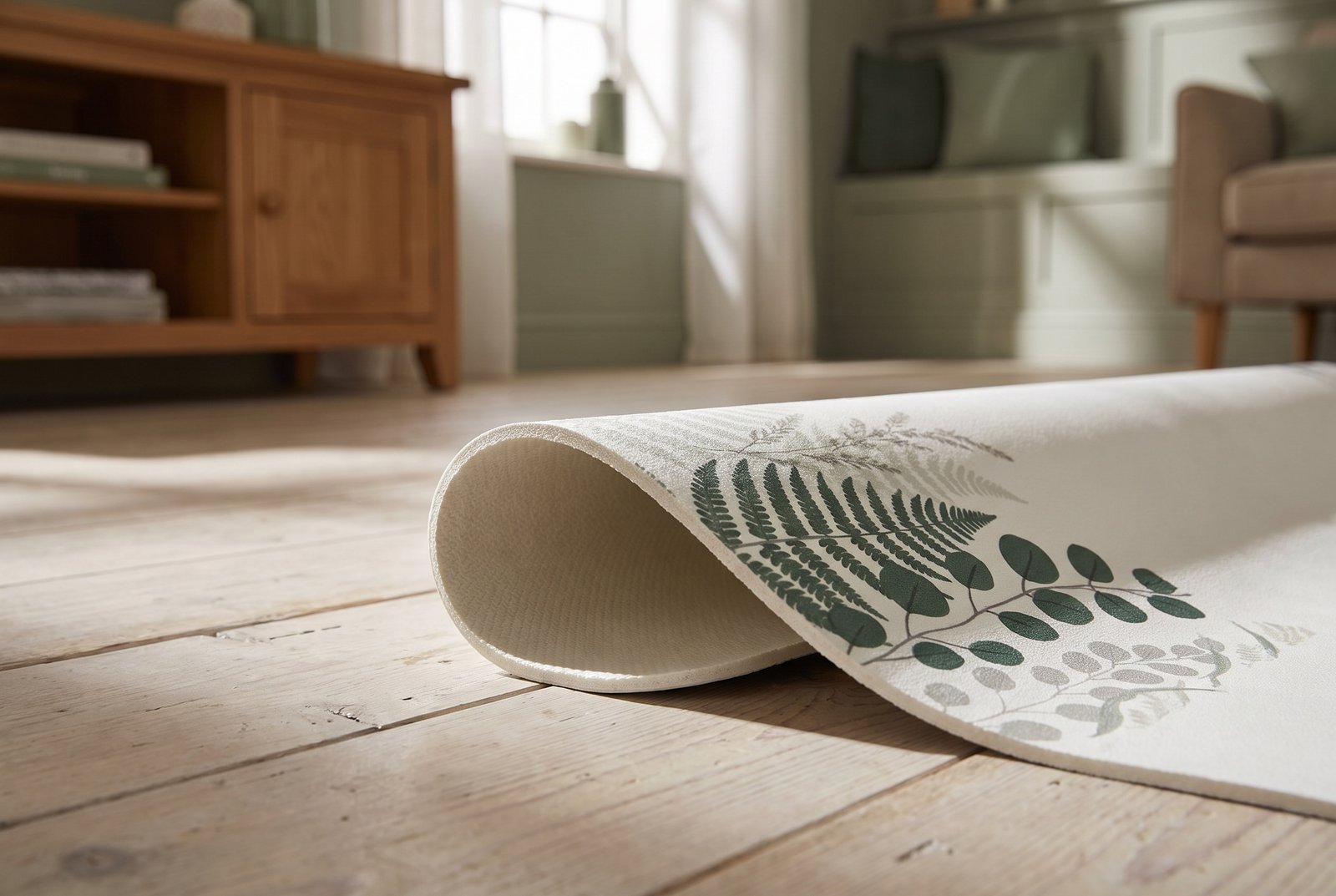
TPE vs natural rubber yoga mat
Natural rubber sits at the other end of the weight scale. A 4mm rubber mat is commonly listed at 2.2–2.8kg, and 5–6mm versions at 3kg and up. In exchange, rubber listings describe high dry grip from the material itself rather than from a stamped pattern, and firm support that doesn’t sink under a planted hand.
Three caveats appear repeatedly in rubber product pages. It contains latex proteins, so it’s excluded for anyone with a latex allergy. It’s degraded by UV and by oil-based products, so sunlight storage and oily feet are both named as problems. And new mats are described as having a strong smell that fades over weeks.
Rubber also comes in cork-topped and jute-topped variants, which change the surface behaviour entirely while keeping the weight.
PVC vs PUR vs TPE: where polyurethane fits
PUR or PU isn’t a mat body. It’s a thin top layer, almost always bonded to a rubber base, and it’s the surface most often specified for grip when the hands are damp, because it’s open cell: the layer takes up a small amount of moisture rather than letting it pool.
The cost is maintenance. PU tops are described as staining from oils and sweat, needing wiping after use, and wearing thinner at the high-traffic spots over time. A mat with a PU top is a mat with a care routine.
EVA, meanwhile, is the foam in cheap mats, puzzle tiles and shoe midsoles. It’s light, warm underfoot, and the cheapest of the lot. EVA compresses fastest and grips least, which is why it dominates floor tiles and children’s mats rather than standing-balance practice.
Published specifications side by side
| Material | Typical listed weight (183 × 61cm) | Common thicknesses sold | Where dry grip comes from | How listings describe ageing |
|---|---|---|---|---|
| PVC | 1.8–2.5kg at 4mm; 3kg+ at 6mm | 1.5, 4, 6mm | Embossed surface texture, closed cell | Long service life; texture flattens in high-use spots |
| TPE (foamed) | 0.9–1.4kg at 6mm | 4, 6, 8mm | Moulded pattern, closed cell | Indentation under hands and knees noted as normal; heat-sensitive |
| Natural rubber | 2.2–2.8kg at 4mm; 3kg+ at 5–6mm | 1.5, 3, 4, 5mm | The compound itself | Degraded by UV and oils; initial odour fades |
| Rubber + PU top | 2.5–3.5kg at 4–5mm | 4, 5mm | Open-cell PU layer, works with slight damp | Stains; top layer abrades at hand and foot positions |
| EVA foam | 0.8–1.2kg at 6mm | 6, 8, 10mm and tiles | Light texture only | Compresses and creases soonest of the group |
Figures above are the ranges manufacturers commonly publish. Individual products sit outside them, which is the whole argument for reading the spec box.
Match the material to your floor first
On hard floors (wood, tile, sealed concrete) mass is what stops a mat travelling. Rubber and PVC stay where they’re put largely because they’re heavy. A 1kg TPE mat on a polished floor is the combination most likely to creep forward during a lunge.
On carpet, the problem inverts. The carpet supplies the cushioning, so a thick foam mat on top gives you two soft layers and a wobbly base. A thinner, firmer mat reads better there — the thickness question is worked through properly in our 3mm vs 5mm vs 6mm comparison.
And on the question nobody wants answered honestly: if you only do floor-based stretching on carpet, supine hamstrings, figure-four, reclined twists, a folded wool blanket on the carpet does the job and costs nothing extra. Buy the mat when you start standing on it. A blanket suits a lot of restorative work better anyway, as covered in our blanket guide.
Then match it to your storage
Weight becomes a decision when the mat has to move. Carried up two flights, lifted onto a high shelf, or packed into a bag alongside a laptop, the gap between 1kg and 3kg decides whether the mat gets used.
Storage also shapes ageing. Rubber kept in a sunny window degrades. TPE kept in a car boot in July softens and deforms. PVC tolerates both better than either, so if the only home for your mat is a radiator-adjacent corner, that’s a specification constraint rather than a preference.
What a TPE yoga mat review can’t tell you
“TPE” covers everything from a dense 4mm sheet to an 8mm pillow of foam, so a review of one TPE mat predicts very little about another. The information that transfers is in the listing: thickness in mm, weight in kg, dimensions, layer construction, closed or open cell, and the care instructions.
Care instructions are the most revealing field on the page. A warning against sun, heat, oils or machine washing tells you what the material actually is, whatever the front-of-pack adjective claims. If a page gives no weight and no care notes, treat the omission as the answer.
Persistent wrist pain in a plank, knee pain that lingers after kneeling, or numbness and tingling in the hands or feet are not mat problems. See a physiotherapist before buying thicker foam to work around a symptom. A clearer picture of the whole buying decision is in how to choose a yoga mat.
Stretching on carpet, mostly lying down: skip the material debate. Use a folded blanket or a thin PVC mat and spend the difference on nothing at all.
Hard floor, standing poses, mat stays in one room: weight is your friend. Look at natural rubber at 4mm, or dense PVC if latex is a problem, and accept 2.5kg or more.
Carrying the mat anywhere, or storing it high: TPE at 4–6mm is the realistic choice. Check the stated weight, read the heat warning, and expect indentations where your hands land.
Hands sweat within five minutes: a PU-topped rubber mat is the surface specified for damp grip — on the condition that you wipe it after every session.
How this comparison was made: we compared manufacturers’ own published specifications, not our own testing. Where we sell something ourselves we say so. Photographs are AI-generated illustrations featuring Elena, our AI guide.


