

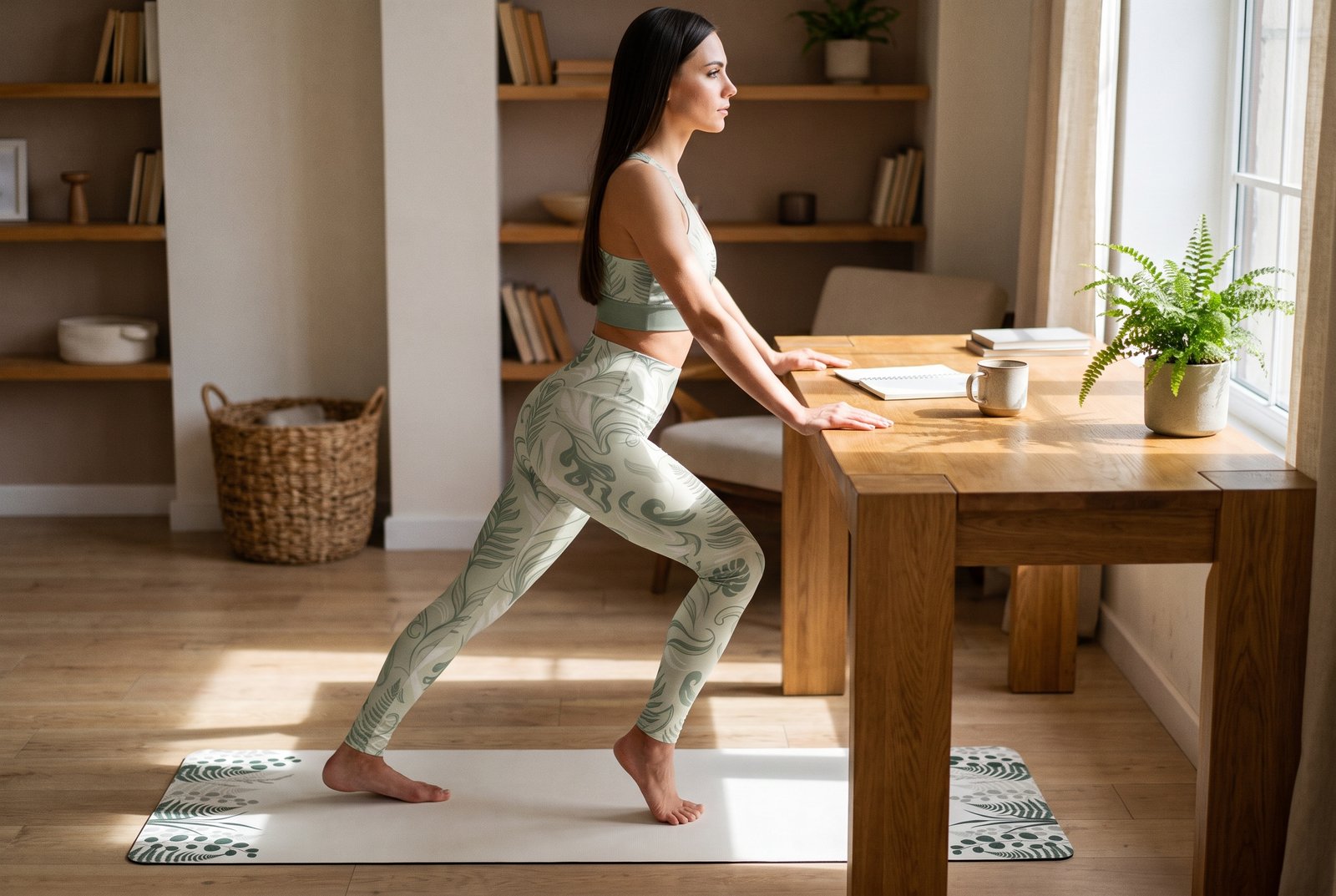
Blame usually lands on the calves. A squat that stops at half depth, a lunge where the back heel lifts, a single-leg balance that wobbles after four seconds — the muscle gets the blame, and the joint doing the limiting sits lower down, where the shin meets the foot.
Ankle range is the quietest thing in a desk worker’s body. Shoes with a raised heel, a footrest, eight hours of the foot held at roughly the same angle: nothing in that day asks the ankle to travel. It doesn’t hurt. It just stops going as far, and other joints start covering for it.
The fix needs no mat, no band, no wedge. A chair, a wall, and one stair.
What is ankle mobility, in plain terms
The ankle moves in four directions worth naming. Dorsiflexion is shin travelling towards the foot — the knee moving forward over the toes. Plantarflexion is pointing the foot down. Inversion and eversion are the sole tipping inward and outward.
Dorsiflexion is the one that goes missing at a desk, and the one squats and running most need. It isn’t purely a calf-length question either: the talus has to glide back in the joint, and the ankle has to tolerate load at the end of that range.
There’s a fast self-check. Stand facing a wall, big toe about 10cm from it, and push the knee forward to touch the wall with the heel staying flat on the floor. If the heel peels up before the knee arrives, you’ve found your working edge. That knee-to-wall distance is a commonly used screening position, not a diagnosis.
The five ankle mobility exercises, start to finish
These are deliberately simple ankle mobility exercises — three seated, two standing. Barefoot or in socks on a non-slip floor. Total running time is about five and a half minutes.
- Seated ankle circles. One foot lifted a few centimetres off the floor, knee still. Trace the biggest circle you can with the big toe, roughly three seconds per circle, 10 each direction, then swap. Keep the movement at the ankle rather than swinging the whole leg from the hip.
- Dorsiflexion rocks. At a wall: toes 10cm away, drive the knee forward to touch, hold two seconds, return. 12 reps a side. In a work chair: plant the foot flat, then slide the knee forwards over the toes while the heel stays pressed down, 15 slow reps. The desk leg or a skirting board works as the target.
- Heel raises. Stand, fingertips on the chair back for balance only. Two seconds up onto the balls of the feet, pause at the top, three seconds down. 15 reps. This is the strengthening half of the session — range you can’t control is range you won’t keep.
- Toe splays and toe lifts. Feet flat on the floor. Spread all the toes apart, hold five seconds, release, 10 times. Then lift only the big toe while the others stay down for 30 seconds, then only the four small toes for 30 seconds. Awkward at first, which is the point.
- Calf stretch off a step. Ball of one foot on the edge of a stair, heel hanging, hands on the rail. 30–45 seconds with the knee straight, then 30 seconds with the knee softly bent — the bent-knee version biases the soleus, which sits underneath and matters most for squat depth. Two rounds, each side.
Which drill, when
If you only have ninety seconds between meetings, take the rocks. Dorsiflexion rocks give the most return per minute at a desk, because they attack the exact direction the chair has taken away.
| Movement | Position | Dose | Mainly trains | Needs |
|---|---|---|---|---|
| Ankle circles | Seated, foot lifted | 10 each way, ~60s total | All-direction range, warm-up | A chair |
| Dorsiflexion rocks | Seated or standing at a wall | 12–15 reps a side | Dorsiflexion, knee-over-toe travel | Wall or desk leg |
| Heel raises | Standing, light hand support | 15 reps, 2s up / 3s down | Calf and ankle strength | Chair back |
| Toe splays and lifts | Seated, feet flat | 10 splays plus 2×30s holds | Foot and toe control | Bare feet |
| Step calf stretch | Standing, heel off a step | 30–45s straight, 30s bent, ×2 | Calf length, soleus | One stair |
Do you need a slant board, wedge or band?
No. And this is the honest part: for these five drills, the free version is the better version.
Slant boards are sold with published wedge angles, commonly in the 15° to 35° range, and they do hold the foot at a fixed incline. We haven’t tested one, so what follows is a comparison of published specifications against what a stair already does. A stair edge gives you a continuously adjustable heel drop, loads one leg at a time, and asks you to balance while it happens. A fixed wedge gives you one angle; a step gives you every angle between flat and your limit.
Resistance bands are useful if you’re rehabbing inversion and eversion strength after a sprain, which is a physiotherapist’s territory rather than a journal’s. For a desk five minutes, skip the kit. If you’re building a corner for everything else, a modest setup covers most needs, and mat thickness matters far more for kneeling work than for ankle work.
Ankle mobility exercises for squats, runners and standing balance
In a squat, missing dorsiflexion has to be paid for somewhere. The heels lift, the torso folds further forward, or the knees track inward to find the range. Adding an inch under the heels hides the problem neatly — useful on lifting day, not a substitute for the rocks.
For runners, the ankle is where the foot’s landing gets absorbed and returned, and stiffness there tends to shunt work up to the knee or down to the sole. Heel raises with a slow three-second lowering are the piece most often skipped.
Standing balance is the cheapest test you have: single-leg, shoes off, eyes open, and count. Then try it with the eyes closed and notice how much of your balance was coming from vision rather than from the foot. Athletes doing agility and change-of-direction work want inversion and eversion control too, which is where the circles earn their minute.
A daily ankle mobility routine that survives past Thursday
Routines die because they have no fixed slot. Pin these to something that already happens: the first call of the day, the kettle, the moment the laptop boots.
Twice a day, three minutes each, beats one heroic ten-minute session on a Sunday. Progress by adding reps and hold time before adding anything else — 15 rocks becomes 20, double-leg heel raises become single-leg, the straight-knee step stretch gains a second round.
Pair it with something that addresses the other half of the sitting problem. The ankles stiffen at the bottom of the chair while the hamstrings shorten at the back of it, and the two show up together in a shallow squat. If you’d rather front-load the day, the ankle work slots neatly into a five-minute morning sequence.
Looking for an ankle mobility exercises PDF?
You don’t need one. Five movements fit on a sticky note on the monitor bezel, which is a better reminder than a file you will never reopen. Write: circles 10, rocks 12, raises 15, toes 30s, step 30s. That’s the whole protocol.
When to stop and see a physiotherapist
Mobility work should feel like effort and stretch, not sharp pain. A pinching sensation at the front of the ankle that stops the movement dead, an ankle that gives way on stairs, swelling that returns after activity, numbness or tingling in the foot, or a sprain from months or years ago that never quite settled: all of those want a physiotherapist’s assessment rather than more reps. This article is general movement guidance, not treatment. If you want a routine built around your own limits, that conversation is a better starting point than a generic list.
If your squat stalls halfway and the heels lift: do the dorsiflexion rocks twice a day, 15 reps a side, and keep a thin heel lift for lifting days only while the range builds.
If you sit eight hours and nothing hurts yet: the circles and toe work are the two to start with, three minutes at the kettle, because they cost nothing and need no floor space.
If you run and your calves feel like cable: slow heel raises with a three-second lowering, plus the bent-knee step stretch for the soleus, before you buy anything shaped like a wedge.
If the ankle pinches at the front or has a sprain history: stop the drill that provokes it and book a physiotherapist. Range you force past a block isn’t range you keep.
Written with Elena, our AI stretch guide, and checked against our editorial and safety rules before publishing. General movement guidance, not medical advice. Photographs are AI-generated illustrations.


