

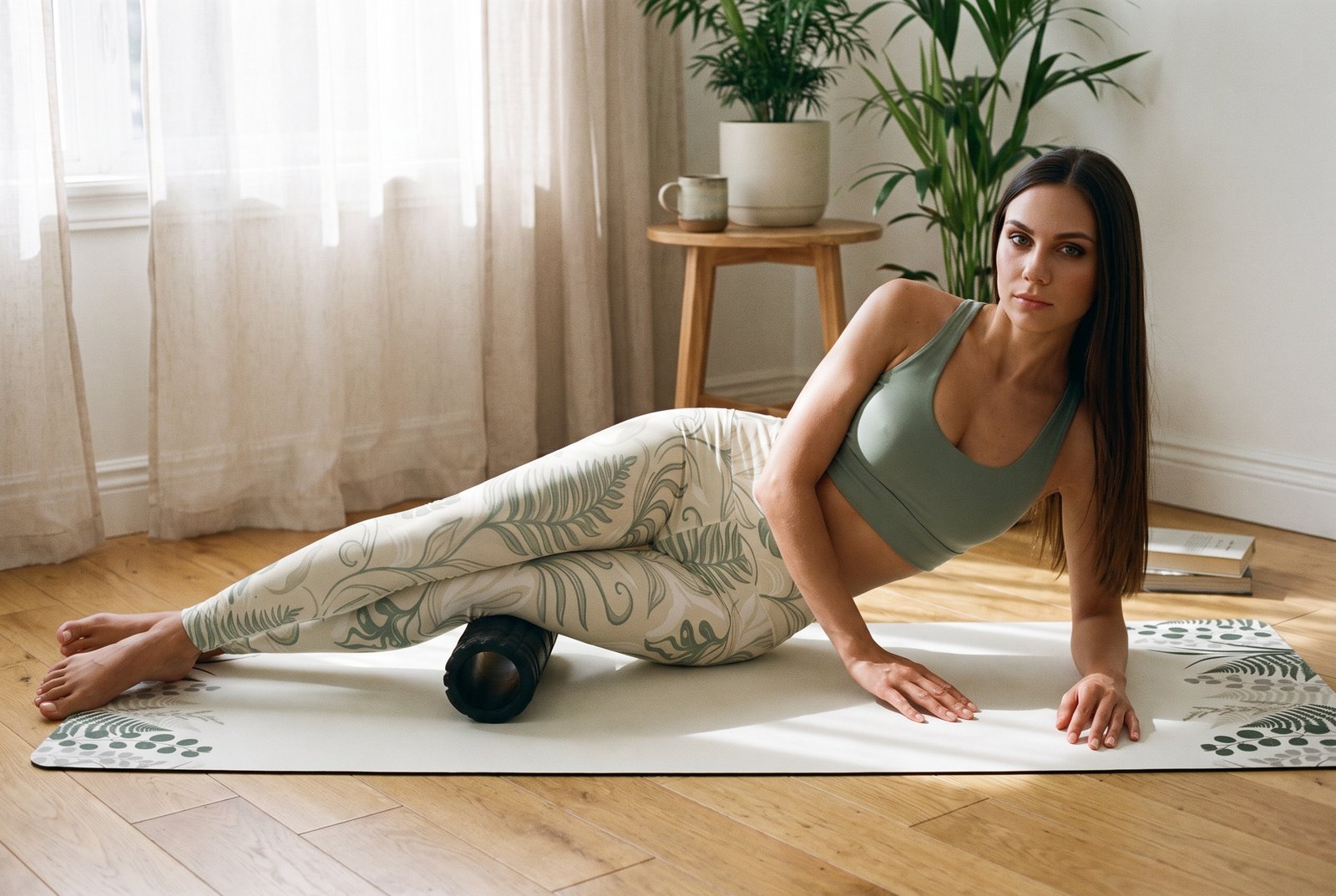
How we make money here: stretching.shop makes the printed pieces in this shop ourselves. Anything on this page marked Recommended gear is made by someone else and sold by a retailer, and we may earn a small commission if you buy through our link at no extra cost to you. We recommend gear we would use, and we say when a cheaper option is the better buy.
Start softer than you think. That’s the whole answer, and the rest of this is why.
The usual mistake runs the other way. Someone buys the densest roller on the listing page, puts a quad on it, and discovers that eight minutes of that is enough to make them avoid the thing for a fortnight. The roller didn’t fail. The pressure was set by body weight and limb position, not by the foam — and a hard roller removes your ability to dial that pressure down.
Soft vs firm foam roller: what actually differs
Three constructions dominate what you can buy, and they’re distinguishable from published specifications alone. We haven’t tested any of them; what follows is a comparison of what manufacturers state.
Smooth soft foam is usually moulded EPE or low-density EVA, a single piece, no core. It compresses visibly under a hand. Listings for these give a diameter and length and often a density figure in kg/m³, worth reading, because it’s the only honest number on the page.
Moulded firm foam is typically EPP (expanded polypropylene). Same shape, same single-piece construction, considerably less give. It holds its profile for years and is the standard in physiotherapy clinics for that reason.
Hollow-core rollers wrap a rigid ABS or PVC tube in a thin EVA sleeve, often 10–15 mm of it. The published load ratings on these are high because the tube carries the weight. The foam is a surface, not a cushion. Functionally these are the firmest option, regardless of how soft the outer layer feels to a fingertip.
Hard vs soft foam roller: the comparison table
| Type | Typical material | Common sizes | Feel under load | Suits |
|---|---|---|---|---|
| Smooth soft | Moulded EPE / low-density EVA, no core | 15 × 90 cm, 15 × 45 cm, 15 × 30 cm | Deforms around the limb, spreading contact | First roller, sensitive legs, restorative use |
| Moulded firm | EPP, single piece | 15 × 90 cm, 15 × 45 cm | Minimal give, narrow contact patch | People who already roll regularly |
| Hollow core, smooth | ABS/PVC tube + EVA sleeve | 15 × 33 cm, 15 × 45 cm | Effectively rigid | Heavier bodies, travel, high published load ratings |
| Hollow core, textured | ABS/PVC tube + moulded EVA ridges | 13–15 × 33 cm | Rigid, with raised zones concentrating load | Targeted work on small areas |
| Half-round | EPE or EPP, flat base | 15 × 90 cm cut lengthwise | Stable, cannot roll away | Balance work, feet, nervous beginners |
Why your body weight matters more than the foam
Here’s the part nobody puts on the box. Pressure is load divided by contact area, and you control both.
Take a calf. Both legs on the roller, hands planted behind you, hips on the floor: a fraction of your weight reaches the foam, and it’s split across two limbs. Lift the hips and stack one ankle over the other, and you’ve moved the entire load onto one calf. For a 70 kg body that’s a shift of tens of kilograms through one contact patch a few centimetres wide.
Nothing about the roller changed. The same roller can deliver gentle or close to intolerable pressure depending on where your hands and your other leg are.
Which is why starting firm is backwards. A soft roller at maximum load, hips up, one limb, no hand support, gets you most of the way to a firm roller. A firm roller at minimum load is still a firm roller. You can’t soften it.
Is a smooth or textured foam roller better?
Smooth, to begin with. Ridged, knobbled and grid-patterned rollers work by reducing contact area. Raised zones take the load that a smooth cylinder would spread, so the pressure at those points goes up sharply for the same body weight.
That’s useful once you know what you’re doing and want to work a small area without hoisting your whole body onto one leg. It’s a poor property in a first roller, where the main risk is overshooting and quitting.
There’s also a practical point: a textured roller makes a bad support. Lie lengthwise along a 90 cm smooth roller for a chest opener and it’s pleasant. Do it on ridges and it isn’t. If you own one roller and want it to double as a prop, buy smooth.
Why does foam rolling feel so good?
Honest answer: the mechanism is still argued over, and most of the confident explanations you’ll read online aren’t supported by much. The old story about breaking up adhesions or reshaping fascia with a foam tube hasn’t held up well.
What’s better supported is that it’s largely a nervous-system effect — pressure and movement over an area change how that area reports and how readily the muscle lets go, for a while. The relief tends to be real and tends to be temporary.
Which has a practical consequence. Rolling is a doorway to stretching and strengthening, not a replacement for either. Three minutes on the hamstrings before a hamstring routine for sitting all day is a sensible use of it. Twenty minutes of rolling instead of the routine is not.
When the free option is better
If what bothers you is your feet, your calves or one stubborn spot in a glute, don’t buy a roller. A tennis ball or a lacrosse ball does small areas better than any 15 cm cylinder, costs almost nothing, and fits in a drawer.
If what bothers you is the mid-back after eight hours at a desk, a rolled bath towel, tight, about 10 cm thick, laid across the floor under the shoulder blades, gives you most of the extension with none of the pressure. Several blankets stacked do the same job, as covered in our notes on the best blanket for restorative yoga.
The roller earns its place when you want one tool for long muscle groups: quads, IT band region, lats, the whole thoracic spine. Also when you want something that doubles as a balance and support prop.
Sizes, and which length to buy
Diameter is near-standard at 15 cm. Smaller 10 cm rollers exist and concentrate load more; treat them as the firm end of the scale whatever their foam.
Length is the real decision:
- 90 cm — the only length you can lie along spine-wise for chest and shoulder work. Most versatile, least portable.
- 45 cm — covers legs and back fine, fits in a cupboard, cannot support the spine lengthwise.
- 30–33 cm — travel size. Narrow enough that a leg can slip off the end mid-roll.
If it’s your only roller and it lives in a corner with your mat, take the 90 cm. If you’re assembling a home stretching corner under £200, the long roller also works as a bolster substitute and a balance challenge, which the short ones don’t.
When to stop and ask someone
Rolling should feel like firm pressure that eases. It shouldn’t produce sharp, electrical or radiating sensations, numbness, or pain that is worse the next day than it was during.
Nerves and bony prominences don’t want compression, so keep off the lower back, the side of the knee, the front of the neck and the armpit crease. Pain that has lasted more than a few weeks, or that wakes you at night, is a physiotherapist’s question, not a foam question. A roller cannot diagnose anything and neither can an article.
Buying your first roller: smooth, soft to medium moulded foam, 15 × 90 cm. You’ll add pressure within a fortnight by lifting your hips and stacking one leg — and you’ll still be using it, which is the only metric that matters.
You already roll three times a week and want more: moulded EPP or a hollow core. You’ve earned the firmness and you know where not to put it. Keep the soft one for support work.
One stubborn spot, not a whole-body habit: a tennis ball and five minutes. Spend the roller money on something you’ll use more, or on nothing at all.
You have abandoned a routine before: the roller isn’t the thing that will fix that. Pair it with something short and fixed, like a five minute morning stretch routine, and let the rolling be the warm-up rather than the whole plan.
How this comparison was made: we compared manufacturers’ own published specifications, not our own testing. Where we sell something ourselves we say so. Photographs are AI-generated illustrations featuring Elena, our AI guide.


