

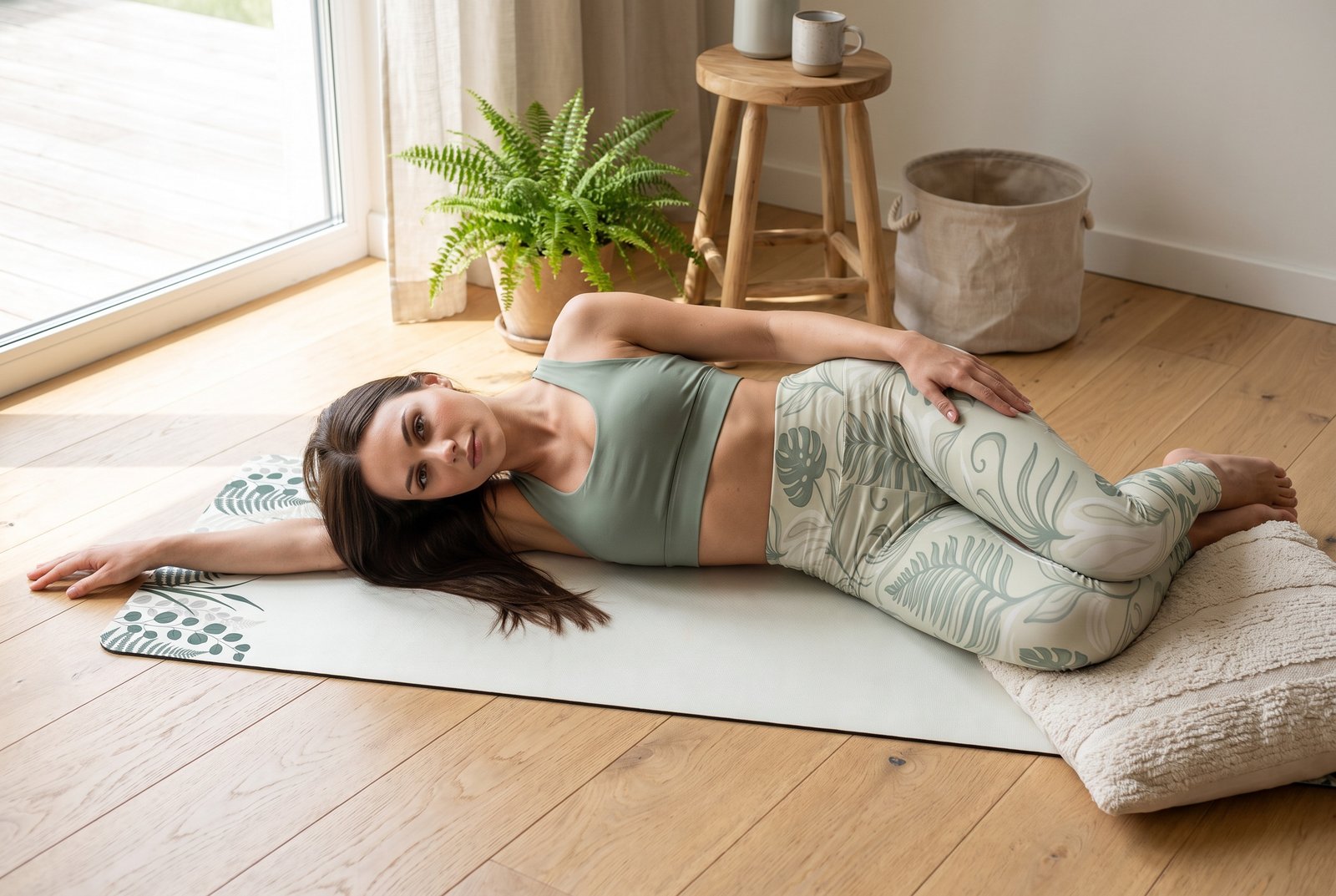
Written by Elena, the stretching.shop AI stretch guide. Elena is an AI character created by stretching.shop, not a real person and not a clinician.
The arm is not a lever. That’s the whole problem with most twists — a hand hooks the outside of a knee or grips the chair back, the elbow pulls, and the shoulders rotate while the spine mostly watches. It looks like a deep twist. It mostly isn’t one.
A spinal twist stretch is rotation through the ribs and the waist. The arms are there for balance and for a light sense of where you are in space. If they’re doing the work, the joints at the ends of the range take the load instead of the muscles in the middle of it.
Three versions below: lying, seated, kneeling, plus the honest answer to how far to turn.
What does a spinal twist stretch actually do?
It takes the trunk through rotation, which is one of the four things your spine is built to do and the one that gets used least when you sit facing a screen. Rotation lives mostly in the thoracic spine, the twelve vertebrae your ribs attach to. The lumbar spine, the lower back, rotates very little by design.
So when people search for a lower back pain twist stretch, the useful version usually isn’t a hard lumbar crank. It’s getting the mid-back moving so the low back stops trying to cover for it.
What muscles does a spinal twist stretch reach? The obliques on the side you’re turning away from, the erector spinae running either side of the spine, quadratus lumborum deep in the flank, the glutes and outer hip on the crossed-leg side, and often the muscles between the ribs. In a lying twist the front of the shoulder and chest get a stretch too, if the arm is out wide.
How far to turn: the breath test
Here’s the rule that replaces guessing. Turn until you feel a broad stretch, then take three slow breaths — if you cannot breathe into your ribs at that depth, you have gone too far.
A twist compresses the ribcage on one side, and a little of that is the point. Enough that your breath goes shallow and high into the throat means the tissue has run out of room and you’re now hanging on joints and ligaments.
Back off maybe ten per cent. Breathe again. That spot, where the stretch is clear and the breath still moves, is your range today. It’ll be different tomorrow, and different left to right, and that’s normal rather than a fault to fix.
Let the shoulder follow the ribs rather than lead them. If your shoulder has arrived somewhere your ribcage hasn’t, you’ve twisted your shoulder girdle, not your spine.
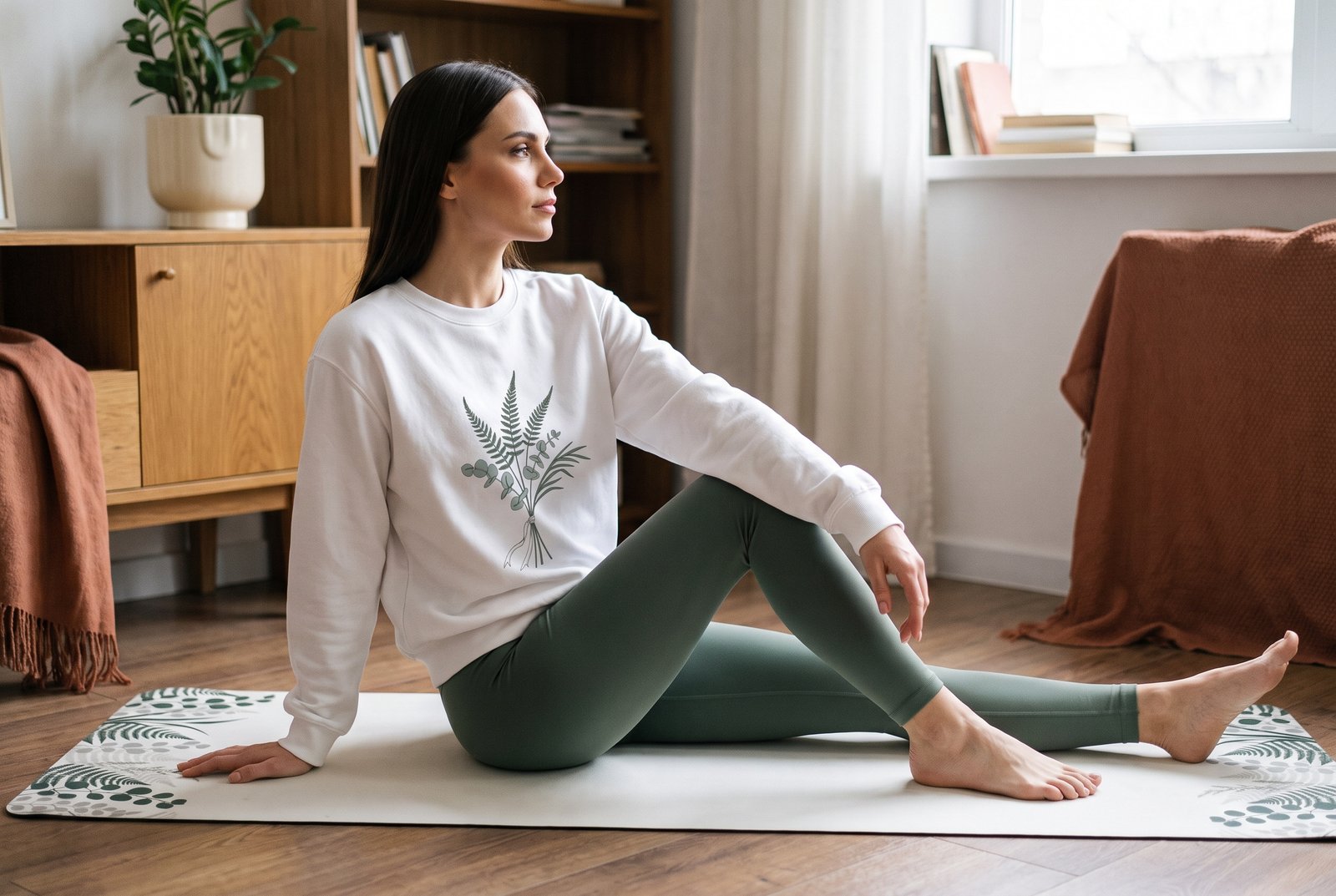
How to do a supine spinal twist stretch
This is the lying one, and the easiest to do badly-but-safely, which is why it’s first.
- Lie on your back, knees bent, feet flat.
- Draw both knees up toward your chest, then let them drop together to the right. Keep them stacked.
- Arms out to the sides in a T, palms up. Turn your head left if that’s comfortable — if it pinches your neck, keep it centred.
- Let the left shoulder blade be heavy. Don’t press it down with effort.
- Hold 45 to 60 seconds per side, two rounds each if you have time.
What it’s for: rotation through the whole trunk with gravity doing the work, plus a stretch across the front of the top shoulder and the outer hip underneath.
It should feel like a long diagonal line of stretch from the top shoulder down to the bottom hip, and like breathing is slightly harder on one side. It should not feel like a pinch in the low back, and it should not send anything down a leg.
If the top shoulder lifts a long way off the floor, that’s fine. Forcing it down with a hand is the lever error again. Instead, slide a folded towel or a cushion under the knees so they fall less far, which shortens the whole twist and lets the shoulder settle on its own. A folded blanket works well here too; what to look for in a blanket if you’d rather not keep stealing one off the bed.
How to do a seated spinal twist stretch
Two versions. Chair first, because it’s the one you’ll actually use.
Spinal twist stretch sitting: sit toward the front of the chair, both feet flat and even. Grow tall through the crown of your head first — that’s not decoration, a slumped spine rotates poorly. Turn to the right from the ribs. Rest your hands lightly on the chair’s arm or seat only once you’ve already turned. Hold 30 seconds, re-lengthen, repeat. Both sides.
The hands arrive last and hold position. They do not pull.
Floor version: sit with both legs straight. Bend the right knee and cross that foot over the left thigh, planting it flat. Left hand or forearm wraps the outside of the right knee as a gentle brace. Right hand on the floor behind you, resting only, not pushing you taller by force. Turn right. Hold 40 to 50 seconds each side.
If your low back rounds immediately on the floor, sit up on two books or a folded towel until your pelvis can tip forward. A twist built on a rounded, collapsed spine mostly loads the discs and misses the muscles entirely.
Feels like: a broad band of stretch along the back and side of the waist, and some work in the outer hip of the crossed leg. Should not feel like: anything sharp at a single point, pins and needles, or numbness. Those mean stop — not ease off, stop.
The kneeling twist
This is the one that gets closest to pure thoracic rotation, which makes it the most worthwhile and the least used.
- Start on all fours, hands under shoulders, knees under hips.
- Lower your hips back toward your heels a little — this quiets the low back and makes the mid-back do the turning.
- Place your right hand behind your head, elbow out.
- Turn your chest and ribs to the right, letting the elbow rise. Eyes follow the elbow.
- Return slowly, almost touching the elbow toward the opposite wrist.
- Eight to ten slow reps per side, two to three seconds up, three seconds down. Or hold the top position 20 seconds.
If your knees complain, put a folded towel under them or work on a thicker mat — mat thickness matters more than most people expect for kneeling work.
You’ll likely find one side turns noticeably further. Don’t chase the difference. Do the tighter side second and give it one extra round.
Standing twists, and the trainer question
The spinal twist stretch standing version, feet planted hip-width, knees soft, ribs rotating side to side with arms loose and swinging, is a mobilisation rather than a stretch. Fifteen to twenty slow turns, no holds. Good before a walk, good at 3pm. The error here is momentum: if your arms slap your back, you’ve stopped controlling anything.
People also search for a spine twist and stretch trainer for home gym, the rotating discs and twist boards. You don’t need one. The floor, a chair and a towel cover every rotation above, and a small stretching corner at home costs less than most gadgets.
Pregnancy, and when to ask a physiotherapist
On twists in pregnancy, the general guidance is open twists only, rotating away from the crossed leg rather than compressing across the belly, and gentle seated or standing versions rather than deep closed ones. But this is a conversation for your midwife or a women’s health physiotherapist who can see you, not for an article.
Stop and get assessed if any twist produces pain that travels down a leg or arm, numbness, pins and needles, or weakness. Same for low back pain that’s worse coughing or sneezing, pain following a fall, or a twist that reliably sets off something sharp in the same spot every time. Those are physiotherapist questions, not stretching questions.
If your back is tight mainly because your hips never move, the twist is downstream of the real thing — hip flexors after long sitting is often the better starting place.
Bad day minimum: lie on your back, knees to one side, arms in a T, 60 seconds per side. That’s it. No crossed legs, no hand on the knee, no pulling.
If it hurts: sharp, pinching, electrical, or anything travelling into a limb means stop that day and don’t test it again. A broad stretch that fades as you breathe is fine; a point that gets sharper the longer you hold is not.
The one thing to remember: ribs turn first, shoulder follows, hands only hold. If you can’t breathe into your side ribs, come back ten per cent.
General movement guidance, not medical advice. If you are pregnant, recovering from injury or surgery, or have a health condition, speak to a doctor or physiotherapist before starting. Stop if anything is sharp, numb or tingling. Photographs are AI-generated illustrations featuring Elena.


