

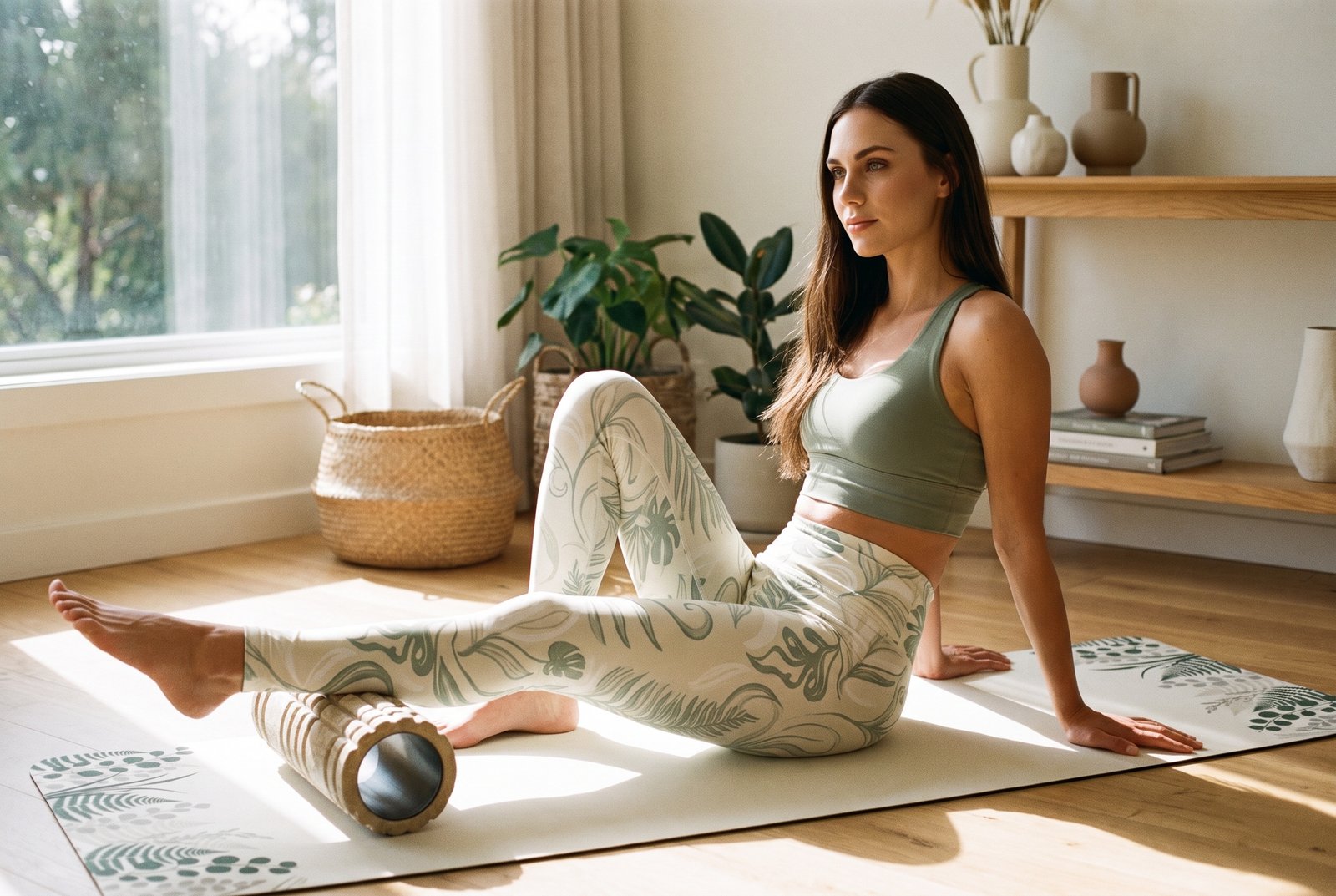
How we make money here: stretching.shop makes the printed pieces in this shop ourselves. Anything on this page marked Recommended gear is made by someone else and sold by a retailer, and we may earn a small commission if you buy through our link at no extra cost to you. We recommend gear we would use, and we say when a cheaper option is the better buy.
Thirteen inches, six inches across. If you want one roller and no further thinking, that’s the size that handles calves, quads, glutes and the outside of the thigh, and still fits in a cupboard.
But the question what size foam roller hides a second question: what do you want to lie on? The moment the roller runs along your spine instead of across your leg, the maths changes completely, and a 13-inch roller becomes the wrong tool. Length decides which positions are available to you; diameter decides how hard the position is.
What size foam roller do I need, in one paragraph
Rollers are published in three or four common lengths: roughly 12–13 inches (30–33 cm), 18 inches (45 cm), 26 inches (66 cm) and 36 inches (90 cm). Diameters cluster at 6 inches (15 cm), 5 inches (12.5 cm), 4 inches (10 cm) and around 3 inches (8 cm) for the slim travel sticks.
Short rollers are for working one limb at a time. Long rollers are for lying along, lengthwise, head to tailbone. The 18-inch sits awkwardly between the two and is the one people most often regret.
Length: what each one actually reaches
A 12–13 inch roller is a limb tool. Put it under one calf and the roller is wider than the leg, which is all you need. It travels, it lives upright in a corner, and it’s the size most often sold as a “travel” or “mini” roller. The limitation shows up when you try to roll your upper back: a short roller wobbles under a broad ribcage and you spend the set correcting it rather than breathing.
An 18-inch roller does both jobs at about 70 per cent. It’s wide enough to take both calves side by side if you’re slim, long enough to sit across the upper back, and too short to lie along. That’s the compromise length, and it’s genuinely fine if the cupboard is the binding constraint.
A 26-inch roller covers both legs at once and will take most torsos across the back without the ends digging in.
A 36-inch roller is the Pilates standard. At that length you lie on it lengthwise, sacrum to skull, arms off either side, and the whole chest opens because the floor is no longer holding your shoulders forward. Nothing shorter does that. If spine-lengthwise work is why you’re buying, 36 inches is not optional.
Diameter: the dial for intensity and for height
Six inches is the default, and there’s a reason. A 6-inch roller lifts your body clear of the floor in side-lying and prone positions, so your working leg has room to move. Drop to 4 inches and your hip bone or elbow starts hitting the mat in the same positions.
Smaller diameter also means a smaller contact patch, so pressure concentrates. A 3-inch stick roller presses harder into a calf than a 6-inch drum at the same body weight. That’s sometimes what you want and often not, particularly on an irritated IT band.
Height matters for the lying-down work too. At 6 inches, lying lengthwise puts your head about 15 cm above the floor, which is a real position change, and a 4-inch roller gives a gentler version with less balance demand. Beginners who feel unstable should go wider, not narrower — a 6-inch roller is easier to balance on than a 4-inch one.
A comparison on published dimensions
These are the specifications manufacturers publish, set side by side. We haven’t tested these sizes against each other, and nobody sensible would claim one length is objectively superior; they do different jobs.
| Size | Reaches well | Cannot do | Storage footprint |
|---|---|---|---|
| 12–13 in × 6 in (33 × 15 cm) | Calves, quads, glutes, IT band, one leg at a time; fits a cabin bag | Lying along the spine; both legs together | Stands upright in a corner; fits most 30 cm shelves |
| 18 in × 6 in (45 × 15 cm) | Single limbs, upper back crosswise, thoracic extension over the ribs | Lying along the spine | Upright in a corner or flat under a sofa |
| 26 in × 6 in (66 × 15 cm) | Both calves at once, broad upper back, most crosswise work | Full head-to-tailbone support for taller bodies | Needs a 70 cm shelf or a floor corner |
| 36 in × 6 in (90 × 15 cm) | Lying lengthwise, Pilates and core work, chest opening, both legs | Travel; precise single-point pressure | Awkward. Wardrobe floor, under the bed, or on display |
| 12–18 in × 3–4 in (30–45 × 8–10 cm) | Calves, forearms, feet, concentrated pressure | Any position needing clearance from the floor | Drawer |
Best size foam roller for back and upper back
Split the question. For the upper back, the stiff thoracic segment that desk work shortens, you want the roller crosswise under the shoulder blades, and 18 inches is enough. Many people prefer short here, because a long roller’s ends catch the floor when you shift weight.
For the whole back lying lengthwise, you need 26 to 36 inches depending on your height, measured from your sacrum to the back of your head. Measure that on yourself with a tape before buying. Most adults land between 60 and 75 cm.
Rolling does not treat back pain, and persistent or radiating pain is a physiotherapist’s job, not a foam roller’s. Numbness, pain down a leg, or anything that wakes you at night needs a clinician.
Best size foam roller for legs, IT band and beginners
Legs: 13 inches × 6 inches, and almost everyone could stop reading here. One leg at a time gives better control anyway, and a 26-inch roller under both calves only saves time.
IT band: wider and softer, not narrower and harder. The outside of the thigh is a sensitive structure over a long bone, and a 3-inch stick pressed into it is unpleasant without being more useful. Many physios now suggest working the glutes and quads instead. If tight hamstrings are the real issue, the desk-based hamstring routine may do more than any rolling.
Beginners: 6-inch diameter, smooth surface, medium density, 18 or 26 inches. Skip the knobbly high-density roller for the first few months — the texture doesn’t add benefit for a body that’s still learning the positions.
Best size foam roller for Pilates, core and ab work
36 inches × 6 inches. That’s effectively a standard, and it’s standard because Pilates roller repertoire assumes the roller supports you head to pelvis while your limbs move in the air. Dead bugs, arm circles and leg lifts all need that full-length support.
For ab and core work specifically, the long roller works as an unstable surface. A shorter one turns the same exercise into a balance scramble around the ribs.
A half-round is the quieter alternative: flat on the bottom, typically 6 inches wide and 3 inches tall, sold in 12, 24 and 36-inch lengths. It won’t roll away, which makes it a better first purchase for anyone nervous on the full round.
The shelf you have is a real constraint
A 36-inch roller doesn’t fit anywhere tidy. It won’t stand in a kitchen cupboard, it doesn’t slide behind a door, and it doesn’t disappear. Rollers you have to retrieve from under a bed get used less, and that’s the mechanism behind most abandoned routines.
So measure the space before the body. If the only honest home is a corner by the sofa, buy the size that stands in that corner. Our notes on building a stretching corner under £200 cover where the kit actually goes.
And the free option: for lying lengthwise, a firmly rolled wool blanket does most of what a 36-inch roller does, costs nothing if you own one, and folds flat. It’s less unstable, which makes it worse for Pilates and better for breathing work — see choosing a blanket for restorative yoga. For plantar fascia and foot work, a tennis ball beats any roller at any size.
If you want one roller and nothing else: 13 inches × 6 inches. It covers every leg position, stands in a corner, and fits a suitcase. You lose spine-lengthwise work, which a rolled blanket can stand in for.
If Pilates or core work is the point: 36 inches × 6 inches, and clear the storage space first. Nothing shorter supports the full spine, and the exercises assume it does.
If your upper back is the complaint and you sit all day: 18 inches × 6 inches crosswise under the shoulder blades, two or three minutes. If the pain radiates, persists past a fortnight, or wakes you, book a physiotherapist rather than buying a firmer roller.
If you’ve abandoned a routine before: buy the size that lives where you’ll see it. A roller behind the wardrobe is a roller you’ve already stopped using.
Written with Elena, our AI stretch guide, and checked against our editorial and safety rules before publishing. General movement guidance, not medical advice. Photographs are AI-generated illustrations.


