

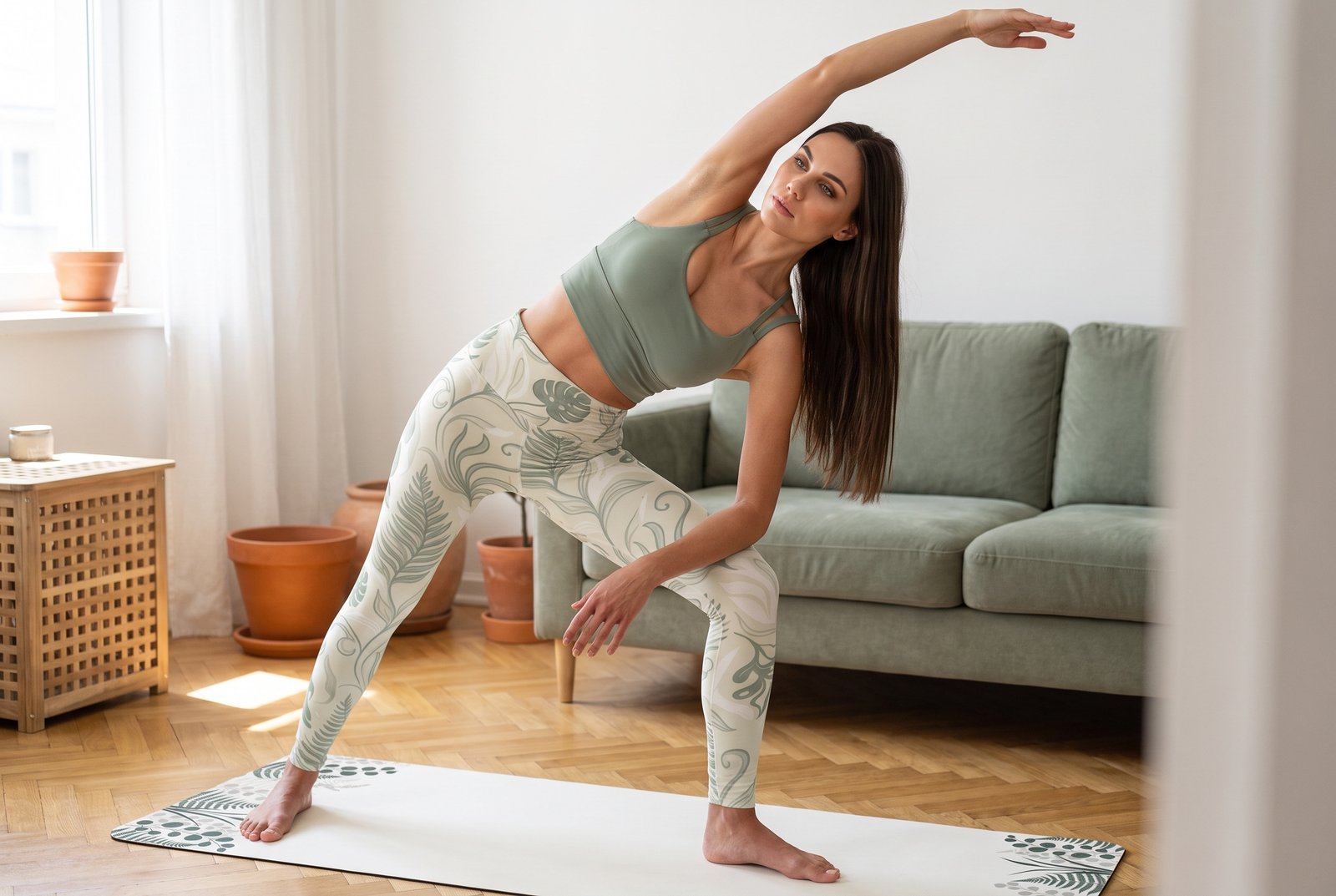
Stretching isn’t a warm-up. That belief is backwards, and it’s why so many people sit down to touch their toes at 7am, feel like a plank of wood, and conclude they’re simply inflexible. Cold tissue doesn’t lengthen willingly. It resists, you pull harder, and the whole thing becomes unpleasant enough to abandon by Thursday.
The fix costs five minutes and no equipment: no mat, no strap, no foam roller. You need floor space roughly the size of a bath towel and a wall to touch for balance.
Why warm up before stretching at all
Warming up does one simple thing: it raises the temperature of muscle and connective tissue by moving it. Blood flow increases to the working limbs, joints produce more synovial fluid, and tissue that was stiff at rest becomes more compliant. It’s why the same hamstring stretch feels brutal at 6:30am and reasonable after a walk to the shops.
There’s a second reason, less discussed. A warm-up gives your nervous system three or four minutes to notice what you are about to do. Stretch a cold, startled muscle and it tends to tighten protectively. Move it first, through its easy range, and it stops guarding.
For anything you intend to hold, meaning any shape you’ll sit in for 30 seconds or more, warming up beats skipping it. For a thirty-second calf stretch in the kitchen between emails, no, just do it. The warm-up question matters when the session has a goal.
What to do first: warm up or stretching
Warm up first, always, if “stretching” means static holds. The sequence that makes sense is: move, then hold, then load if you’re training.
The confusion comes from sport. Static stretching immediately before a sprint or a heavy lift has fallen out of favour for performance reasons, which got garbled into “never stretch before exercise”. That isn’t the same as “never warm up before stretching”. If your session is the stretching, warm up and then stretch. If your session is a run or a gym workout, warm up with movement and save the long holds for afterwards or a separate slot.
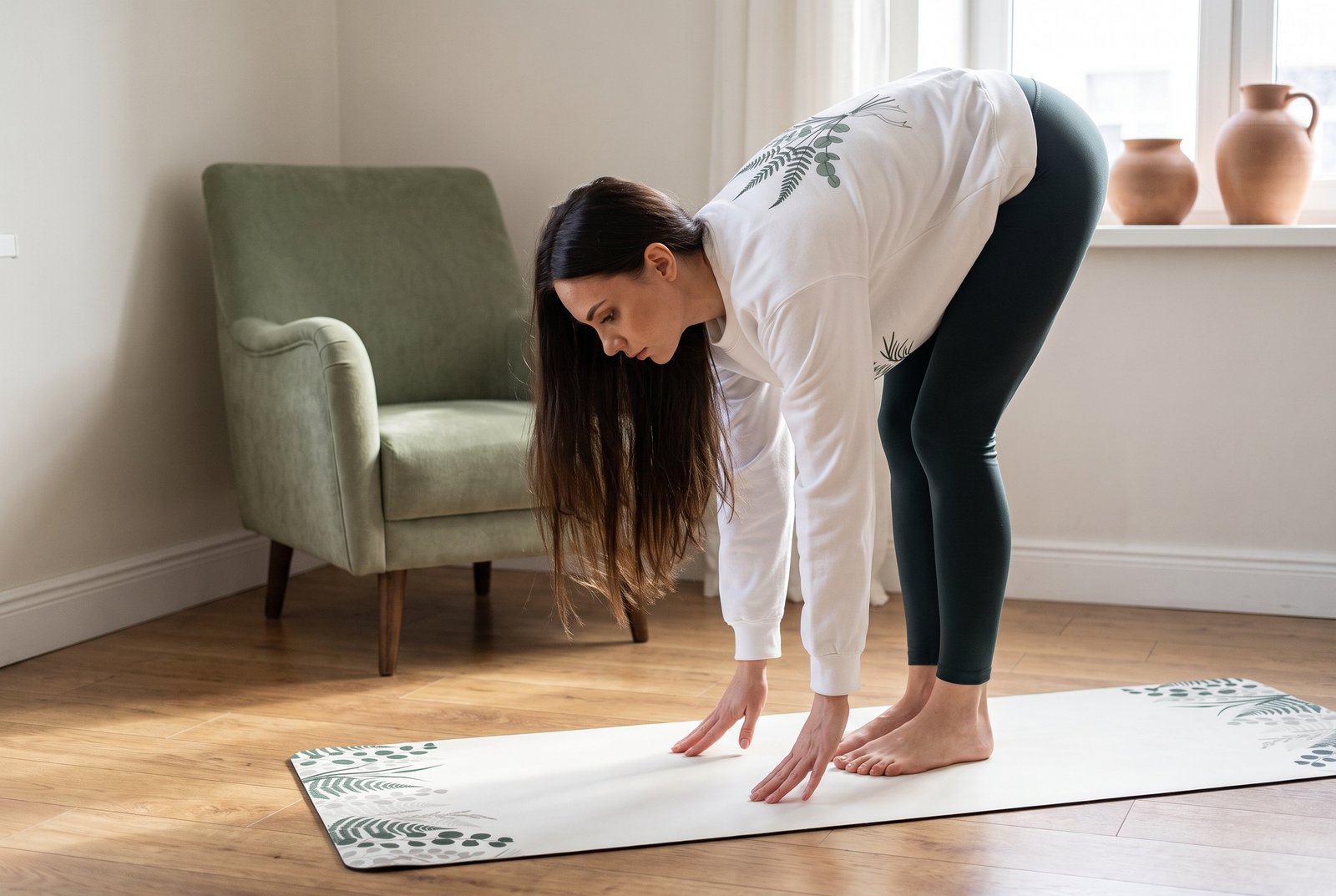
How long to warm up before stretching
Five minutes is the honest minimum for a general flexibility session in a room at normal living temperature, around 19–21°C. Ten minutes if you’re cold, early, or going after end-range shapes like splits.
The marker isn’t the clock, it’s your breath and skin. You want to be breathing noticeably but still able to talk in full sentences, with a faint warmth at the back of the neck. If you’re sweating, you overdid the warm-up and ate into the session.
| Warm-up method | Time | Kit needed | Best for | Cost |
|---|---|---|---|---|
| Brisk walk or stair climbing | 5–8 min | Shoes | Whole-body, lower limb focus | Free |
| Moving sequence below | 5 min | None | Indoors, small spaces, all joints | Free |
| Stationary bike or rower | 5–10 min | Machine | Legs, cold mornings | Equipment |
| Hot shower | 5–10 min | Bathroom | Skin warmth only, no joint movement | Water and heating |
| Nothing | 0 min | None | Brief single stretches, not sessions | Free |
Note the shower row. It feels productive and does less than people assume, because heat on skin is not the same as circulation through working muscle. If you only have one free option, take the stairs twice — it beats anything you can buy.
The five-minute sequence, no kit
Run this standing, in socks or bare feet, on any floor. Nothing is held. Everything moves.
- 0:00–0:45 — March on the spot. Arms swinging freely, about 90 steps a minute, heel touching down each time. Pick the knees up a little higher in the last fifteen seconds.
- 0:45–1:30 — Shoulders and arms. Ten shoulder rolls backwards, ten forwards, then five big arm circles each direction. Finish with ten slow arm swings across the chest and open.
- 1:30–2:15 — Hips and knees. Hands on hips, eight hip circles each direction. Then lift one knee to hip height and draw eight circles with it, each leg.
- 2:15–3:00 — Leg swings. Fingertips on a wall. Ten forward-and-back swings per leg, then ten side-to-side. Keep them loose and under control, not kicked.
- 3:00–3:45 — Spine. Eight standing cat–cows: hands on thighs, round the back on the exhale, lengthen on the inhale. Then eight gentle trunk rotations, arms heavy, letting them wrap.
- 3:45–4:30 — Ten half squats. Feet hip-width, heels down, going only as deep as feels easy. Sit-to-stands from a dining chair work identically if balance is a concern.
- 4:30–5:00 — Ankles and shake-out. Twenty small heel raises, then shake each limb for five seconds.
Then begin your holds. If you want a ready-made session to drop onto the end of this, the five-minute morning stretch routine follows on neatly, and the hamstring routine for sitting all day picks up the specific tissue that desk work shortens.
Cold mornings and cold rooms
Below about 17°C, five minutes isn’t enough. Tissue loses heat to the air faster than gentle movement replaces it, and your first hold will feel like the warm-up never happened.
Three adjustments. Extend to eight to ten minutes and add a second round of marching and half squats. Keep long sleeves and socks on for the whole session rather than peeling layers off at minute two. And work away from draughts and tiled floors, since a cold floor pulls heat out of your hands, feet and sitting bones for the entire session.
Thin mats matter here more than people expect. A 3mm travel mat on a tiled kitchen floor is, thermally, barely a mat; the thickness comparison goes through the published specifications. A folded blanket under the knees and hips costs nothing and works.
How to warm up before stretching for splits
End-range work needs more than five minutes. Budget 10–12.
Keep the sequence above, then add: ten walking lunges or stationary lunges per leg, ten glute bridges, and ten more leg swings per leg once the hips are already warm. The second set of leg swings, done warm, reaches a noticeably bigger range than the first — that range is what you are trying to bring into the split. Finish the warm-up with two or three shallow versions of the split itself, held for five seconds each, before any long hold.
Warm-ups for running, golf and upper body training
The principles don’t change; the emphasis does.
- Before running: three to five minutes of brisk walking, then ten leg swings per leg, twenty ankle bounces, and ten walking lunges. Start the run itself slowly for the first kilometre.
- Before golf: ten trunk rotations with a club across the shoulders, ten hip hinges, ten arm circles, then half-speed practice swings. Rotation and hinge are what the swing demands.
- Before upper body training: twenty scapular retractions, ten slow press-up-position shoulder taps against a wall, arm circles, then two light sets of the first exercise at perhaps 40–50% of working weight.
- Before a general workout: the five-minute sequence covers it, plus light sets of whatever comes first.
When stiffness is not stiffness
A warm-up makes cold tissue behave better. It doesn’t address pain. If a stretch produces sharp pain, pins and needles, numbness, or pain that travels down a limb, stop and book a physiotherapist rather than warming up harder. The same applies to stiffness that is worse on waking every day for weeks, or any joint that swells after activity. Guided sessions like working with a teacher can clean up technique, but they’re not a substitute for assessment.
If you have five minutes total and must choose: spend the first two moving — march, arm circles, half squats — and the remaining three holding. Two warm minutes of stretching beats five cold ones.
If your room is under 17°C: double the warm-up to eight or ten minutes, keep your layers on, and put a folded blanket between you and any hard floor before the first hold.
If you are chasing splits or any end-range shape: give it ten to twelve minutes, repeat the leg swings once warm, and treat shallow versions of the target shape as the last stage of the warm-up rather than the first stage of the stretch.
If stretching hurts rather than pulls: no warm-up will fix that. See a physiotherapist before adding more volume.
Written with Elena, our AI stretch guide, and checked against our editorial and safety rules before publishing. General movement guidance, not medical advice. Photographs are AI-generated illustrations.


