

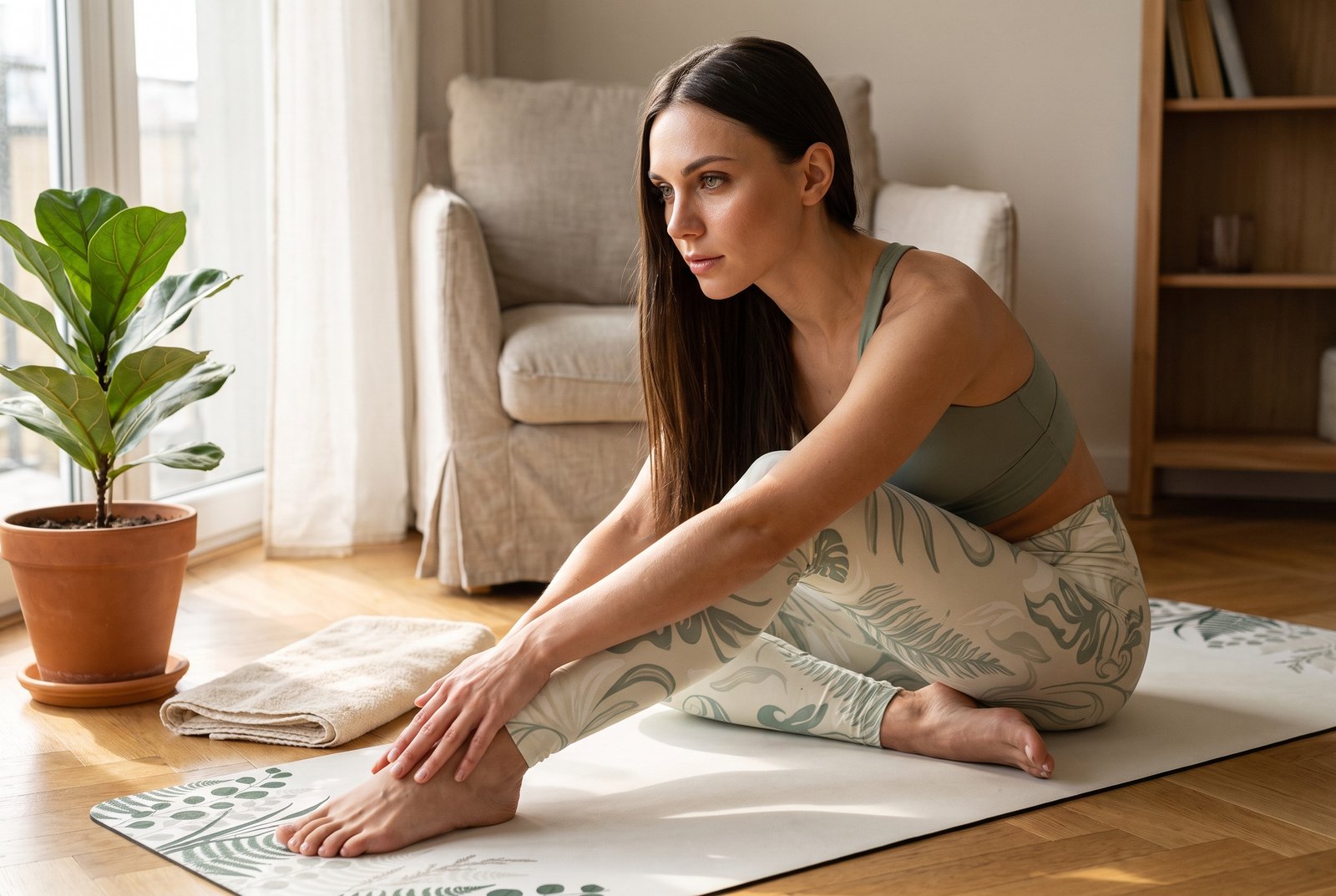
A yoga strap sold as “6 foot” is 183 cm long and usually 38 mm wide, in cotton webbing, with a metal D-ring or plastic cinch at one end. A bath towel out of your airing cupboard is around 70 × 140 cm. Folded lengthwise into a band, that towel gives you roughly 140 cm of usable reach with a 10 cm width you can actually grip. For a supine hamstring stretch with the other leg flat on the floor, 140 cm is enough for most people. That’s the whole argument, in one paragraph.
Do you need a yoga strap? Mostly, no
If your stretching happens on a mat in your living room, four or five times a week, in the same handful of positions, the towel wins on cost and does the same job in every position where you only need something to hold. It costs nothing, because you already own it. It washes, and it doubles as a folded prop under your hips.
The strap earns its place for one reason, and it isn’t comfort or grip. It’s a fixed, repeatable length. More on that below, because it matters more than most people selling straps bother to explain.
A note on where this comes from: we have not tested these options against each other. Everything specific below about strap lengths, widths and buckle types is read off published manufacturer specifications, and everything about towels is read off standard UK linen sizing. Your towel may differ by 10 cm either way.
What do you use a yoga strap for, really
Three jobs, and they’re worth separating, because people muddle them.
- Extending your arms so you can hold a foot you cannot reach — supine hamstring, seated forward fold, reclining figure-four.
- Binding — holding two body parts at a set distance, like looping the thighs in a reclined bound-angle position or keeping the elbows shoulder-width in a shoulder opener.
- Measuring — a mark on the webbing tells you where your hand was six weeks ago.
A towel does job one perfectly, and job two badly, since it slips and has nothing to fasten with. Job three it can’t do at all.
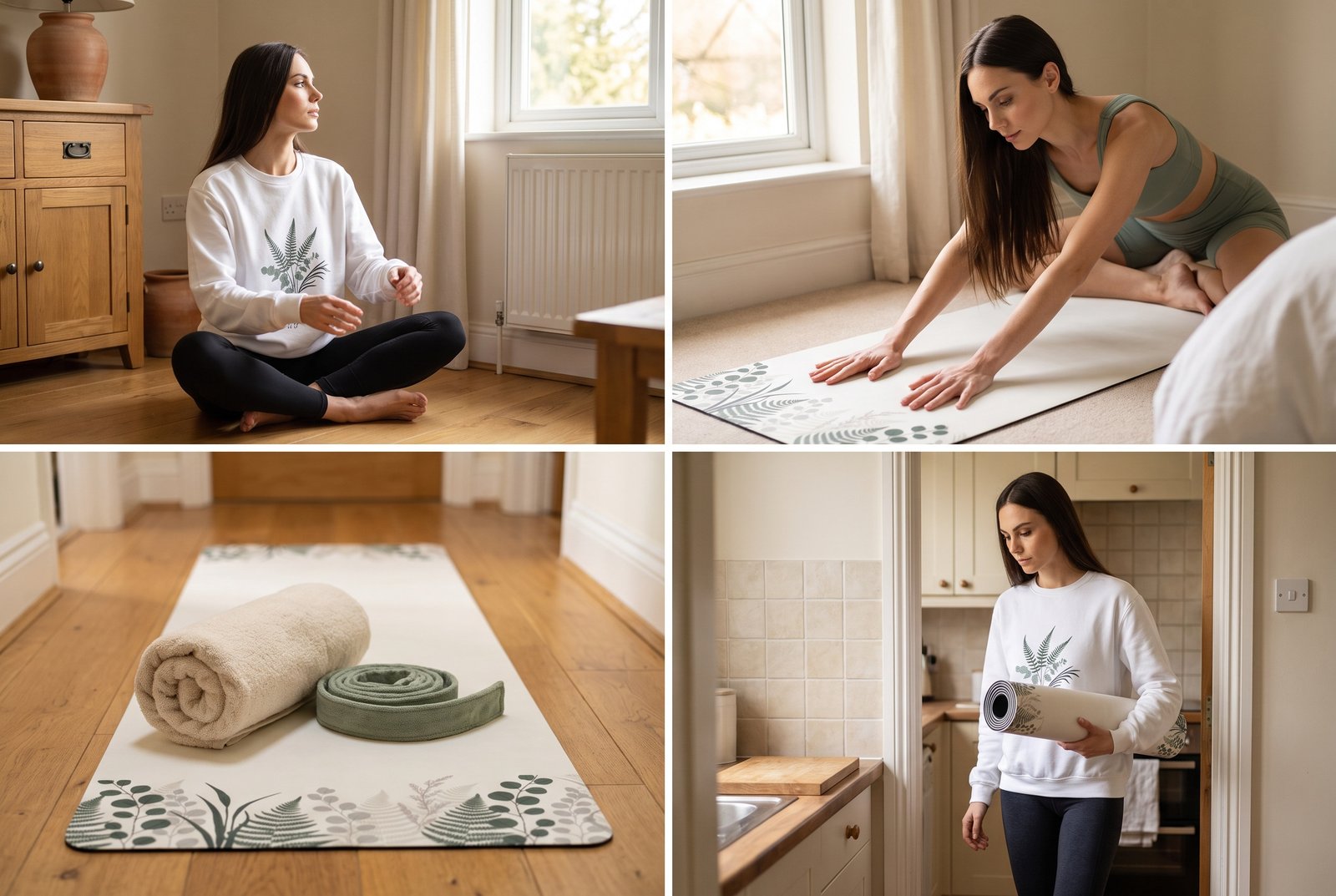
Position by position
Here’s the comparison that decides it. “Bent knee” means skipping the prop entirely and holding behind the thigh with both hands, knee softened, which is the correct answer more often than the strap-selling industry admits.
| Position | Purpose-made strap (183–244 cm, 38 mm cotton webbing) | Bath towel (approx. 70 × 140 cm) | Dressing-gown belt (approx. 150 × 5 cm) | Bent knee, no prop |
|---|---|---|---|---|
| Supine hamstring, one leg down | Works. Buckle lets you shorten it as the leg rises | Works. Fold lengthwise, hook the arch, grip wide | Works if cotton waffle; satin belts slide off the arch | Works, and keeps the pelvis more honest for many people |
| Seated forward fold | Works, long enough for tall legs and long arms | Usually works; tight if you are over about 185 cm | Marginal — too short once looped | Fine, hold the shins |
| Reclined bound angle (thighs looped) | Only real option — buckle holds the loop | No. Cannot fasten | Can be knotted, slips under load | Not applicable |
| Shoulder opener behind the back | Works. Width is narrow but grippy | Works well — the width is an advantage here | Works | Only if your shoulders already allow clasped hands |
| Quad stretch lying face down | Works, loop the ankle | Works, though the loop is bulky | Works | Hand to ankle, if you can reach |
| Carrying a rolled mat | 244 cm version works; 183 cm is tight | No | No | Not applicable |
| Cost | Retail price varies by brand and length | Nothing, you own it | Nothing, you own it | Nothing |
Read down the towel column. It fails on exactly one thing: anything requiring a fastened loop.
How do you use a yoga strap — the three-minute version
Lie on your back. Bend the right knee into your chest, hook the strap or folded towel around the arch of the foot, and hold one end in each hand. The arch, not the toes, or the ankle will cramp. Straighten the leg towards the ceiling only as far as the left leg stays flat on the floor. That last clause is the whole exercise: if the left knee lifts or the left hip rolls up, you’ve gone too far, and you’re now stretching your lower back instead.
Hold 30 to 60 seconds. Breathe out slowly rather than counting. Swap sides. If you want this inside a longer sequence, the hamstring routine for sitting all day puts it in order with the hip work that usually needs to come first.
Same technique with a towel, with one change: fold it lengthwise into a band about 10 cm wide rather than bunching it into a rope. The wide band spreads pressure across the foot instead of digging in, and the wide grip stops your hands from clenching, which is where most people’s shoulders go to die.
How do you use a yoga belt, and is a dressing-gown belt good enough
“Yoga belt” is the same object as a yoga strap. The terms get used interchangeably across catalogues, with “belt” more common in Indian and European listings, and nothing is different about the technique.
A dressing-gown belt is a genuine free option, with one catch: material. Waffle cotton belts grip; satin and polyester belts slide off the foot under load, which is precisely when you do not want it to happen. Check yours by looping it round your hand and pulling. If it creeps, use the towel.
Length is the second catch. A typical gown belt around 150 cm has to go round the foot and come back to two hands, so the usable reach is closer to 65 cm per side. Shorter arms and longer legs run out.
How do you use a yoga band — not the same tool
Worth saying clearly, because the search terms collide. A yoga band or resistance band stretches. A strap does not. If the thing in your hand gives when you pull, it is for strengthening, not for holding a stretch in place. Using an elastic band for a supine hamstring stretch means the length changes every time you breathe, which defeats the point of holding still.
Can you use a yoga strap to carry your mat?
Yes, with the longer one. A 5 mm mat rolls to roughly 12–14 cm across and 60–66 cm along the roll. To make two loops that slide over each end and leave a shoulder length between them, published mat-sling lengths cluster around 150–170 cm for the sling alone, and general-purpose straps at 244 cm do it comfortably. A 183 cm strap will do it but leaves very little slack, so the mat rides high under your armpit.
If carrying is the only reason you were considering a strap, buy a sling instead, or do what most people end up doing and tuck the mat under your arm. If you’re still choosing the mat itself, 3 mm, 5 mm and 6 mm roll to quite different diameters, which changes how much slack you need.
The one thing a towel cannot do
Repeatability.
Mark a strap with a pen or a stitch at the point your hand reaches in a given position, and in six weeks you’ll know whether anything changed. A towel comes out of the wash a slightly different shape every time, and you fold it differently each session. If you abandoned a routine before because you could not tell whether it was working, a fixed reference length is a better argument for the strap than comfort ever was.
Binding is the other. Reclined bound angle with the thighs looped, or a figure-four held at a set width, needs something that fastens and stays fastened. No towel does that.
When to see a physiotherapist instead
A strap changes your reach. It doesn’t diagnose anything. Pain that is sharp, that travels down the leg past the knee, that includes pins and needles or numbness, or that is worse in the morning and not better after twenty minutes of moving, is a reason to book a physiotherapist rather than buy a prop.
The same goes for any stretch that produces a reliable click with pain attached, or a hamstring that has felt “tight” for months without ever loosening. Persistent tightness is sometimes a nerve or a joint problem wearing a muscle costume, and more pulling makes it worse.
If you’re building a corner to work in rather than solving a specific restriction, the under-£200 home stretching corner puts the strap where it belongs in the queue, behind the mat and well behind a blanket.
If you stretch at home, alone, in the same five positions: fold a bath towel lengthwise to about 10 cm wide and use that. Spend the money on a better mat or a wool blanket instead.
If you want to know whether six weeks of work changed anything: buy the strap, mark it, and record the mark. That repeatable length is the only thing here a towel genuinely cannot give you.
If you need binds — reclined bound angle, looped thighs, fixed-width shoulder work: you need a fastening, so a 244 cm strap with a D-ring or cinch. The 183 cm length is fine until you try to carry a mat with it.
If the tightness has not shifted in months, or anything travels down the leg: stop adding props and see a physiotherapist. No strap length fixes a nerve.
How this comparison was made: we compared manufacturers’ own published specifications, not our own testing. Where we sell something ourselves we say so. Photographs are AI-generated illustrations featuring Elena, our AI guide.


