

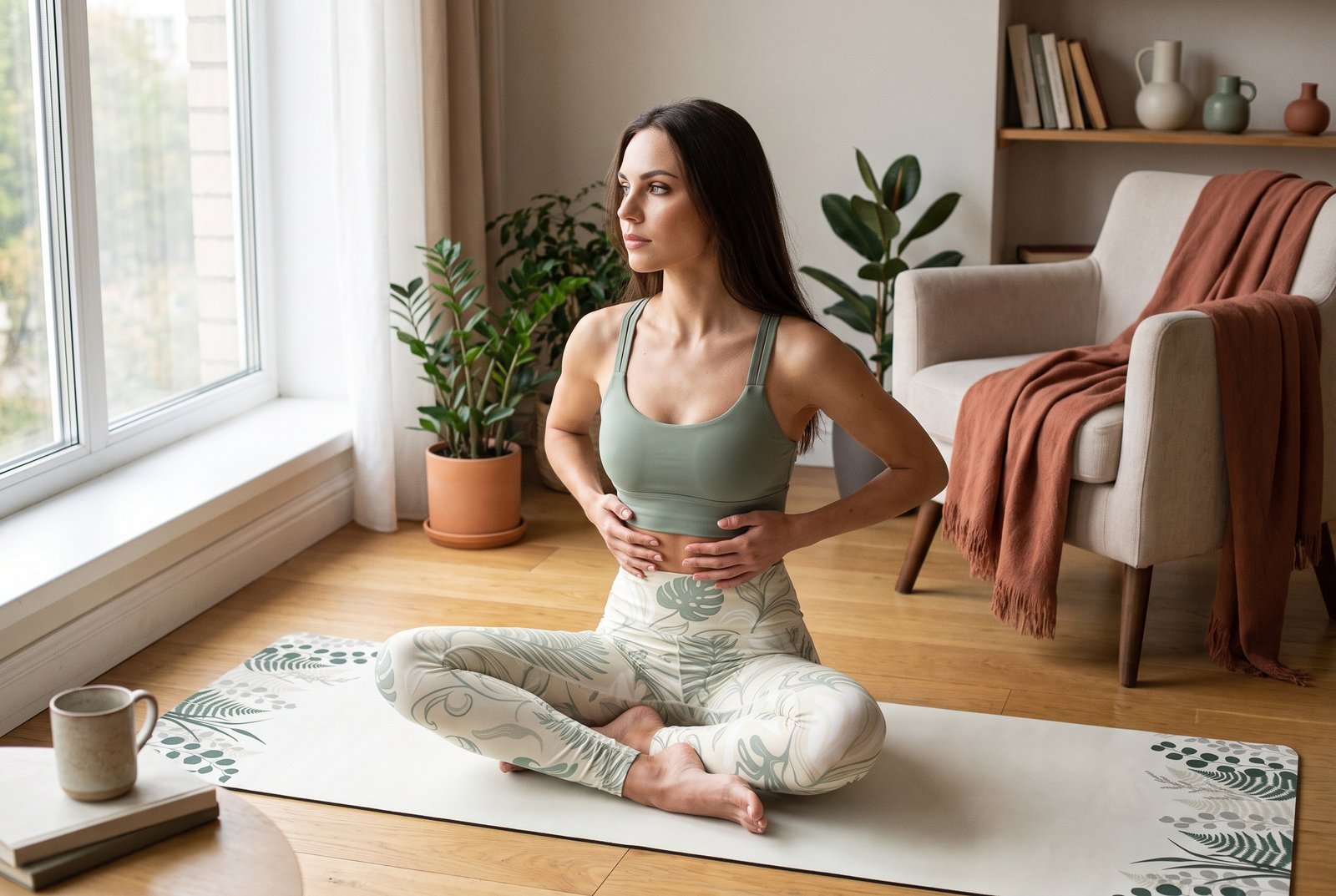
In or out as you fold forward. That’s the question almost everyone actually has, and the answer is short: out as you go deeper, in while you hold, and through your nose for both. Everything after this is detail.
The trouble is that the detail has been oversold. Somewhere between a studio cue and a podcast, breathing turned into a project — counts to track, apps to buy, a nasal strip, a four-seven-eight pattern someone half-remembers at 7am on a cold floor. Then the counting becomes the thing you’re doing, and the stretch becomes background noise.
Here’s a working version. Two patterns, one default, and a simple test for whether you’ve gone too far.
How should you breathe when stretching: the default
Slow nasal breathing. In through the nose, out through the nose, no counting unless you want it. If you need a number to hang it on, aim for roughly four seconds in and six seconds out, which lands you near six breaths a minute — slow enough to feel different, not so slow that you’re straining to reach the end of the exhale.
The nose matters more than the count. It filters and warms the air, it naturally slows the flow, and it makes it very hard to breathe fast without noticing. Mouth breathing in a static stretch tends to arrive with the shoulders, the jaw, and a slight sense of urgency.
Two things not to do. Don’t force the exhale down to empty — a hard squeeze at the end of the breath recruits the abdominal wall, which is the opposite of what you want in a fold. And don’t hold at the top of the inhale while you wait to be told to move. Static passive stretching doesn’t need breath-holds of any kind.
Two patterns worth knowing (and one you can skip)
Pick one of these and stop reading about breathing. Both work; they do different jobs.
| Pattern | Rough counts | Where it fits | Watch for |
|---|---|---|---|
| Even nasal breathing | 4 in / 4 out | Morning routines, pre-activity mobility, anything with movement in it | Drifting faster without noticing once the stretch gets uncomfortable |
| Extended exhale | 4 in / 6–8 out | Long holds of 60 seconds or more, evening sessions, restorative shapes | Squeezing the last two seconds out with the belly; let the exhale end on its own |
| Exhale on entry, then free | One long out-breath as you move in, then stop counting | Deep hip and hamstring work where counting becomes a distraction | Nothing much — this is the one most experienced stretchers end up using |
The one to skip is anything with a breath-hold built in. Box breathing and 4-7-8 are fine practices in a chair; inside a stretch, a deliberate hold removes exactly the feedback you need, which is whether your breath is still available. Save them for after.
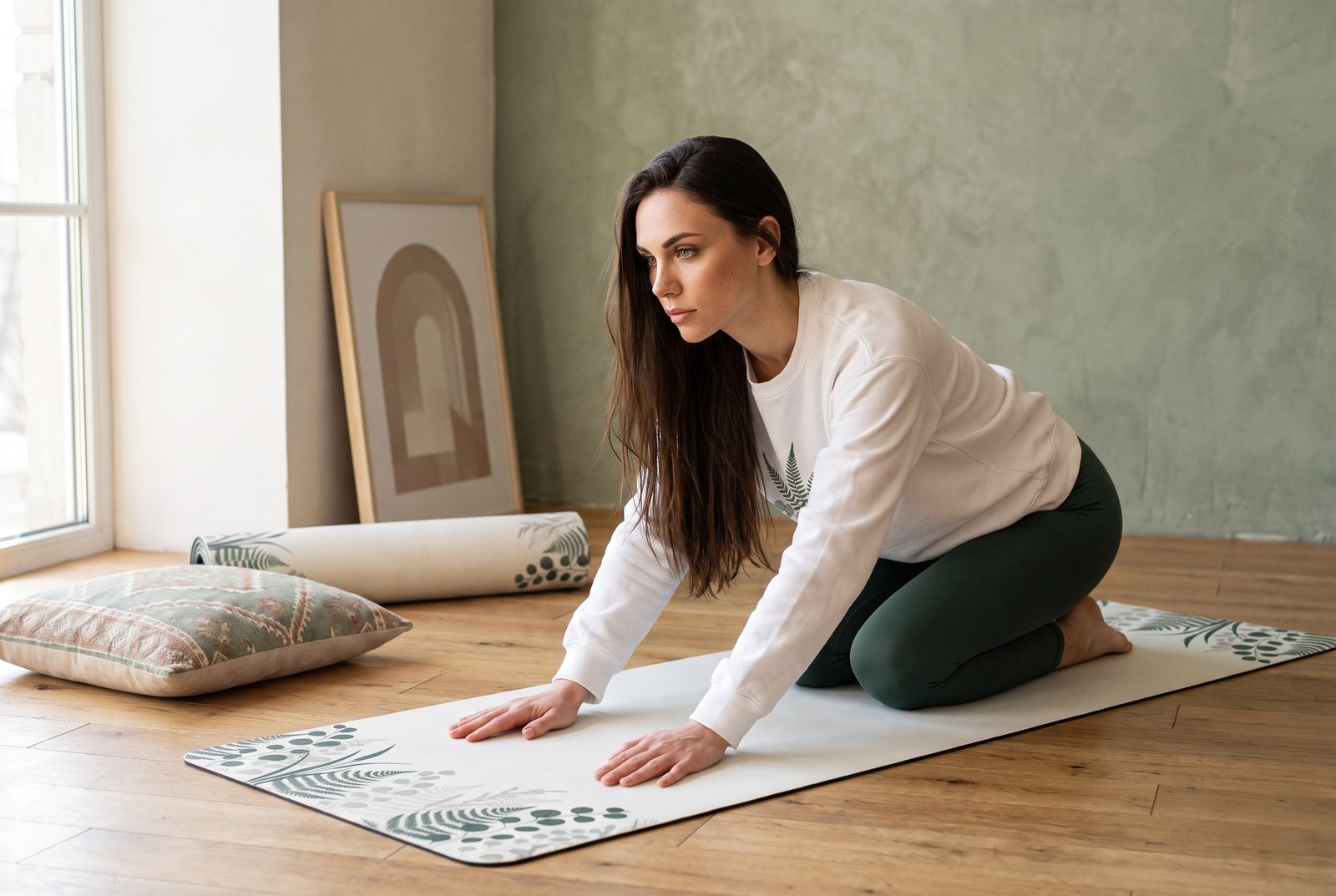
How to breathe properly when stretching: folds versus twists
This is where generic advice falls apart, because “breathe into your belly” is useless in a seated forward fold. Your belly is pressed against your thigh. There is nowhere for it to go.
In a fold (seated forward bend, standing hamstring stretch, child’s pose), direct the breath into the back and sides of the ribcage. Put a hand on your lower back ribs if you want proof the movement is there. The inhale makes the back of you wider, not the front of you taller.
This is the single most useful adjustment in the whole article, and it’s why folds feel claustrophobic to people breathing into their front.
In a twist, both front and side are partly closed on one side. Breathe into the open side, the ribs facing the ceiling. Then use the exhale, which naturally narrows the ribcage, to settle a few millimetres further into the rotation. Don’t chase the twist on the inhale; the inhale lengthens, the exhale rotates.
In a backbend or chest opener over a rolled blanket, the front ribs are already stretched open. Breathing there feels like pushing on a full balloon. Aim the breath low and back again, into the kidneys.
If you want a routine that puts this into practice in one place, the positions in our hamstring routine for people who sit all day are mostly folds, which makes them a clean place to practise back-of-ribs breathing.
What breath-holding tells you about how far you have gone
You didn’t decide to hold your breath. You arrived at a depth where holding felt necessary. That’s information.
A stretch that interrupts your breathing is a stretch your nervous system is treating as a problem to brace against. Bracing is the correct response to a heavy barbell. It’s a poor response to a hamstring you’re trying to convince to lengthen.
Three signals, in order of how early they appear:
- The exhale shortens first. You’re still breathing, but out-breaths have gone from six seconds to three. Back off perhaps ten per cent and they come back.
- The jaw and tongue clench. Tongue pressed to the roof of the mouth, teeth together. Classic brace.
- You hold at the top. Full inhale, suspended, waiting for it to be over. You’re past working range and into enduring.
The practical test: could you say a short sentence out loud right now without unwinding the stretch? If not, come out a little. Nothing useful is happening at a depth you can’t talk from.
Sharp, shooting, or electrical sensation is a different category altogether and is not a breathing problem. Stop, and see a physiotherapist if it keeps happening in the same place.
How to breathe while exercising in the gym — a different rule
Worth separating, because people carry gym cues into stretching and they don’t transfer. Under load, the usual instruction is exhale on the exertion — out as you press, lift, or stand up from the squat, and inhale on the return. On heavy lifts near a maximum, experienced lifters do brace and hold deliberately. That’s a coached skill with real blood pressure implications, and it’s a conversation for a strength coach or your doctor, not a stretching journal.
For cardio, the honest answer to “when to breathe while exercising” is that your body will set the rhythm and it will be faster than you’d like. Nasal breathing at easy conversational effort is reasonable; at hard effort, the mouth opens, and that’s normal.
How to breathe while exercising with COPD
Not our territory, and we’re not going to pretend otherwise. Pursed-lip breathing and paced-breathing patterns are commonly taught in pulmonary rehabilitation programmes, and the version that suits you depends on your lung function and your medication. Get this from a respiratory physiotherapist or your respiratory nurse, not from a yoga brand. The general-population advice above is written for people without a diagnosed respiratory condition.
There is nothing to buy here
No breathing device, app subscription, or nasal tape will do more for your stretching breath than sitting two inches higher. If your pelvis tips backwards in a seated fold, your lumbar spine rounds, your ribs compress, and the back-of-ribs breathing described above becomes mechanically unavailable.
Fix the geometry instead. A folded bath towel under the sitting bones is free and works. A dense wool blanket works better because it holds its height rather than flattening — we go through what to look for in choosing a blanket for restorative work, but a towel from your airing cupboard is a genuinely good first answer.
Mat thickness interacts with this too, mostly in kneeling and lying shapes rather than seated ones. Thicker isn’t automatically better, and the trade-offs are set out in our comparison of 3mm, 5mm and 6mm mats.
If you want one instruction and nothing else: breathe in and out through your nose, slowly, and let the exhale be the moment you go deeper. Stop counting after the first two breaths of any hold.
If folds feel like you can’t breathe: sit on a folded towel or blanket until your pelvis is upright, then send the inhale into your back ribs rather than your stomach. Two changes, both free.
If you keep catching yourself holding your breath: treat it as a depth gauge, not a discipline problem. Come out ten per cent, wait for three full exhales, and go back in only if the breath has returned.
If you have COPD, asthma, or any diagnosed breathing condition: use the patterns your respiratory physiotherapist gave you and ignore the counts in this article. They were written for a general reader.
Written with Elena, our AI stretch guide, and checked against our editorial and safety rules before publishing. General movement guidance, not medical advice. Photographs are AI-generated illustrations.


