

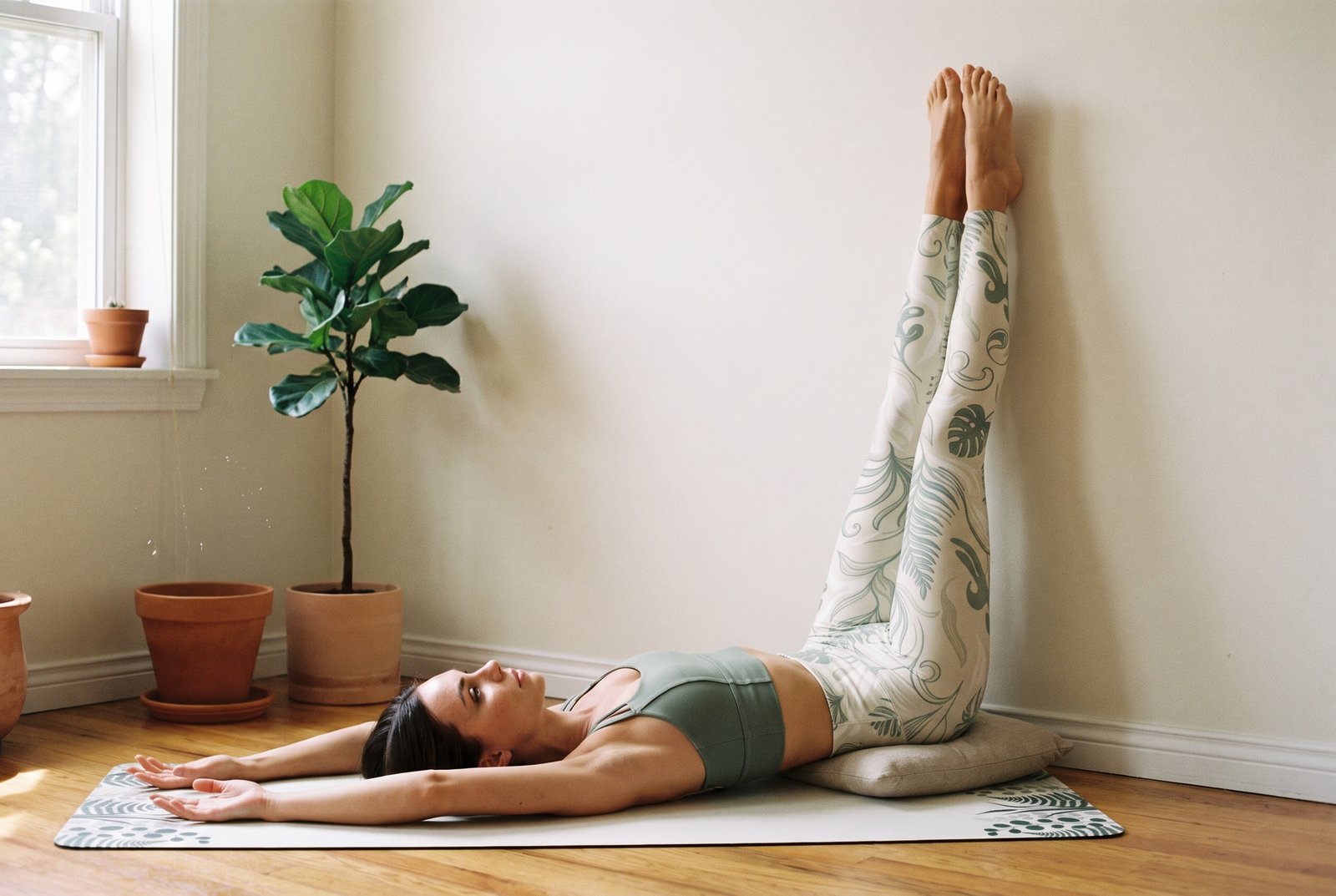
A wall is load-bearing. That’s the entire argument for using one.
Everything you do on the floor asks your body to produce the shape and hold it at the same time. A wall takes over the holding. It gives you a flat, immovable plane to press into, hang off, or rest your legs against, so the muscle you’re trying to lengthen stops bracing for balance and actually lengthens.
That’s the difference, and it isn’t a small one for anyone who sits at a desk and then tries to stretch at nine in the evening with the attention span of a tired person.
What are wall stretches?
Wall stretches are any stretch where a vertical surface provides support, alignment feedback, or leverage. They split into three jobs. The wall either holds your limb up, tells you where your spine actually is, or gives you something to push against.
Legs-up-the-wall holds your legs. A wall angel tells you that your ribs are flaring and your head is three inches forward of where you thought. A calf step gives your forefoot something fixed to press into so the heel can drop.
No equipment in that list. A skirting board and a metre of clear plaster covers it.
How to do a wall stretch if you have never done one
Start by standing with your back to the wall, heels about 10 cm away from the skirting, and leaning back until your hips, upper back and head touch. Most people find the head doesn’t reach without tipping the chin up. That’s information, not failure.
Then work from the simplest version of each move and add range later. The common beginner error is going straight to the deepest variation, feeling a sharp pull, and deciding stretching isn’t for them.
A stretch should feel like a broad pull at 5 or 6 out of 10, never a sharp point, never anything travelling down a limb. Hold 30 to 60 seconds. Breathe out slowly on the way in. If you’re counting breaths rather than seconds, roughly eight to twelve slow breaths lands in the same range.
Legs up the wall, and why it is the easiest thing on this list
Sit sideways with one hip touching the skirting, swing your legs up, and shuffle your seat until your hips sit somewhere between touching the wall and 20 cm away. Closer means more hamstring. Further away means more rest and less stretch.
Knees can stay softly bent. Straight legs aren’t the goal, and locking them out is how people turn a restful position into a ten-minute hamstring argument.
Five minutes is plenty. People do fifteen, and if you have the evening, fine, but the first two minutes do most of the work of letting the lower back settle onto the floor.
A folded towel or a cushion under the hips raises the pelvis slightly and most people find it more comfortable. You don’t need a bolster for this; a folded blanket from the airing cupboard sits at the same height and costs nothing. If you want to know what a proper fold looks like, the blanket guide covers depths and weights.
Wall angels, for the desk posture everyone complains about
This is the one people search for by name. What are wall angel stretches: you stand with your back against the wall, heels 10 to 15 cm out, arms bent at the elbow in a goalpost shape, backs of the hands against the plaster. Then you slide the arms up and down.
Most desk-bound shoulders won’t keep the hands flat the whole way. Let them lift. Keep the ribs down and the lower back in light contact rather than arching to fake the range.
Eight to ten slow slides is a set, and doing it twice a day beats doing forty once a week. It takes ninety seconds. Do it while the kettle boils.
Wall calf stretches and plantar fasciitis
Two versions, and they target different tissue.
Straight knee stretches the gastrocnemius: foot back, heel pressed down, front knee bent, hands on the wall. Bent back knee shifts the load to the soleus, lower down, nearer the Achilles. Do both, 30 seconds each side.
The third one is the toe-on-wall version that people with heel pain get given. Place the ball of the foot against the wall with the toes about 10 cm up it, heel on the floor, then lean the shin forward. That loads the plantar fascia along with the calf.
Morning heel pain that eases after a few minutes of walking is a pattern worth describing to a physiotherapist rather than managing alone for six months. Stretching may be part of the plan. It isn’t the whole plan, and nobody online can tell you what’s happening in your foot.
Wall stretches for legs, hamstrings and the lower back
The doorway hamstring hold is the best-value move here. Lie down with one leg up the door frame and the other extended through the open doorway along the floor. The frame holds the leg so you aren’t gripping your own thigh for ten minutes.
Shuffle closer to the frame for more stretch, further away for less. Three minutes a side isn’t excessive for stubborn hamstrings, and it pairs with the sitting-all-day hamstring routine if you want the floor-based versions too.
For the lower back, legs-up-the-wall with the knees bent and feet flat on the wall, like sitting in an invisible chair, is gentler than the straight-leg version.
On sciatica: pain, numbness or pins and needles travelling below the knee is a nerve symptom, not a tight muscle, and stretching into nerve pain tends to make it louder rather than quieter. See a physiotherapist or GP, particularly if there is weakness in the foot or any change in bladder or bowel function, which needs same-day attention.
Which wall move for which complaint
| Move | Mainly targets | Typical hold | Floor space | Watch for |
|---|---|---|---|---|
| Legs up the wall | Hamstrings, lower back decompression | 3–5 min | 1 m of wall, body length of floor | Locked knees, tingling feet |
| Wall angels | Upper back, shoulders | 8–10 slides, twice daily | 1 m standing | Arching the lower back to cheat range |
| Calf step, straight knee | Gastrocnemius | 30–45 s each side | Lunge length | Heel lifting off the floor |
| Calf step, bent knee | Soleus, Achilles region | 30–45 s each side | Lunge length | Rolling onto the inner edge of the foot |
| Toes on wall | Plantar fascia, calf | 30 s each side | Standing | Sharp heel pain, not a broad pull |
| Doorway hamstring | One hamstring at a time | 2–3 min each side | Open doorway | Lower back lifting off the floor |
| Wall chest opener | Pec major and minor | 30 s each side | Corner or door frame | Pinching at the front of the shoulder |
What stretches should you do daily
The honest answer is: the two or three that address what your day does to you, every day, rather than nine that you abandon by Thursday.
For a desk worker, a defensible daily minimum is wall angels, one calf variation, and either legs-up-the-wall in the evening or the doorway hamstring. That’s under eight minutes.
Morning works for some people and not others. Tissue is stiffer on waking, so keep the morning set shorter and gentler and save the long holds for the evening. The five-minute morning sequence is built on exactly that logic.
What you actually need
A metre of clear skirting board. Not a decorative metre — one you can press your heels against without a radiator, plug socket or stack of shoes in the way.
Hallways tend to work better than living rooms. Behind a door is often the only unfurnished wall in a flat.
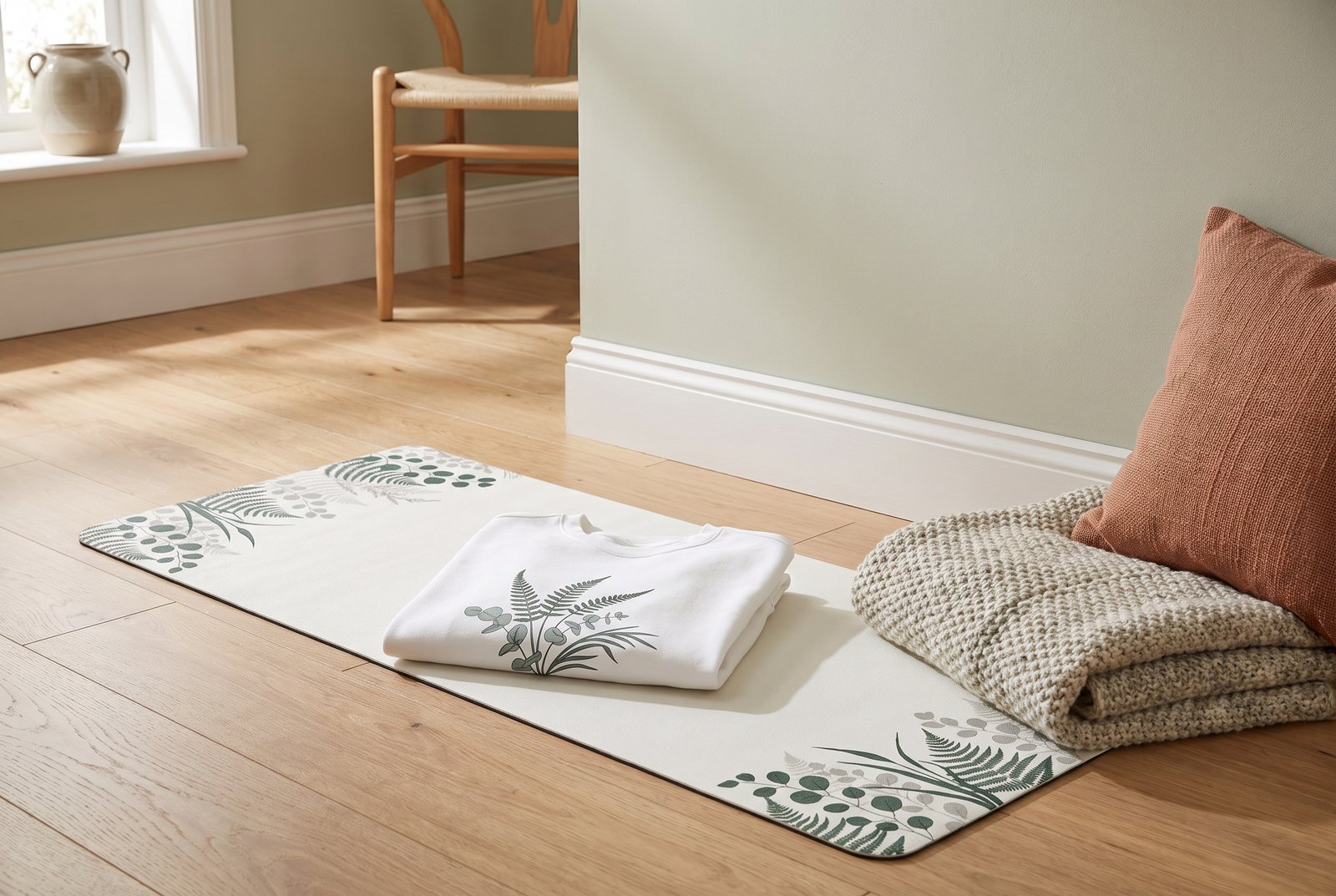
For the lying-down moves, something under your spine helps. A towel folded in four is adequate. A mat matters more for comfort than performance here, and published thickness specs are the thing to compare: 3 mm reads as firm underfoot for standing work, 5 to 6 mm reads as softer for lying down, which is the trade-off set out in the thickness comparison.
Wall straps, inversion gear and door anchors solve problems this list doesn’t have.
If you sit at a desk and have abandoned a routine before: pick wall angels and one calf stretch only. Ninety seconds, twice a day, attached to an existing habit like the kettle. Add more in three weeks if it stuck.
If your lower back is the complaint: legs-up-the-wall with knees bent and feet flat on the wall, five minutes in the evening, folded towel under the hips. Stop if anything travels down a leg.
If your heels hurt in the first steps of the morning: the toes-on-wall stretch is a reasonable thing to try, and a physiotherapist assessment is the better next step than another six months of guessing.
If you are shopping before you start: don’t. Clear the wall, use a folded blanket, stretch for a fortnight, then buy only what the fortnight proved you were missing.
Written with Elena, our AI stretch guide, and checked against our editorial and safety rules before publishing. General movement guidance, not medical advice. Photographs are AI-generated illustrations.


