


The notebook wasn’t the problem. Three entries: Monday, Tuesday, a Thursday with a question mark beside it. Then forty blank pages, and the ribbon marker still sitting on page four.
Discipline wasn’t the problem either. The entries recorded nothing useful. “Did stretches, 15 min, felt good” tells you nothing on the day you read it back, which is why nobody reads it back, which is why the logging stops.
A stretching journal only works if each entry answers a question you will actually have next week. Everything else is decoration.
Is stretching important enough to track at all?
This is the question underneath the question, and the honest answer is: important, not urgent. Commonly cited guidance from the American College of Sports Medicine puts flexibility work at two to three days a week, with holds of roughly 10 to 30 seconds and two to four repetitions per stretch. That’s a modest, unglamorous prescription.
Which is exactly why it gets dropped. Nothing dramatic happens if you skip a week. Nothing dramatic happens if you skip five.
The log isn’t there to make stretching more important. It’s there to make the gap between intention and behaviour visible before the gap becomes six months long. If you’ve abandoned a routine once, you know the slide is silent.
What is worth logging
Five fields. They fit on one line of a phone screen or one line of a notebook.
- The shape. Name it the same way every time. “Half-kneeling hip flexor, left” beats “hip stretch”, because in eight weeks you want to know whether the left side was always the stubborn one.
- The hold. Seconds, not vibes. A 20-second hold and a 60-second hold are different interventions, and most people who think they hold for a minute are holding for about 25 seconds.
- Time of day. One word: morning, lunch, evening. This is the field that most often explains why the habit died.
- How it felt. One number, 1 to 5, for tightness at the start. Not for enjoyment.
- What you skipped. The shape you decided not to do today. The pattern in the skips is more informative than the pattern in the completions.
Example entry, whole thing: Tue, evening, hamstrings seated 3 × 30s, right 4/5 left 2/5, skipped couch stretch again.
Twenty seconds to write. That’s the ceiling. If logging takes longer than a single stretch hold, the logging is the thing you’ll quit.
What is noise
Streaks past about three weeks. Once a streak is long, breaking it feels like total failure, and total failure is a reason to stop rather than restart. Count sessions per fortnight instead — a target of six out of fourteen days survives a bad week, and a streak does not.
Mood essays. Useful in a diary, useless in a training log, and they double the time cost of every entry.
Daily measurements. Fingertips-to-floor or a wall-sit shoulder flexion check is a reasonable rough marker, but range moves with time of day, temperature and sleep. Measure monthly, on the same day of the week, at the same hour, or you’re logging weather.
Perceived “progress” ratings. People rate themselves worse on days they tried harder. The hold lengths already tell the story.
Paper, notes app, spreadsheet or a printed journal
These are comparisons of published specifications and formats, not of anything we’ve tested.
| Format | Cost | Entry time | Main failure mode | Best for |
|---|---|---|---|---|
| Phone notes app | Free, already installed | ~15 seconds | You open the phone and leave through a different app | People who stretch away from home, or at a desk |
| Paper notebook (A6 or pocket) | A few pounds | ~20 seconds | Lives in the wrong room | Anyone whose phone is a distraction machine |
| Spreadsheet | Free | ~40 seconds | Over-engineered in week one, abandoned in week three | People who genuinely enjoy charts |
| Printed habit journal | Retail price, varies by edition | Prompt-led, often 1–2 minutes | Fixed programme length ends and nothing replaces it | Those who want the decisions made for them |
| Wall calendar and a pen | Near nothing | 3 seconds | Records that you did something, not what | Pure adherence problems |
Here’s the uncomfortable recommendation, given that we sell made-to-order goods: for most people the free notes app is the correct tool. It’s in your pocket, it searches, and “hamstring” typed into the search bar pulls up every entry you’ve ever made. No paper system does that.
Why paper still wins for some people
Paper has one property the phone can’t match. You cannot scroll past a notebook.
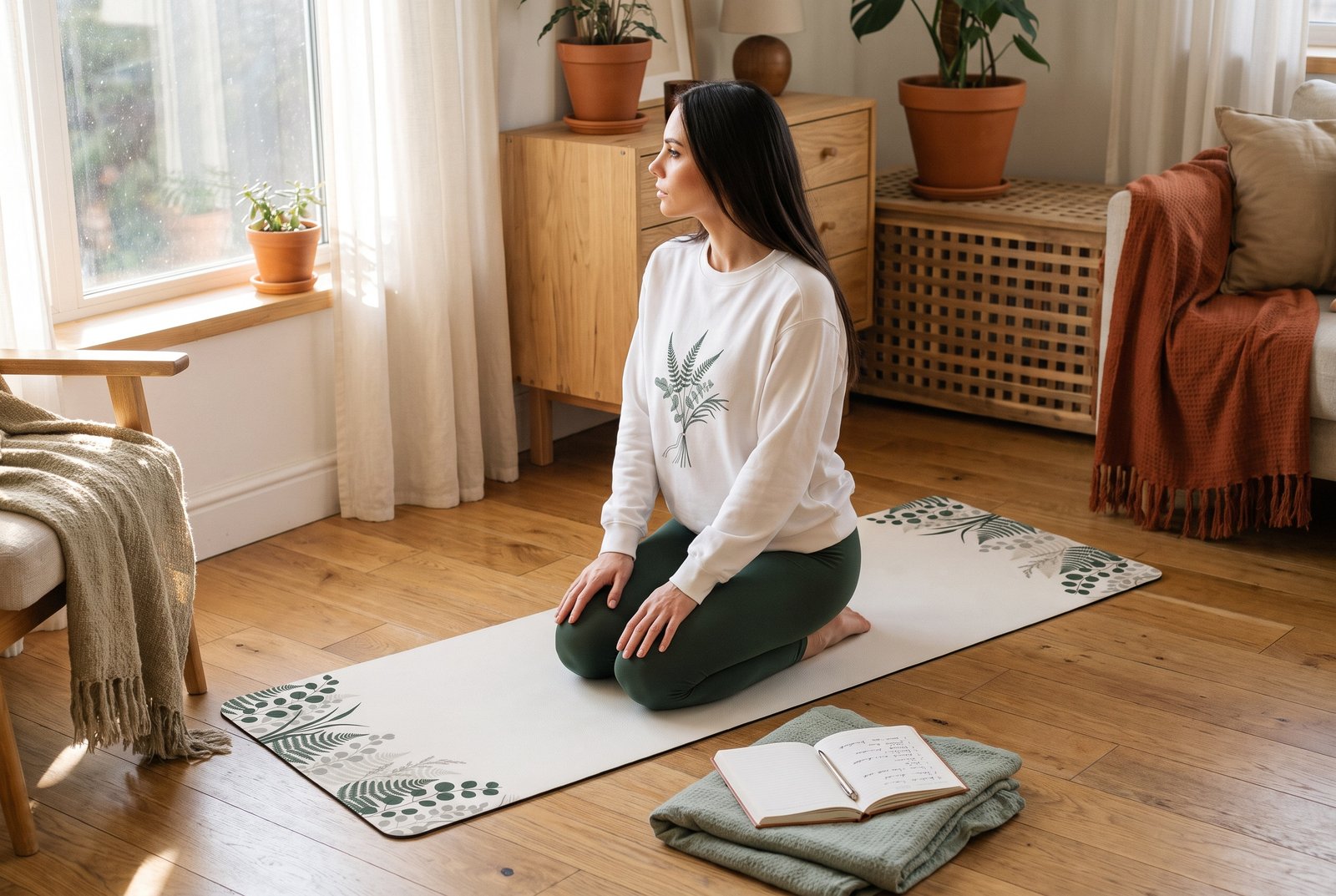
Open the notes app to log a hip flexor hold and there are eleven other things on that screen, three of them with badges. Open a pocket notebook on the floor beside the mat and there’s one thing: last week’s handwriting.
If your routine lives in a corner of a room, with the mat out, a strap nearby and a blanket folded, the notebook belongs in that corner rather than in a bag. A fixed physical home for the log does the same work as a fixed physical home for the mat, which is the argument behind a permanent stretching corner rather than a mat that gets rolled away.
The published stretching journals: Habit Nest, Stretching Sidekick, Anna McNulty
These come up constantly in searches, so here’s what the formats are, based on how the publishers describe them rather than any use on our part.
Habit Nest stretching journal. Habit Nest’s format across its range is a fixed-length daily programme with pre-written pages, prompts and a defined start and finish. The appeal is that it decides for you. The limitation is structural: when the programme’s day count runs out, you need a plan for what follows, and that’s the point at which most people stop.
Stretching Sidekick journal. Sold as a guided flexibility log with routines bundled in. Check the current listing for what the edition actually contains, since contents differ between printings.
Anna McNulty stretching journal. McNulty is a contortionist whose flexibility programmes circulate widely online; material sold under her name is aimed at splits and backbend goals, not desk-worker maintenance. If your aim is undoing eight hours in a chair, a general hamstring routine for sitting all day is a closer match to the problem.
A plain stretching exercise journal, a ruled notebook with the five fields above, does the same job as any of them for the price of a coffee. Where the published journals earn their keep is in removing the choice of what to do each day, which is a real obstacle for some people and no obstacle at all for others.
Logging PNF work specifically
PNF is contract-relax stretching, where you push against resistance for a few seconds before easing deeper. It needs two extra fields, because it has two extra variables. Log the contraction length in seconds and the number of contract-relax rounds, and note whether you used a strap, a wall or a partner.
Without those, a “PNF stretching journal” entry is unreadable. Three rounds of six-second contractions against a strap is a different session from one round of a twenty-second push against a partner, and the second is considerably harder to judge on your own.
PNF is also the technique most often taught in person, for a reason: the end-range contraction is where people push past what they can control.
When the log should send you elsewhere
A journal isn’t a diagnostic tool, but it does produce dates, and dates make a clinical conversation faster.
Book a physiotherapist if you’re logging sharp or localised pain rather than stretch sensation, if discomfort lingers for hours after a session, if there’s numbness or pins and needles down a limb, or if one side has stayed markedly behind the other for more than six or eight weeks of consistent work. Turning up with “left hamstring, 2/5 since early March, four sessions a week” is worth more than “it’s been tight for ages”.
And if the entries show you stretching at 10pm and hating it, the fix is the schedule, not the willpower. Shifting to a five-minute morning sequence changes the variable the log has been pointing at all along.
If you have abandoned a journal before: use your phone’s notes app, one line per session, five fields, twenty seconds. Don’t buy a notebook to solve a problem that was never about the notebook.
If your phone is where routines go to die: put a pocket notebook and a pen permanently where you stretch, not in a bag. Ruled paper, no printed template, no streak boxes.
If deciding what to do each day is the blocker: a published guided journal such as Habit Nest’s buys you a fixed programme, but plan what happens on the day after the last page, or the habit ends with the book.
If you are logging PNF or chasing splits: record contraction seconds and rounds as well, and get at least one in-person session before working deep into end range on your own.
Written with Elena, our AI stretch guide, and checked against our editorial and safety rules before publishing. General movement guidance, not medical advice. Photographs are AI-generated illustrations.


