

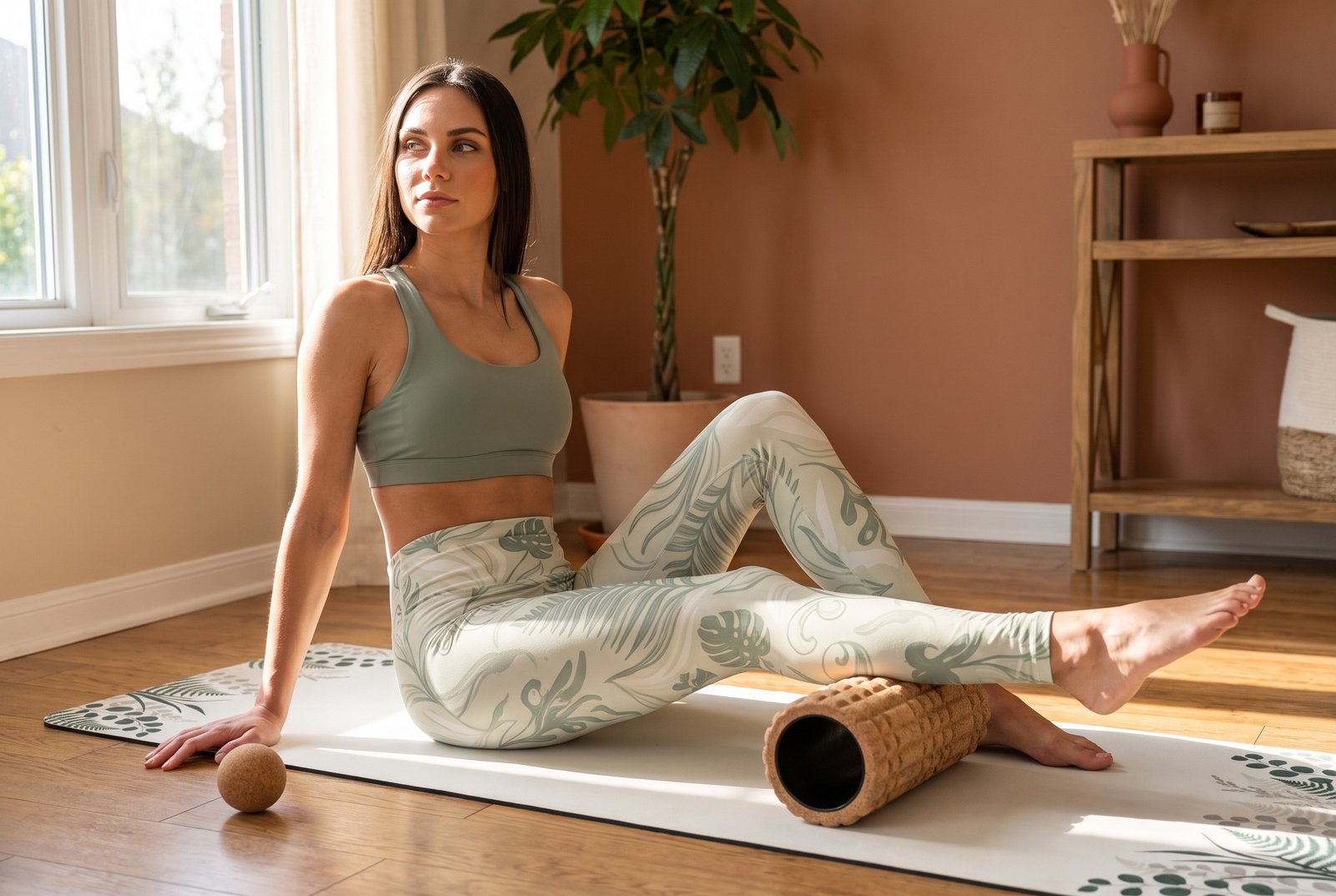
Contact area is the whole argument. A 45cm foam roller spreads your body weight along a strip about the length of your forearm. A 6.5cm ball puts that same weight through a patch the size of a coin.
Everything after that is detail stacked on top of one fact: EVA or EPP foam, smooth or ridged, cork or rubber. A roller covers ground, a ball finds a spot, and neither one does the other’s job well.
Which is why the roller that’s lived under your sofa since January never touched the ache under your shoulder blade, and why ten minutes of standing on a hard ball can leave you limping to the kitchen.
Foam roller vs massage ball, by published specification
None of these have been tested here. What follows is a comparison of manufacturers’ published dimensions and materials, plus the sport governing-body specs for the two balls most people already own.
| Option | Typical published size | Material | Reaches well | Awkward for |
|---|---|---|---|---|
| Standard foam roller | 45cm long, 15cm diameter | Moulded EVA or EPP foam, solid | Quads, calves, IT band area, lats, upper back | Feet, deep glute, around the shoulder blade |
| Short / travel roller | 30–33cm long, 13–14cm diameter | EVA foam, often hollow ABS core | Same areas, one limb at a time; fits a carry-on | Lying along the spine lengthwise |
| Long roller | 90cm long, 15cm diameter | EPE or EPP foam | Both calves at once, thoracic spine lengthwise, supported chest opener | Storage. It does not hide |
| Grid / textured roller | 33cm long, 14cm diameter | EVA over hollow rigid tube | Firmer, more localised pressure than smooth foam | Anyone new to rolling; the ridges concentrate load |
| Tennis ball | 6.54–6.86cm diameter, 56–59.4g (ITF spec) | Hollow pressurised rubber, felt cover | Soles of the feet, glutes, around the shoulder blade | Deep pressure — it compresses and gives |
| Lacrosse ball | ~6.3–6.5cm diameter, 142–149g | Solid vulcanised rubber | The same places, with far less give | Beginners, bony areas, late evenings |
| Cork massage ball | 6–8cm diameter, commonly sold | Compressed cork | Feet and glutes; grips a wooden floor | Rolling on carpet, where it sinks |
| Peanut / twin ball | ~16cm long, two lobes of 6–7cm | EVA or rubber | Either side of the spine without pressing the bone | Single-point work; it straddles |
Is foam rolling like a massage?
Not really, and the comparison sets you up for disappointment. A massage therapist varies pressure, angle and speed, works across the fibre as well as along it, and adjusts when you flinch. A roller offers one pressure — your body weight, divided by however much of you is on the floor.
What a roller does give you is repeatability at zero marginal cost. Two minutes per calf, four evenings a week, no booking, no travel. That’s a different product category from a massage, not a cheap copy of one.
Rolling is self-applied pressure you control. Treat it as part of a stretching habit rather than as treatment, and it stops failing at something it was never going to do.
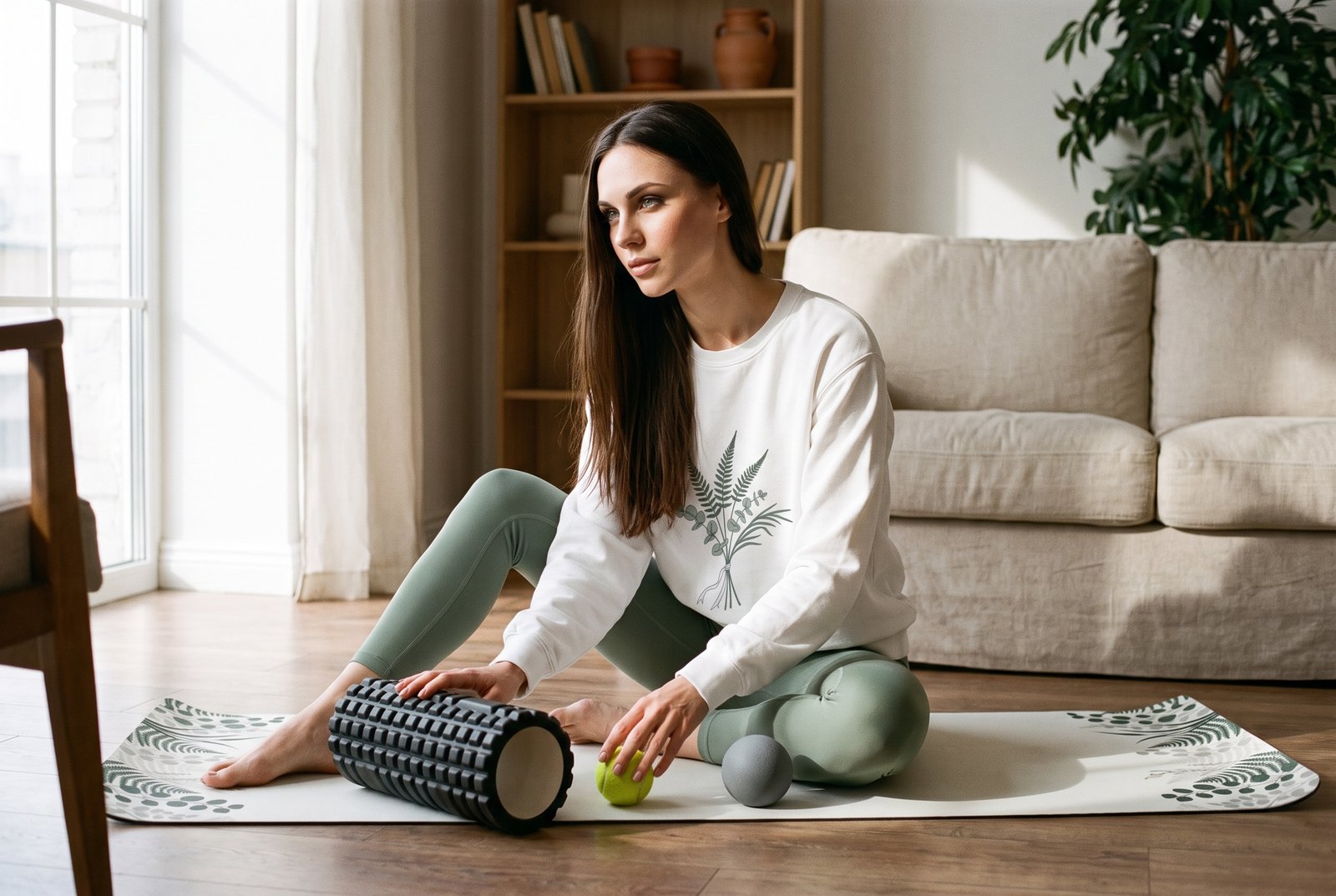
Why does foam rolling feel so effective?
Partly because the sensation is unmistakable. Press a stiff quad against 15cm of dense foam and the feedback is instant, unlike a hamstring stretch where you hold for 40 seconds and wonder whether anything is happening.
The explanations have shifted over the years. The old “flushing out lactic acid” story has largely been dropped in favour of nervous-system accounts: a short-term change in how much stretch you tolerate, rather than anything being physically reshaped. What is not in dispute is that the effect is temporary.
So use it as a door-opener. Roll the calves and quads for three or four minutes, then do the actual range-of-motion work while the tolerance is there. Rolling and then sitting back down wastes the window — a hamstring routine built for desk days is a better use of the ten minutes after.
Do massage roller balls work?
For the places a 15cm cylinder can’t physically reach, yes. The list is short but specific: the sole of the foot, the deep glute behind the hip, the strip between spine and shoulder blade, and the upper trapezius against a wall.
Here’s the part a shop isn’t supposed to say. Compare the published specs of a branded 6cm rubber massage ball against a lacrosse ball at 6.3–6.5cm and 142g of solid rubber, and the functional difference is close to nothing. A tennis ball does most of what a branded massage ball does, and a lacrosse ball does the rest.
Where branded balls earn their keep is grip and shape. Cork holds position on a hardwood floor better than felt, and a peanut-shaped ball straddles the spine so you’re not pressing on vertebrae. Those are real design differences. A smooth rubber sphere at 6cm isn’t.
How to use a massage roller ball
- Start standing or sitting, not lying. Standing on a ball under the arch lets you lift the foot off the moment it’s too much. Lying on one puts your full torso weight through it with no escape.
- Find the sore area, then stay. Roll the ball slowly across 3–5cm, or hold still for 20–30 seconds and breathe out slowly.
- Keep it under soft tissue. Arch of the foot, glute, the muscle beside the shoulder blade — not on bone, not on the spine, not on the side of the knee.
- Two to three minutes per area. A ball concentrates load; 15 minutes of it is how people end up bruised.
- Wall first for the upper back. Ball between you and the wall, feet a step out, lean in. You control the pressure with your legs.
If you want a soft version, a tennis ball wrapped in a folded towel takes a lot of the edge off, and if you’ve got a thick wool blanket for restorative work, two folds of it under the ball does the same job.
Foam roller or massage ball: what to buy first
The roller. It covers quads, calves, lats and thoracic spine, which is the bulk of what sitting all day stiffens, and you almost certainly don’t own anything 45cm long and cylindrical. You very likely do own a ball.
Buy a 45cm × 15cm roller in moulded EVA or EPP at medium density, smooth surface. The 90cm version is better if you’ve got the storage and want both calves at once. Skip aggressively ridged rollers until smooth foam feels like nothing — the ridges concentrate the same body weight into a smaller area, which is the ball’s job anyway.
Then add a ball only when you notice a spot the roller can’t reach. That’s a real purchase decision, not a precaution. If you’re planning the whole corner at once, the under-£200 stretching corner breakdown puts the roller in context with the mat and the rest.
Is a foam roller and massage ball set worth it?
Sometimes. A set that bundles a 33cm roller, a 6cm ball and a peanut is usually cheaper than the three bought separately, and the peanut is the one piece you can’t improvise from a sports cupboard.
But check the roller specification in the bundle before anything else. Sets often pair a decent ball with a short, low-density roller that squashes flat under a heavier user. If the roller is 30cm and soft, you’ve bought accessories with a token cylinder attached.
The advice that keeps resurfacing in forum threads on this question is some version of: buy the roller, use the ball you already have. That is the right answer for most people, and it costs the price of one item.
When to stop and see a physiotherapist
Rolling is for muscle that feels tight and tired. It isn’t for pain you can’t explain. Stop and book an assessment if you have numbness, tingling, pins and needles, pain that shoots down a limb, sharp pain at a joint, swelling, or anything that has been getting worse over weeks rather than better.
Also worth a conversation if you’re pregnant, taking blood thinners, or have a skin or circulatory condition in the area. A roller cannot diagnose anything, and neither can an article.
And if the barrier isn’t equipment but starting at all, the thing most people abandon twice, a five-minute morning routine with no kit beats a roller you keep meaning to use.
If you own nothing yet: one 45cm × 15cm medium-density foam roller, smooth surface. It handles quads, calves, lats and upper back, which is most of what desk sitting tightens, and nothing in your house substitutes for it.
If you already have a roller and a specific stubborn spot: try a tennis ball for a fortnight before buying a massage ball. If the tennis ball keeps compressing under you, step up to a solid 6.3cm ball — and choose cork if your floor is wood.
If your foot or glute is the main complaint: the ball genuinely outperforms the roller there, so buy it first. Two to three minutes per side, standing or seated so you can lift off.
If the pain is sharp, spreading, numb or worsening: put both down and see a physiotherapist. Pressure applied to the wrong thing delays the answer.
How this comparison was made: we compared manufacturers’ own published specifications, not our own testing. Where we sell something ourselves we say so. Photographs are AI-generated illustrations featuring Elena, our AI guide.


