

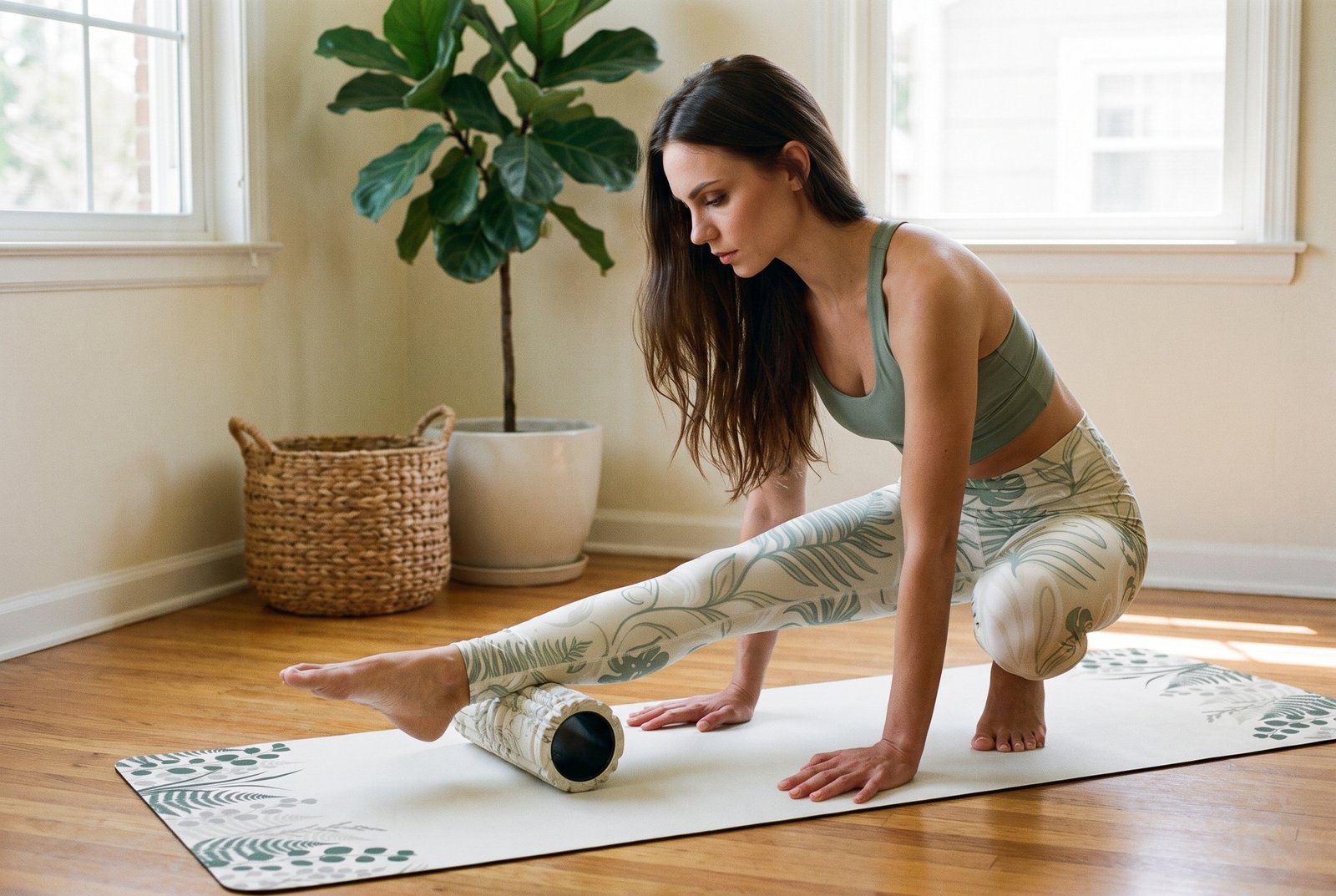
Short answer first: neither is better, because they’re not competing for the same job. Holding a position for 45 seconds and rolling pressure along a muscle for 45 seconds feel similar from the outside and do different things to how your body responds.
The question gets asked constantly: is foam rolling or stretching better, is foam rolling the same as stretching, usually by someone standing in a shop holding a roller, trying to decide whether it’s the missing piece. It’s almost never the missing piece.
What follows separates the two habits properly, puts them in an order that makes sense inside ten minutes, and then says the awkward part out loud: you can build a complete, useful routine with neither a roller nor a single long hold.
Is foam rolling the same as stretching?
No, and the difference is mechanical. Stretching puts a muscle and its connective tissue under lengthening tension and keeps it there — a hamstring at end range, a hip flexor in a half-kneel, held while you breathe.
Foam rolling applies compression across the muscle belly while you move over it. The tissue is squashed, not lengthened. You can roll a quad while the knee is bent and the muscle is shortened, which is the opposite of what a stretch asks for.
The two also differ in what they ask of you. A static hold needs stillness and 30 to 60 seconds of patience per side. Rolling needs about the same time per area, but asks you to move slowly and find spots that feel sharp.
Calling them interchangeable is the main source of confusion — one changes your tolerance to length, the other changes your tolerance to pressure.
Why does foam rolling feel so good?
Because pressure on a sensitive muscle produces a strong, locatable sensation that then recedes. That recession is the pleasant part — the “it hurts, then it stops hurting” curve.
The old explanation, that you’re breaking up adhesions or melting fascia, is widely disputed now. A 10 cm roller held under bodyweight isn’t plausibly restructuring connective tissue in 45 seconds. The more common current explanation is a nervous-system one: the area becomes temporarily less sensitive and feels looser, and you move more freely for a while because of that.
Which is not nothing. Feeling less guarded before a session is genuinely useful. It’s just a short-lived change, closer to washing your face than to training.
Treat the good feeling as information about sensitivity, not proof that tissue has changed.

Should you stretch before foam rolling, or after?
Roll first, then stretch, then move. That’s the ordering most coaching sources settle on, and the logic is easy to follow.
Rolling reduces the immediate protective tension in an area. Stretching then works in whatever range you have. Then you load that range with something active: a squat, a lunge, a slow sit-to-stand, so the new range gets used rather than just visited.
If you only want a rule to remember: rolling is a doorway, stretching is the room, and movement is what makes you stay there.
One real exception. If long static holds before a hard effort leave your legs feeling vague and unstable, drop them pre-session entirely. Roll for two minutes, do dynamic work, and save the long holds for afterwards or for a separate slot in the evening.
When to stretch vs foam roll, by situation
| Situation | Better choice | Why, and for how long |
|---|---|---|
| Desk stiffness at 3pm | Stretching, standing | Two or three positions, 30–45 seconds each. No kit, no floor, no changing clothes. |
| Before a run or a strength session | Rolling then dynamic work | 30–45 seconds per area, three areas maximum, then move. Keep long holds short or skip them. |
| Day after heavy legs | Either, gently | Gentle rolling for pressure tolerance, easy range of motion rather than end range. Walking also qualifies. |
| Chasing a specific range, like a deeper fold | Stretching, repeatedly | Long holds several times a week over weeks. Rolling will not accumulate the same way. |
| Travelling with 20 litres of luggage | Stretching | A 90 cm roller does not pack. A floor and a wall are available everywhere. |
| One hot, specific sore spot | A 6.5 cm ball | More precise than a roller for glute, foot and upper-back spots, and costs a fraction of one. |
What the stretching vs foam rolling arguments usually miss
Search stretching vs foam rolling reddit and the threads split into two camps that are both partly right and arguing past each other. One camp says rolling does nothing measurable, so skip it. The other says rolling is the only thing that makes their hips feel human. Both are describing the same honest finding: the effect is real, short, and mostly about sensation.
The thing the arguments skip is consistency. Someone who rolls for ten minutes four times a week and someone who stretches for ten minutes four times a week will both be in better shape than the person comparing methods in a browser tab. The method you will actually repeat beats the method that wins the comparison.
If your sticking point has been repeating anything at all, the fix is scheduling, not equipment. A five-minute morning sequence that you do most days outperforms a 30-minute protocol you do twice.
A ten-minute session, in order
- 0:00–2:00 — Roll, if you have a roller. Two areas only. Calves and quads, or glutes and upper back. 45–60 seconds each, moving slowly, pausing where it bites. Skip this block entirely if you have no roller; the session still works.
- 2:00–6:00 — Hold. Three positions, 40 seconds per side. Half-kneeling hip flexor, seated or standing hamstring, and one for whatever your week has been: chest doorway stretch after a laptop week, calves after running.
- 6:00–9:00 — Move through the range. Slow bodyweight squats, controlled leg swings, a few sit-to-stands without hands. This is the part people cut, and it’s the part that makes the holds stick.
- 9:00–10:00 — Breathe on the floor. Knees bent, feet flat, slow exhales. Unglamorous and worth the minute.
Note the ratio. Rolling gets 20 per cent of the session at most, and it’s the only block that requires buying something.
What to buy, and what not to
If you decide you want a roller, the published specifications that actually differ are length, diameter and material. Common lengths are 33 cm, 45 cm and 90 cm. Standard diameter is around 10 cm, with 15 cm versions offering a gentler contact. Materials range from soft EVA foam to moulded EPP to hollow-core PVC with a firmer outer layer, and the firmer builds are described by their makers as more aggressive.
We haven’t tested rollers and won’t pretend otherwise. The 90 cm length is the one worth noting: it lets you lie along your spine with both shoulder blades supported, which the short ones can’t do.
If you own a tennis ball and a wall, you already have 80 per cent of what a roller gives you for upper-back and glute work. Spend on the mat instead — thickness matters more for the floor time you’ll actually spend, and 3mm, 5mm and 6mm feel genuinely different under a knee.
If stiffness is concentrated in one leg, wakes you at night, comes with numbness or tingling, or hasn’t shifted in six weeks of consistent work, that’s a physiotherapist’s question rather than a roller’s. Pressure and holds are not diagnostics.
For the most common desk complaint, the back of the legs after eight seated hours, the specific sequence matters more than the tool, and a hamstring routine built for sitting is a more direct answer than anything you roll.
If you own nothing and want to start this week: skip the roller. Do the four-block ten-minute session with the rolling block removed, four days this week, and judge from there.
If you already own a roller and never use it: give it two minutes at the front of a session, two areas, then put it away and hold three positions. Rolling as a 20-minute ritual is where the habit usually dies.
If you’re chasing a specific range — a flatter fold, a deeper squat: long holds, several times a week, over weeks. Rolling feels better faster and accumulates less.
If the stiffness is one-sided, numb, or unchanged after six weeks: book a physiotherapist rather than buying firmer foam.
How this comparison was made: we compared manufacturers’ own published specifications, not our own testing. Where we sell something ourselves we say so. Photographs are AI-generated illustrations featuring Elena, our AI guide.


