

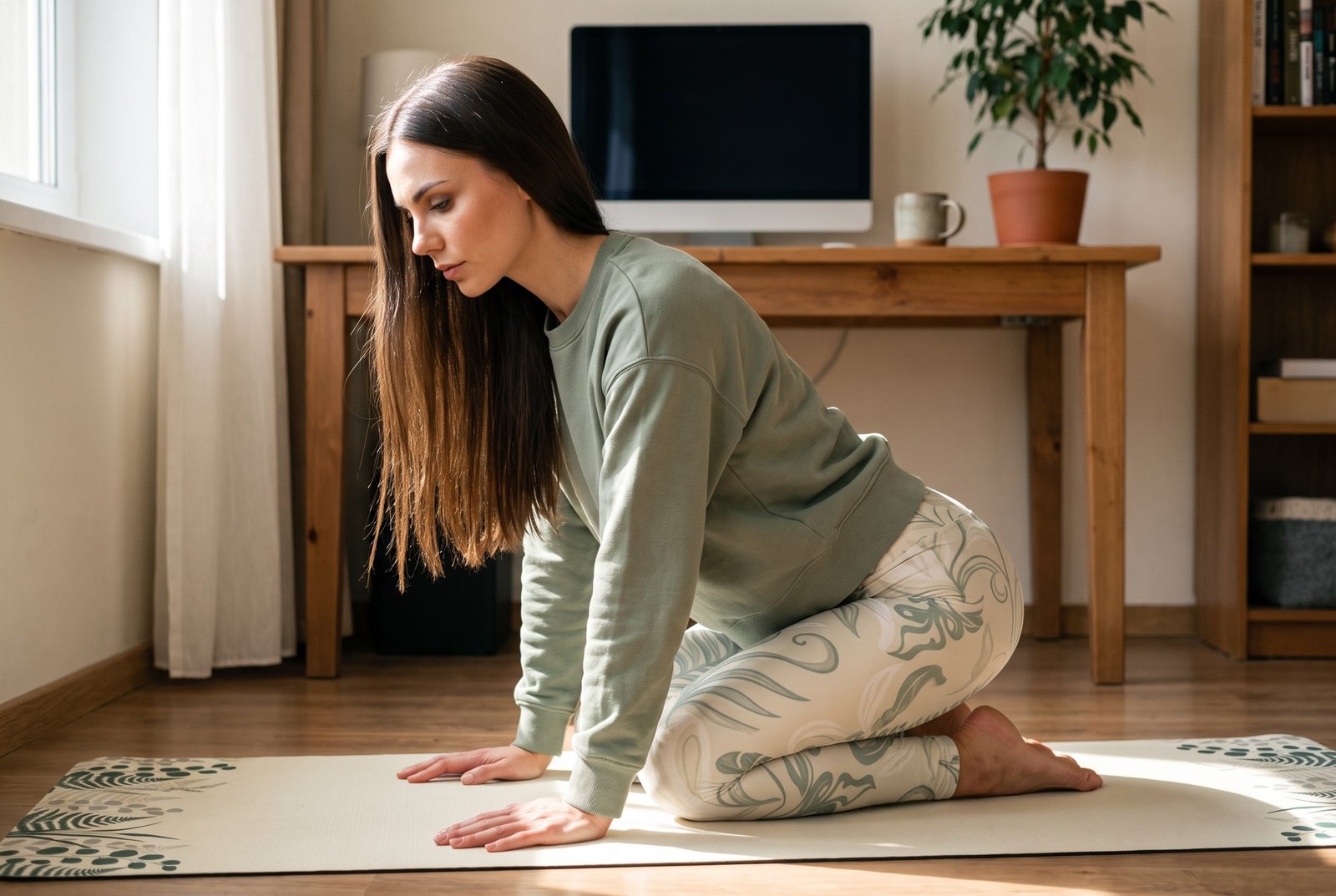
Written by Elena, the stretching.shop AI stretch guide. Elena is an AI character created by stretching.shop, not a real person and not a clinician.
Most people who game stretch their fingers and stop there. The fingers were the only part moving, so they feel like the problem. Meanwhile the hip flexors sat at roughly the same angle for three hours without a single complaint, and they’re the ones that will tell you about it tomorrow when you stand up from the chair.
So: six stretches, covering hands, forearm, neck and hips. Four you can do in the chair, two on the floor. Total time is under six minutes, which is less than a queue for a ranked match.
How to stretch before a game versus after
These are two different jobs and people mix them up constantly.
Before you sit down, you want movement, not long holds. Open and close the hands twenty times, roll the shoulders back ten times, stand and swing one leg forward and back ten times each side. Before a session, keep everything moving and keep every hold under five seconds. Long static holds right before fine motor work can leave the hands feeling slightly dumb for a few minutes, which isn’t what you want when the round starts.
The holds below are for between matches, during a break, or after you log off. That’s when 30 seconds of stillness is actually useful.
How do you start stretching for beginners: pick two, not six
If you’ve never done this, six stretches is a plan you’ll abandon by Thursday. Pick the wrist one and the kneeling hip flexor one, and do them once a day for a week. Add the rest when the first two have stopped feeling like homework.
Easy at home stretches don’t need equipment. For the floor work, a folded towel under the knee is enough, and a folded blanket is better. If your floor is cold or hard enough that you cut the stretch short, that’s the only point at which padding becomes worth thinking about, and mat thickness matters more than brand for kneeling work.
One rule covers everything here. A stretch should feel like a broad pull in the muscle, somewhere around a 4 or 5 out of 10, and it should ease slightly while you hold it. Sharp pain, pins and needles, or numbness means stop that stretch immediately and do not push back into it.
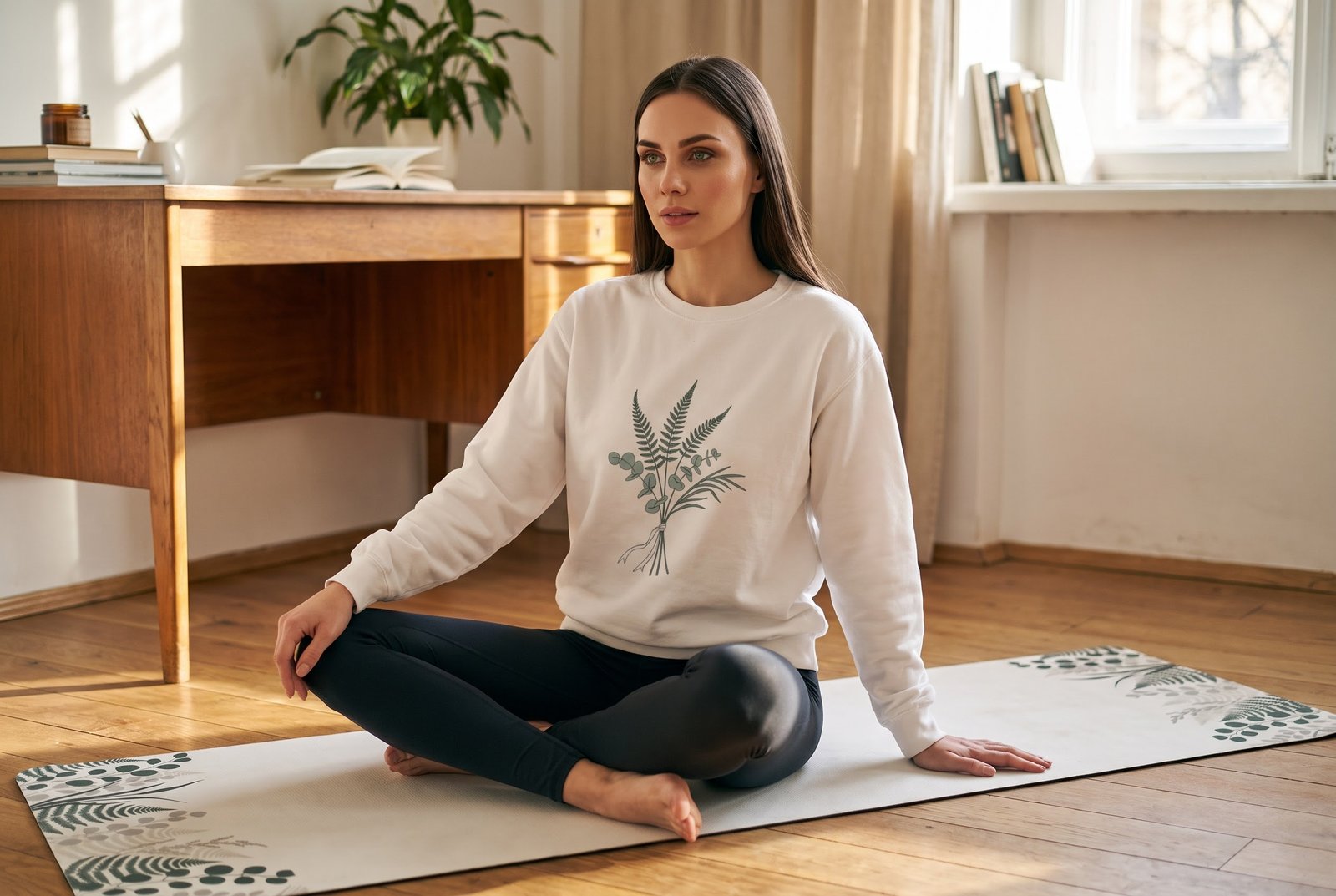
Wrist stretches for gamers: the two directions
1. Palm-up wrist flexor stretch. Straighten one arm out in front of you, elbow locked, palm facing up and fingers pointing at the floor. Use the other hand to gently pull the fingers back toward your body. Hold 30 seconds, then switch. Do each side twice.
This targets the forearm flexors, the muscles that close your hand around a mouse or controller and never fully let go during a session. You should feel a long pull down the underside of the forearm from wrist to elbow. You shouldn’t feel anything in the wrist joint itself, and you shouldn’t feel electrical tingling into the fingers.
2. Palm-down extensor stretch. Same arm position, elbow straight, but palm facing down and fingers pointing at the floor. Gently press the back of the hand toward you. Hold 30 seconds each side.
This is the top-of-forearm counterpart, and it’s the one most relevant if you’re searching for stretches for gamers elbow discomfort. The extensors anchor on the outside of the elbow, so a mouse hand that grips all evening can leave that bony point sore. Keeping the elbow straight is what makes this work — bend it and you lose most of the stretch.
Thumb and finger stretches for gamers
3. Thumb web and tendon glide combo. Two parts, both for the hand itself.
First, the thumb. Hold your hand flat, fingers together, and pull the thumb gently away from the index finger until you feel a stretch in the webbing. Hold 20 seconds each hand. Then tuck the thumb across the palm, wrap the fingers over it lightly, and tilt the wrist toward the little finger. Hold 15 seconds each hand, gently. This one has a reputation for being overcooked — the thumb stretch should be mild, never a wince.
Second, the glides. Start with the hand open and fingers straight. Bend only the big knuckles so the fingers point forward like a tabletop, and hold 3 seconds. Then curl into a hook, fingertips to the base of the fingers, 3 seconds. Then a full fist, 3 seconds. Then open fully and spread the fingers wide, 3 seconds. Five rounds per hand.
Finger stretches for gamers are less about lengthening tissue and more about moving tendons through their full range after hours of small, repeated, half-range movement. If your fingers lock, catch, click painfully, or go numb at night, stop self-managing and see a physiotherapist or your doctor. Persistent numbness and grip weakness aren’t stretching problems.
Stretches for gamers neck and back, in the chair
4. Chin tuck, trap stretch, chair-back extension. The head drifts forward toward the screen. Everything behind the neck pays for it.
Chin tuck first: sit tall, draw the chin straight back as if making a double chin, without tipping the head. Hold 5 seconds, repeat 8 times. This is for the deep neck muscles that hold the head over the shoulders rather than in front of them.
Then the upper trapezius: drop the right ear toward the right shoulder, let the left hand hang or hold the chair seat, and rest the right hand lightly on the head for weight only. Hold 30 seconds each side. You want a stretch along the side of the neck into the top of the shoulder. Not into the arm.
Then the back: sit so the chair’s backrest hits the middle of your back, lace the hands behind the head, and lean back over it, letting the upper back extend while the ribs stay down. Hold 10 seconds, repeat 5 times. That’s the one that counters three hours of rounded shoulders. Stop if leaning back produces any pain down the arms.
The two on the floor: the hips nobody stretches
5. Half-kneeling hip flexor stretch. Kneel on the right knee with the left foot forward, both knees around 90 degrees, towel under the back knee. Tuck the tailbone under so the lower back flattens slightly, then shift your weight gently forward. Hold 45 seconds per side. Reaching the right arm overhead and leaning slightly left adds the front of the hip and the side of the torso.
You want a broad pull across the front of the right hip and thigh. You shouldn’t feel a pinch at the front of the hip socket; if you do, shorten the stance. This is the direct answer to sitting in one angle all evening, and there’s more detail on the pattern in the hip flexor guide for desk workers, because a gaming chair and an office chair do the same thing to the same tissue.
6. Lying figure-four. On your back, knees bent, feet flat. Cross the right ankle over the left thigh just above the knee, reach through the gap and pull the left thigh toward your chest. Hold 45 seconds per side. This is for the glutes and deep hip rotators, which hold a constant low-level load whenever you sit with weight through the back of the pelvis.
Expect a deep stretch in the right buttock. Numbness or shooting sensation down the back of the leg is a stop signal, not a sign it’s working.
Where to put it in the day
Between matches is realistic. Chair work in a loading screen, floor work in a longer break. If you prefer a fixed slot, the five-minute morning routine covers the hips before the day puts you back in the chair.
And yes, people search for games to relax to. Playing something calm still parks the hips in the same angle for two hours, so the stretches apply either way.
Minimum version for a bad day: palm-up wrist stretch, 30 seconds each arm, and the half-kneeling hip flexor, 45 seconds each side. Two minutes, one of them on a towel. That covers the grip and the angle you held longest.
If it hurts: sharp pain, pins and needles, or numbness means stop the stretch — do not ease back into it to test. Hands that go numb at night, fingers that catch or lock, grip that has noticeably weakened, or hip pain that pinches at the front of the socket all belong with a physiotherapist rather than a routine.
Nothing here should leave soreness the next day. A mild sense of having been stretched, yes. Ache in a joint, no.
General movement guidance, not medical advice. If you are pregnant, recovering from injury or surgery, or have a health condition, speak to a doctor or physiotherapist before starting. Stop if anything is sharp, numb or tingling. Photographs are AI-generated illustrations featuring Elena.


