

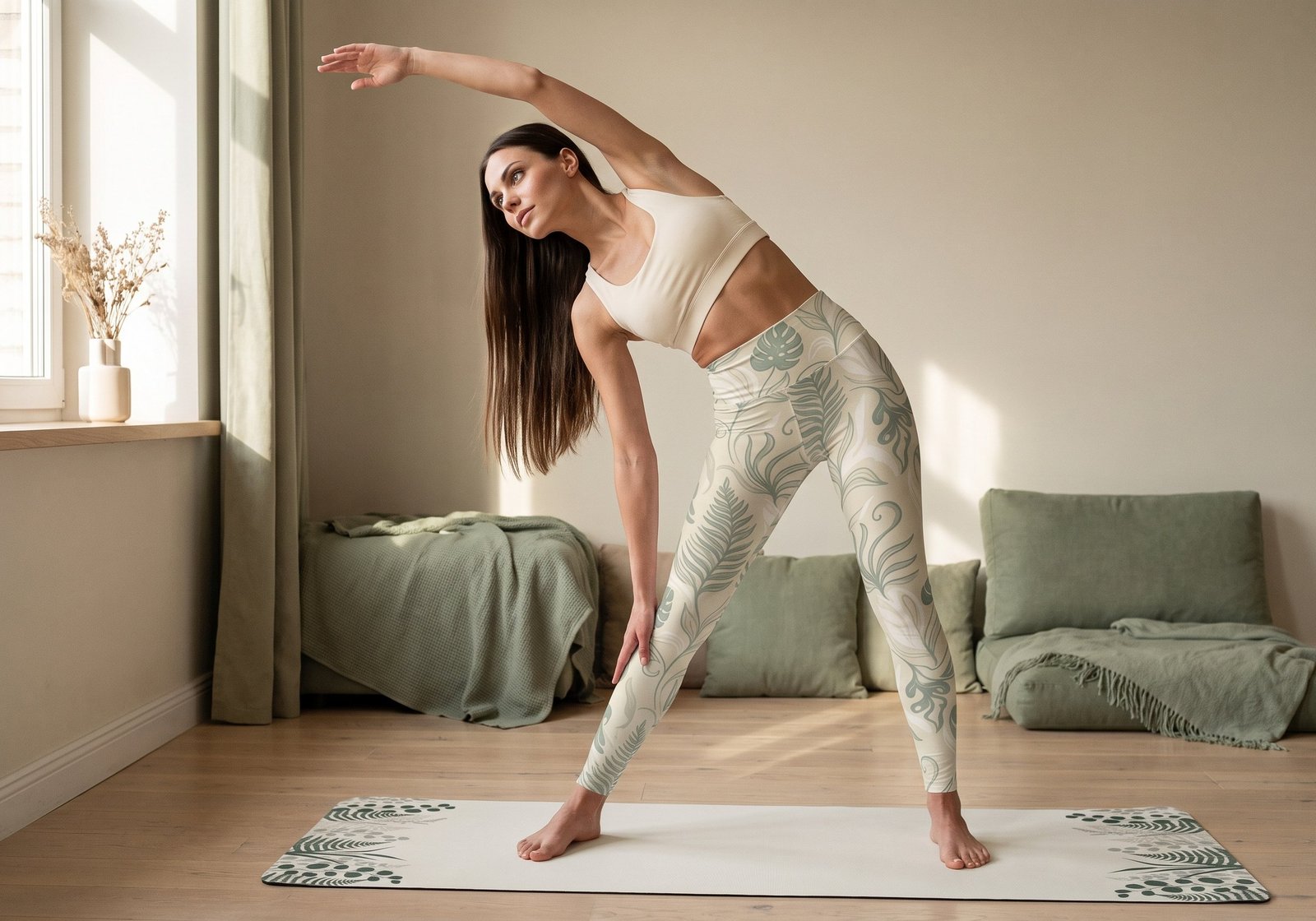
You set the alarm fifteen minutes early, unrolled the mat on a cold floor, reached for your toes and got somewhere around mid-shin. It felt awful. Three days later the alarm won. Then you tried evenings instead, got much deeper into everything, and quit that too, because 9pm is where plans go to die.
So the question “what’s the best time to stretch” is really two questions wearing one coat: when is your body most receptive, and when will you actually show up. The answers are different. Here’s what changes across the day, what to do at each point, and why the habit argument wins anyway.
What actually changes between a cold morning body and a warm evening one
Three things shift over a day, and they’re well documented in the exercise physiology literature. We’re summarising published material here, not measuring anything ourselves.
- Core and muscle temperature. Body temperature follows a circadian curve: lowest in the small hours, highest in the late afternoon and early evening. Warmer tissue is more compliant, so end-range positions feel less hostile after work than before breakfast.
- Spinal disc hydration. Intervertebral discs take on fluid overnight while you’re unloaded and lose it through the day. That’s why you’re measurably taller in the morning, and why loaded, deep spinal flexion first thing is the one category worth being conservative about.
- Nervous system tone. Morning stretch tolerance is generally lower. Same tissue, less willingness to sit in discomfort.
None of this makes morning stretching unsafe. It means a morning session should be shorter, gentler, more movement-based, and aimed at waking the body up rather than at hitting a new range.
Best time to stretch morning or night: the honest answer
If your only goal is maximum range of motion in a single session, the late afternoon or evening has the physiological advantage. If your goal is a routine that still exists in six weeks, the morning usually wins, because fewer things get in its way.
Most people do better with a split: two to five minutes of movement in the morning, and the longer holds later. Here’s how the slots compare on the attributes that matter.
| Slot | Tissue state | Best for | Sensible length | Main risk |
|---|---|---|---|---|
| 6–8am, out of bed | Cool, discs fully hydrated, low stretch tolerance | Mobility drills, cat-cow, hip circles, gentle spinal rotation | 3–8 minutes | Pushing end range on a cold body; snoozing the alarm |
| Midday desk break | Warm-ish, stiff from sitting | Hip flexors, chest, neck, standing hamstrings | 2–5 minutes, twice | Never actually leaving the chair |
| Straight after training | Warmest, fatigued | Static holds on the muscles you just used | 5–10 minutes | Skipping it to get to the shower |
| Evening, 1–2h before bed | Warm, highest stretch tolerance | Long holds, 60–120 seconds, flexibility progress | 10–20 minutes | Social life, screens, fatigue |
Notice that the best slot is the one with the risk you can personally manage. Pick the time whose failure mode you can defend against, not the one with the best physiology.
Best time to stretch before or after workout
This one has a clearer answer than morning-versus-night, and it isn’t “always stretch first”.
Before: dynamic only. Leg swings, walking lunges, arm circles, hip openers with movement, 5–10 minutes, progressively bigger. The point is raising tissue temperature and rehearsing the ranges you’re about to load. Long static holds before heavy lifting or sprinting are the thing most coaching guidance now advises against, because of the short-term drop in force output reported in the literature.
After: static holds, as long as you like. The muscle is warm, the session is over, and nothing depends on peak force any more. This is the single most efficient flexibility window in the day, because the warm-up is already paid for.
So: when is the best time to stretch during an exercise routine? Dynamic at the start, static at the end, and never the reverse. If you only have ten spare minutes on a training day, spend them after, not before.
When is the best time to stretch after a run — or a ride
Within about 10 to 20 minutes of finishing, while you’re still warm and before you sit down in a car or at a desk. For running, the obvious targets are calves, soleus, hamstrings, hip flexors and glutes. Hold each for 30 to 60 seconds, breathe out into the position, don’t bounce.
After cycling the list is different, and people get it wrong. Cycling holds the hip in flexion for the entire session and the thoracic spine in a fixed curve, so the priority is hip flexors, quads, chest and thoracic extension, not more hamstring work. A couch stretch and two minutes over a rolled blanket does more for a cyclist than another forward fold.
If something hurt during the run or ride, stretching isn’t the answer to it. Sharp, localised or one-sided pain that lasts more than a few days is a physiotherapist’s question, not a mobility question.
When is the best time to stretch for flexibility
For actual range-of-motion change, timing is a rounding error next to frequency and total time under tension. The published consensus across stretching research points at the same lever: accumulate around 5 to 10 minutes per muscle group per week, spread over several sessions, and hold long enough to settle — 30 to 120 seconds.
Five days of six minutes beats one Sunday hour. And if you’re choosing a slot purely for range, evening or post-training gives you the most comfortable starting point.
The other practical lever is the same position, repeated. Rotating through fourteen novel stretches you found online produces less change than returning to the same four for eight weeks. If you sit for a living, a fixed sequence like this hamstring routine for sitting all day is worth more than variety.
Best time to stretch for height, and what stretching can’t do
People search this a lot, so let’s be straight about it. Stretching doesn’t lengthen adult bones. The daily height variation you can see on a tape measure is disc fluid and posture, not growth. You’re tallest within an hour or so of waking and shortest at the end of a long standing or sitting day.
What you can genuinely change is how much of your existing height you use: thoracic extension, hip flexor length, rib position over pelvis. That shows up as standing taller, and evening is a reasonable time to work on it, since you’re warm and your day of compression is done. Anything else marketed as height gain for adults isn’t something we’ll claim.
The habit argument that beats both
Search “best time to stretch reddit” and the thread consensus is boringly correct: the best time is the one you’ll repeat. That sounds like a dodge, but it’s the whole mechanism. Flexibility responds to frequency, and frequency is a scheduling problem.
Three things that make a slot stick:
- Anchor it to something you already do without deciding — the kettle boiling, the end of the last work call, the shower running. Not “sometime in the evening”.
- Set the floor absurdly low. Three minutes. On bad days you do the three minutes and stop. The aim isn’t the session, it’s keeping the chain unbroken. A five-minute morning routine exists for exactly this reason.
- Remove the setup. If the mat lives in a cupboard behind the vacuum, you’ve added a decision. Leave it out, or leave a corner of floor clear.
And the cheap truth: you don’t need to buy anything to start. Carpet and a folded bath towel under the knees is a legitimate surface for most floor stretching, and free beats optimal when the thing you’re fixing is adherence. Thickness only matters once you’re doing regular kneeling or supine work on hard floor, at which point 3mm versus 5mm versus 6mm becomes a real question rather than a shopping one.
When to stop optimising and ask a professional
Timing debates are for healthy, stiff bodies. See a physiotherapist or your GP if you have pain that wakes you at night, numbness, pins and needles, a joint that gives way, stiffness that’s clearly worse on one side, or morning stiffness lasting more than an hour. Persistent symptoms need assessment, not a better stretching schedule.
If you’ve quit a routine before: take the morning slot, cap it at five minutes, and do movement rather than deep holds. Anchor it to the kettle. Add the longer evening session only after four consecutive weeks.
If you want measurable flexibility change: stretch in the evening or straight after training, 30–120 second holds, the same four positions, four or five days a week. Track the positions, not the minutes.
If you train or ride: dynamic before, static within 20 minutes of finishing. Cyclists: hip flexors, quads, chest, thoracic extension — not more hamstrings.
If your floor is hard and your knees complain: start with a folded towel on carpet for nothing, and only buy padding once the habit has survived a month.
Written with Elena, our AI stretch guide, and checked against our editorial and safety rules before publishing. General movement guidance, not medical advice. Photographs are AI-generated illustrations.


