

Flexibility is the range a joint has. Mobility is the range you can produce and control yourself, with no help from gravity, a strap or a hand. That’s the entire difference, and every rewording of it you’ll find online comes back to those two sentences.
The interesting part is the gap between them.
Are flexibility and mobility the same thing?
No. They overlap, which is why the terms get swapped so casually, but they fail in different ways and respond to different work.
A hamstring that reaches 90 degrees when you pull your leg towards you with a belt has flexibility at 90 degrees. If the same leg, lifted by its own hip flexors with nothing holding it, stops at 60 degrees, your mobility ends 30 degrees earlier. Those last 30 degrees exist in your body but not in your control, which means they don’t show up in a running stride, a lunge, or getting out of a car.
Flexibility is a property of tissue and joint structure. Mobility is flexibility plus the strength and coordination to own the end of the range.
The home test that shows you the gap
You need a floor and about two minutes.
- Lie on your back, both legs straight. Lift one leg as high as it goes using only that leg. No hands. Note roughly where it stops against an imagined clock face.
- Lower it. Now loop a belt, dressing gown cord or towel around the foot and pull the same leg up as far as is comfortable. Note where it stops.
The second number is flexibility. The first is mobility. A difference of 10 to 15 degrees is unremarkable. A difference closer to 30 degrees tells you that more passive stretching probably isn’t what the leg is short of.
Repeat it with the shoulder: lie on your back, arms overhead, and see whether your arms reach the floor without your ribs flaring. Then let someone, or a wall, take them further. Same gap, same conclusion.
Mobility vs flexibility vs agility
Agility turns up in this search because the three get grouped in fitness glossaries. It belongs to a different category: it’s about changing direction at speed, and it depends on mobility rather than competing with it.
| Flexibility | Mobility | Agility | |
|---|---|---|---|
| What it is | Passive range available at a joint | Range you can reach and control actively | Changing direction and speed under control |
| Usually limited by | Tissue length, joint shape, nervous system tolerance | Strength and coordination at end range | Mobility, power, reaction, skill |
| Home test | Belt-assisted leg raise; wall-assisted shoulder flexion | Unassisted leg raise; deep squat held without heels lifting | Not really testable at home without space |
| Typical training | 30 to 60 second holds, breathing out into the position | 5 to 8 slow reps into end range, 2 to 3 second holds | Drills, footwork, sport practice |
| Equipment needed | None; a belt or towel helps | None | Open floor or outdoor space |
| What changes first | Comfort in the position, within days to weeks | Control at the top of the range, over weeks | Skill-dependent |
All three start on a bare floor, and none of the tests above require a single purchase.
What is mobility and flexibility training, in practice
Flexibility training is what most people already picture: hold a position near the edge of comfort, breathe, let the position settle. Thirty to sixty seconds is the usual prescription, and it works best on a warm body.
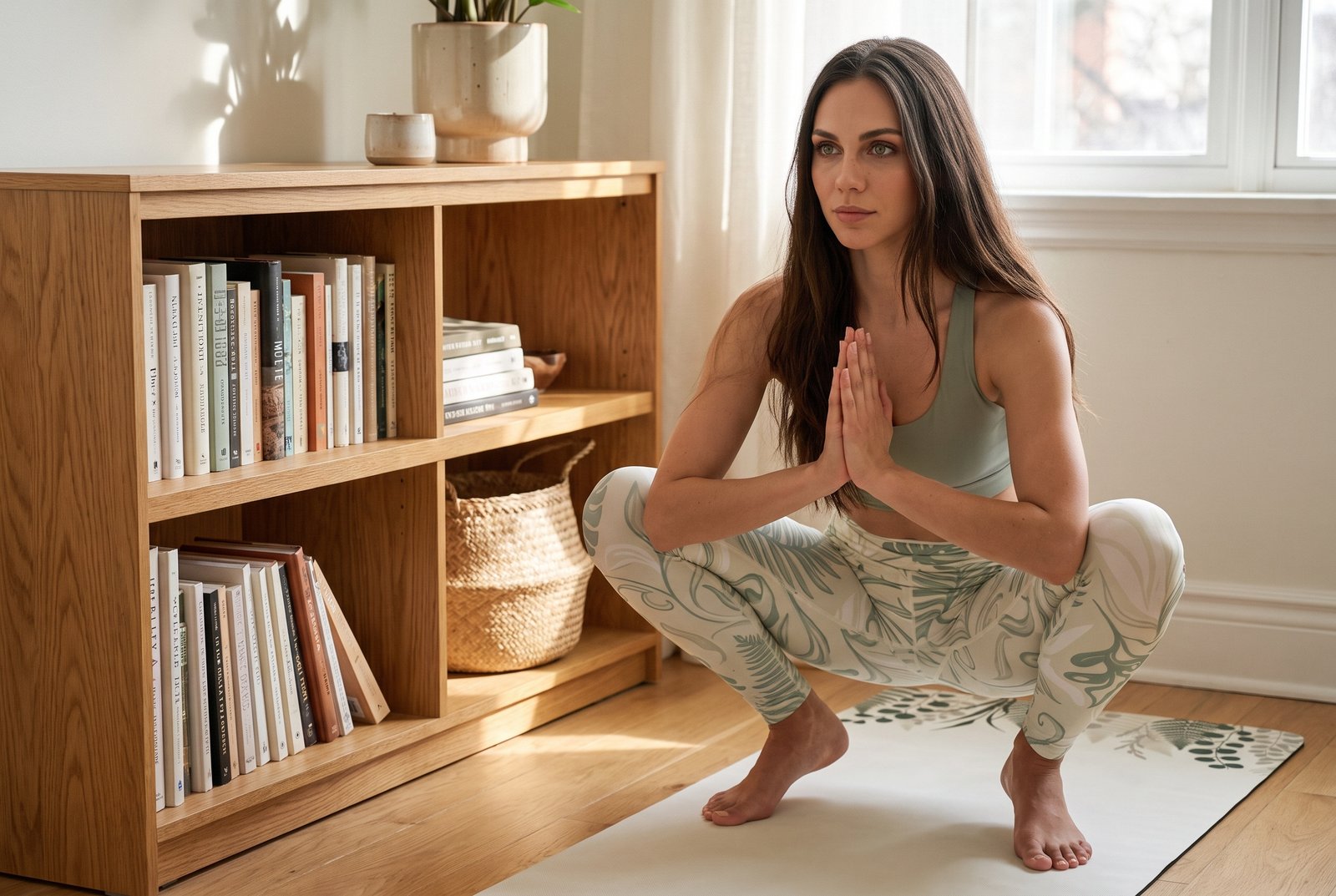
Mobility training looks stranger from the outside. You move slowly into the end of a range and then try to hold yourself there without assistance, often for only two or three seconds, repeated five to eight times. Think of lifting the leg off a yoga block rather than resting it on one. Or sitting into the deepest squat you can hold with heels down, standing up, and doing it again.
The sensation is effort, not stretch. That’s the tell.
Is yoga mobility or flexibility?
Both, depending on the style and on what you do with a pose.
Long-held yin shapes, supported by bolsters and blankets, sit firmly on the flexibility side: the point is to let the body hang in a position with the floor doing the holding. A vinyasa transition where you float from a lunge into a standing balance without touching the floor is almost entirely mobility.
The same posture can be either. Pigeon with the hips sunk onto a folded blanket is passive. Pigeon where you lift the back leg off the floor and hold it for three seconds is active. What makes a pose mobility work is whether your own muscles are producing the range.
Is mobility or flexibility more important?
For a reader who sits at a desk for six or more hours, the honest answer is that flexibility tends to be the symptom and mobility the thing that was missing.
Hip flexors shorten with sitting. Hamstrings stop being asked to lengthen. But the more common complaint comes down to ranges that are rarely visited rather than ranges that have disappeared: the stiff first hour of the morning, the knee that protests on stairs. Our hamstring routine for sitting all day deliberately mixes both for that reason.
If you can already fold forward and touch the floor but your deep squat collapses, build mobility. If the belt test shows genuine restriction at 60 degrees, spend some weeks on flexibility first, then layer control on top.
Mobility and flexibility for beginners: start with eight minutes
A workable beginner structure, three to five days a week:
- Two minutes of movement first — walking, stairs, arm circles. Cold tissue tolerates less.
- Three minutes of active work: 8 slow unassisted leg raises per side, 8 deep squat sit-downs, 8 shoulder reaches lying on your back.
- Three minutes of passive work: two positions, 45 seconds each side, breathing out as you settle.
Our five-minute morning routine is shorter and more passive, which makes it a better fit for the first ten minutes after waking, when active end-range work tends to feel awful.
Runners, dancers, BJJ: where the balance shifts
Runners usually need ankle dorsiflexion and hip extension they can produce under load, not deeper hamstring stretches. Dancers tend to arrive with abundant flexibility and need active control to use it in the air. Grapplers in BJJ need hip, spine and shoulder range that holds up while someone is applying force to it, which is mobility with a resistance requirement bolted on.
None of these change the definitions. They change which half of the gap you’re closing.
Apps, books and programmes: where free wins
There are well-known published programmes in this space — Kelly Starrett’s work on joint position, Kit Laughlin’s stretching material, the various mobility apps that sell a daily ten-minute video. Judge them on whether they distinguish active from passive work and whether they progress, rather than on the number of poses in the library.
Honestly: for the first two or three months, a free YouTube routine you actually repeat will outperform a paid subscription you open twice. The limiting factor is almost never the content. A phone timer, a hard floor and a towel cover the whole of the beginner stage, and a dedicated space matters more than a programme — a corner you can leave set up removes the friction that kills routines.
Buy a mat when your knees complain on hard floor, not before.
When to stop self-managing
Sharp pain, pain that refers down a limb, pins and needles, a joint that catches or gives way, or restriction on one side only that hasn’t shifted in six weeks — see a physiotherapist rather than stretching harder. A one-sided range difference in particular is worth having looked at in person, because it’s information neither a test nor an article can interpret for you.
If the belt test showed a gap of 25 degrees or more: stop adding passive stretches. Spend six weeks on unassisted leg raises and deep squat sit-downs, 8 reps each, and retest.
If both numbers are low and close together: you have genuine flexibility work to do. Longer holds, 45 to 60 seconds, after a warm body, four days a week, before you worry about control.
If you have abandoned three routines already: ignore apps, books and programmes for now. Pick two movements, do them for eight minutes, and keep the mat where you will trip over it.
If one side is noticeably more restricted than the other: book the physiotherapist. That is an assessment question, not a stretching question.
How this comparison was made: we compared manufacturers’ own published specifications, not our own testing. Where we sell something ourselves we say so. Photographs are AI-generated illustrations featuring Elena, our AI guide.


