

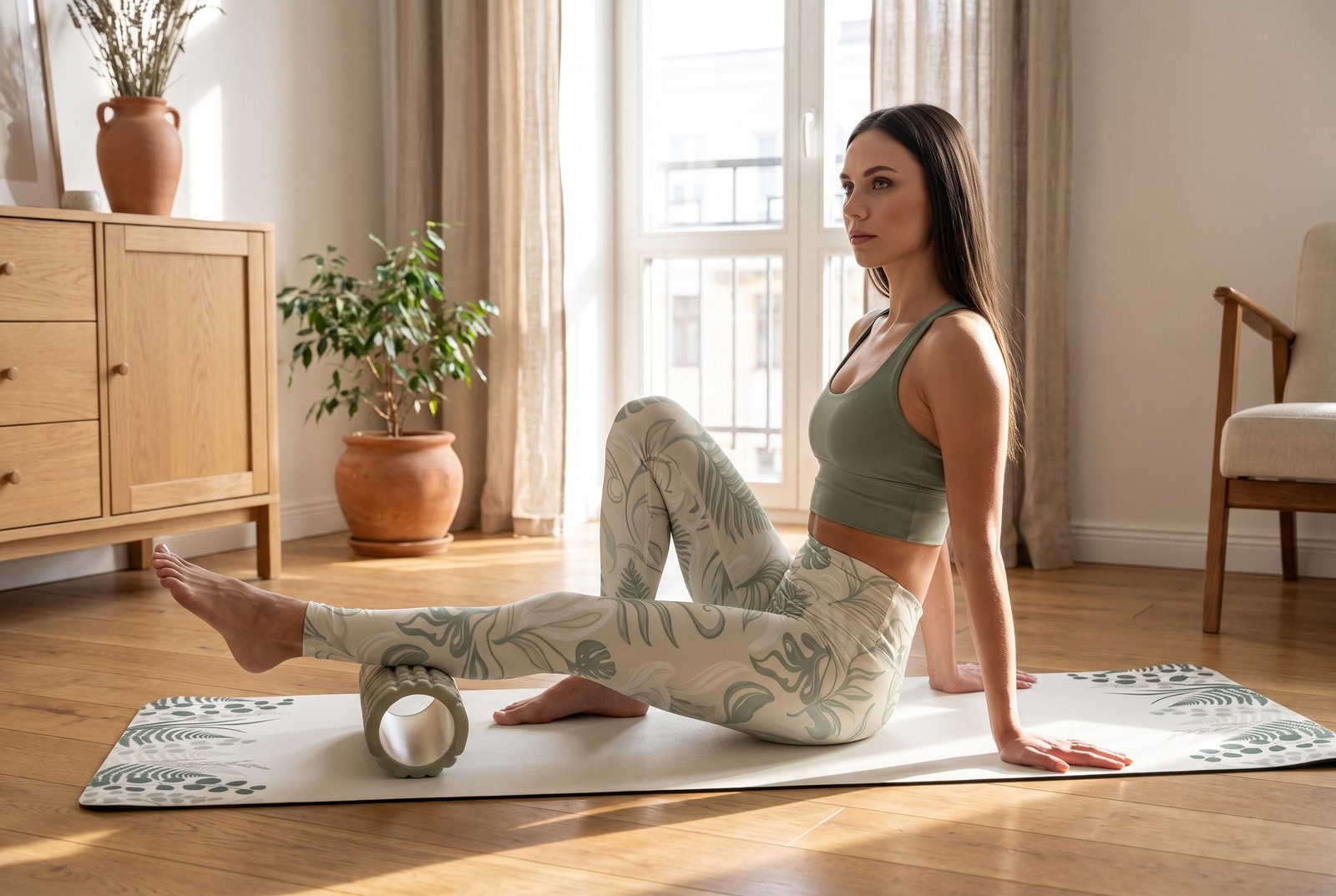
How we make money here: stretching.shop makes the printed pieces in this shop ourselves. Anything on this page marked Recommended gear is made by someone else and sold by a retailer, and we may earn a small commission if you buy through our link at no extra cost to you. We recommend gear we would use, and we say when a cheaper option is the better buy.
No, a massage gun isn’t foam rolling with a battery. The two tools apply pressure in ways their own specification sheets describe quite differently, and once you read those numbers side by side the question of which one to buy mostly answers itself.
A foam roller is a passive surface. It has no settings. You put part of your body on it and move, and your own body weight sets the pressure, which is why the same roller feels mild under a forearm and severe under a quad.
A percussive device is a powered handheld. It supplies its own force at a fixed stroke length and a selectable rate, and you aim it. One tool is driven by your body weight, the other by a motor, and that single difference decides most of what follows.
Is a massage gun better than a foam roller?
For most people stretching at home, the roller does more for less. Here’s the honest reasoning, drawn from what manufacturers publish rather than from anything we’ve measured ourselves.
A standard long roller is listed at roughly 90 cm long and 15 cm in diameter. That’s a contact surface you can lie your whole upper back across, or put both calves on at once. A percussive head is usually a 4–6 cm ball or flat pad, so covering one calf with the smaller tool takes dozens of passes. The roller covers both in one position.
Coverage per minute matters more than anyone admits. A ten-minute floor session with a roller can touch calves, hamstrings, glutes, mid-back and lats. Ten minutes with a handheld, held at arm’s length, realistically covers two or three areas before your shoulder objects.
The roller also costs a fraction of what a mid-range percussive device costs, has no battery, and will not be obsolete when a charging port changes shape.
What the published specifications actually say
Specification comparison only — figures below are the ranges manufacturers publish for each category, not results from any testing on our part.
| Attribute | Foam roller | Percussive device (massage gun) | Muscle roller stick |
|---|---|---|---|
| Pressure source | Your body weight | Motor, typically 20–60 W | Your arms |
| Typical dimensions | 90 × 15 cm; also 45 cm and 33 cm versions | Head 4–6 cm, total length 15–25 cm | 45–50 cm bar, 3–5 cm rollers |
| Depth / stroke | Not specified; set by load and foam density | Amplitude usually listed as 10–16 mm | Not specified; set by grip force |
| Speed | Whatever you choose | Commonly 1,700–3,200 percussions per minute, 3–6 settings | Whatever you choose |
| Weight | EVA or EPP foam, roughly 300–900 g | Usually 0.6–1.2 kg in hand | 250–400 g |
| Power | None | Lithium battery, published run times 2–6 hours | None |
| Noise | Silent | Often quoted at 40–65 dB | Silent |
| Reaches without help | Back, glutes, calves, quads, lats | Calves, quads, forearms, feet; mid-back is awkward | Calves, quads, hamstrings, shins |
| Travel | Bulky unless 33 cm model | Case-sized; airline battery rules apply | Fits a kit bag |
Notice the one row where the handheld clearly wins: amplitude is specified, pressure is repeatable, and you do not have to get on the floor. For anyone who can’t kneel or lower to the ground comfortably, that isn’t a small thing.
Massage gun vs foam roller for calves
Calves are the clearest case, and it goes to the roller on coverage and to the handheld on precision.
Sitting with both calves on a 90 cm roller, ankles crossed to load one side, you can work the whole span from Achilles to the back of the knee in about 60–90 seconds a leg. The roller’s 15 cm diameter clears the floor enough for the heel to hang free.
A handheld gives you one thing the roller doesn’t: you can sit in a chair, point a 5 cm head at the soleus just above the Achilles, and stay off the floor entirely. Desk workers with tight calves from heeled shoes or long sitting often find this the practical option at 3 pm.
Neither one lengthens a calf. Length comes from holding a loaded stretch, a knee-straight wall calf stretch for 60 seconds then a knee-bent version for 60, and from doing it four or five days a week. The five-minute morning routine includes that pairing.
Massage gun vs foam roller for runners
Runners usually want a quick pre-run wake-up and a post-run wind-down, and those are two different jobs.
Before running, short bursts suit the handheld: 20–30 seconds per area on a lower speed setting, while standing, nothing that leaves the muscle sleepy. Before-run rolling tends to pull people into five minutes of lying on the floor, which isn’t how most sessions start well.
After running, the roller wins on area. Quads, ITB-adjacent lateral quad, glutes, hamstrings, calves, upper back — four or five minutes gets round all of it. If you run and you are choosing one tool, choose the roller and spend the saved money on shoes.
There is one case for the powered option. If you travel to races weekly, a 1 kg handheld in a case beats carrying a 90 cm foam cylinder through an airport.
Massage gun vs muscle roller stick
The stick, a 45 cm bar with rollers on it, is the forgotten middle option and the cheapest of the three. You grip it with both hands and push along the muscle, so pressure comes from your arms instead of your body weight.
For calves and quads while sitting in a chair, a stick does nearly everything a handheld does, silently, with nothing to charge. It can’t reach the mid-back, and it can’t work glutes well. But if the whole reason you were considering a powered device was “I don’t want to get on the floor,” try a stick first.
What the massage gun vs foam roller threads keep landing on
Search Reddit on this and the recurring conclusion is consistent: people who bought the handheld first usually end up also owning a roller, and people who bought the roller first often never buy the handheld. Treat that as pooled opinion, not evidence. It’s forum consensus, nothing more.
The other recurring theme is that neither tool fixed the thing people bought it for. Tight hamstrings from eight hours of sitting are a position problem, not a tissue-texture problem. Rolling them makes the next ten minutes feel better; changing how often you stand up changes the month. A structured hamstring routine for sitting all day does more than either device.
Can a massage gun replace foam rolling?
Partly, for limbs. Not for the thoracic spine.
Lying backwards over a roller placed across the mid-back, arms crossed, is a loaded extension of a region that sitting flattens. No handheld reproduces that, because what does the work is the shape your spine is held in while you breathe, not the massage itself. That single use is the strongest argument for owning a roller even if you already own a percussive device.
And the free option deserves saying plainly. A rolled bath towel, 15 cm thick and placed horizontally under the shoulder blades, gives you most of the same thoracic opening for nothing. A tennis ball under a glute costs less than any of this. If the budget is tight, start there and put the money towards floor space instead — a stretching corner under 200 changes behaviour more than hardware does.
When to stop self-treating
Tools like these are for general, non-specific tightness. See a physiotherapist if you have pain that wakes you at night, numbness or pins and needles down a limb, swelling, pain following a fall or impact, or anything that hasn’t shifted in two to three weeks. Don’t aim a percussive device at bone, joints, the front of the neck, the abdomen, varicose veins, or any area you have been told to protect, and check with a clinician first if you take anticoagulants or have a nerve condition.
If you are buying your first tool: buy the 90 cm foam roller. It covers more body area per minute, has no battery, and handles the mid-back work that no handheld reproduces.
If getting on the floor is the obstacle: try a muscle roller stick before a powered device. It works the calves and quads from a chair for a fraction of the cost and nothing to charge.
If you travel weekly or want repeatable pressure: the percussive device earns its place — published amplitude of 10–16 mm and fixed speeds give you the same dose each time, in a case that fits hand luggage.
If what you actually want is more range: neither tool delivers it. Put ten minutes into held stretches four or five days a week and treat the hardware as a warm-up to that, not a substitute.
How this comparison was made: we compared manufacturers’ own published specifications, not our own testing. Where we sell something ourselves we say so. Photographs are AI-generated illustrations featuring Elena, our AI guide.


