

The honest answer is a range, not a number. Thirty to sixty seconds per static stretch covers almost everything a desk-bound body needs, and the difference between 30 and 60 matters far less than whether you came back on Thursday.
But “how long to hold a stretch” is really four questions wearing one coat. A hold between emails isn’t a hold after a 10k. An evening hamstring session isn’t a restorative shape you melt into for four minutes. Below are workable lengths for each, and then the thing that makes a clock unnecessary.
Where the 30-second figure comes from
It isn’t folklore. The American College of Sports Medicine’s published guidance for adults describes static stretching held to the point of mild tightness for 10 to 30 seconds, repeated two to four times, for a total of around 60 seconds per muscle group. For older adults it suggests the longer end, 30 to 60 seconds per hold.
Read that carefully, because the useful part is the last clause. The published target is roughly 60 seconds of total time per muscle group, however you slice it. Two 30s holds, four 15s holds, one long 60s hold — the guidance treats these as broadly interchangeable.
That single fact dissolves most of the arguments. If you only have 20 seconds per side, do three rounds across the day rather than one perfect minute you keep postponing.
How long to hold a stretch after a workout
Shorter than you think, and the purpose is different. After training, muscle is warm, compliant and slightly irritable. The job isn’t to gain range. It’s to come down.
Thirty seconds per position, one round each, five or six positions, is a sane cool-down. Eight to ten minutes total if you dawdle.
Two cautions, both from mainstream exercise guidance rather than anything we have measured: long static holds before power or sprint work are associated in the literature with a short-lived dip in force output, which is why warm-ups shifted towards dynamic movement. And a very long, deep hold on a muscle you’ve just thrashed tends to feel worse the next day, not better. Save the three-minute holds for a day you haven’t trained.

How long to hold a stretch for flexibility
If the aim is actual new range rather than a pleasant sensation, the variable that does the work is weekly accumulation, not the length of any one hold.
Practically: 60 to 120 seconds of total time per target muscle, five days a week, beats a single heroic session on Sunday. Split that as two or three holds of 30 to 60 seconds. Pick two or three targets, not nine. Hips, hamstrings and the front of the chest are the usual suspects for anyone who sits.
Six weeks is a fair window before judging it. Range tends to arrive quietly — you notice you can tie a shoe standing on one leg, not that a number changed. Our hamstring routine for sitting all day is built around that accumulation idea rather than one long evening block.
How long to hold a stretch for tight muscles
Longer, gentler, and with the intensity dialled down to about a four out of ten.
A muscle that feels permanently short is often guarding rather than genuinely stiff — a hip flexor that’s been held in 90 degrees since nine in the morning, a trap holding a laptop screen in place. Pull hard on a guarding muscle and it usually guards harder.
Try 60 to 90 seconds at low intensity, breathing out slowly, then ease a few millimetres deeper for a second round. If it burns, sharpens or refers down a limb, that is not a stretch to hold longer — stop.
Pain that travels, pins and needles, weakness, or stiffness that’s dramatically worse first thing in the morning and doesn’t ease after half an hour: book a physiotherapist. Those patterns aren’t a mobility problem to out-stretch, and a stretching journal isn’t a diagnosis.
Restorative shapes: two to five minutes
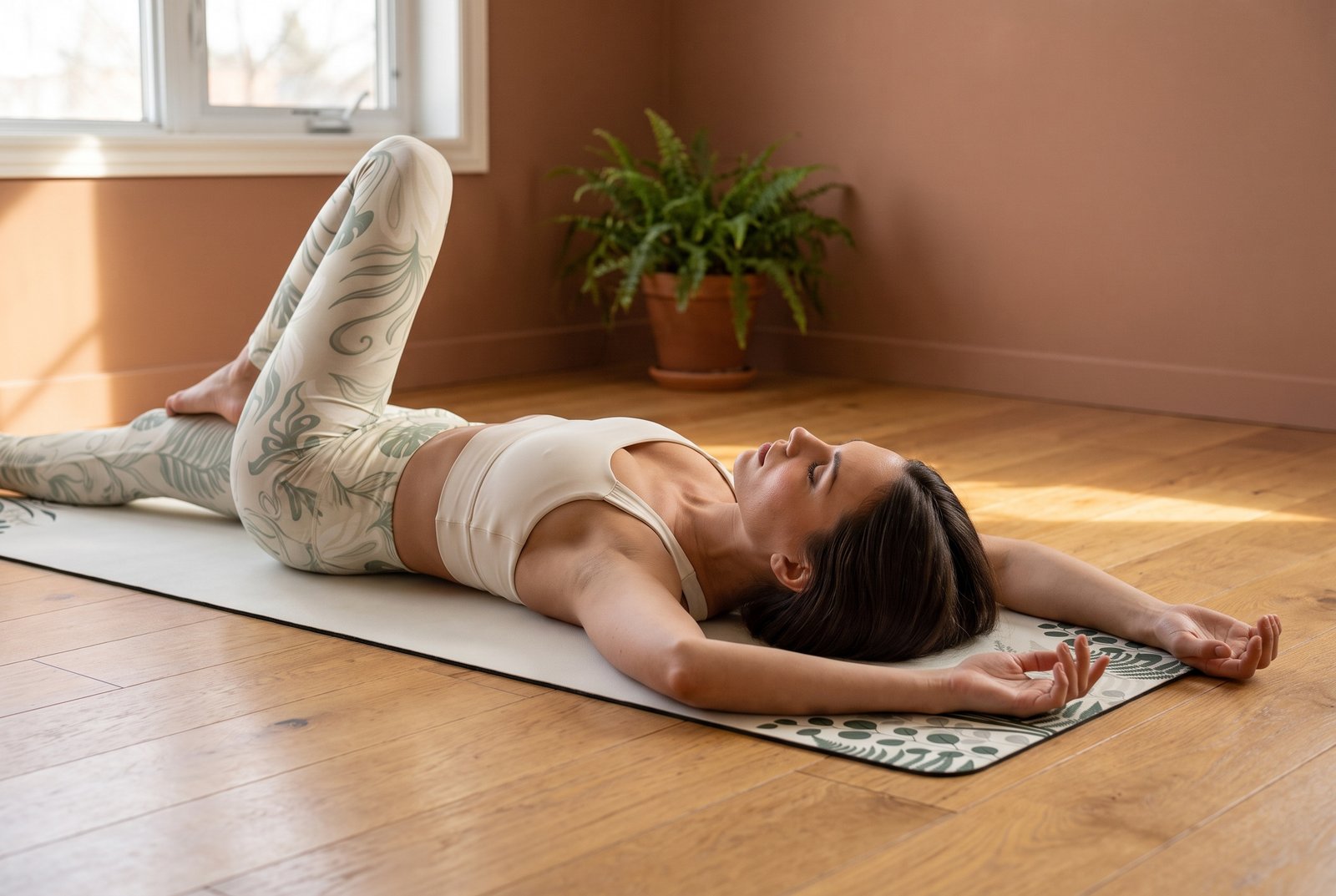
Different category entirely. A supported reclined twist or a legs-up shape is held for two to five minutes, sometimes longer, and the intensity should be nearly nothing. You’re not loading tissue. You’re letting a propped-up body stop bracing.
Props matter more than duration here, because unsupported long holds just mean five minutes of low-grade effort. A folded duvet or three bed pillows does the same job as a bolster for most shapes, and costs nothing. If you want the firmer, flatter support of a dedicated wool layer, the trade-offs are set out in our guide to blankets for restorative yoga — but start with what’s on the bed.
A comparison of hold lengths by purpose
| Context | Hold per position | Rounds | Intensity (1–10) | Session length |
|---|---|---|---|---|
| Desk break | 20–30 seconds | 1 | 3–4 | 60–90 seconds |
| Morning routine | 20–30 seconds, moving between shapes | 1–2 | 3–5 | 5 minutes |
| Post-workout cool-down | 30 seconds | 1 | 4–5 | 8–10 minutes |
| Flexibility block | 30–60 seconds | 2–3 | 5–7 | 15–20 minutes |
| Stubborn, guarded muscle | 60–90 seconds | 2 | 3–4 | 10 minutes |
| Restorative, supported | 2–5 minutes | 1 | 1–2 | 20–30 minutes |
What the Reddit threads actually agree on
Search this question on Reddit and the answers cluster in a predictable way. The r/flexibility regulars push back on the 30-second default and talk instead about total weekly volume, loaded end-range work and consistency; the fitness subs mostly repeat the textbook 30 seconds; someone always arrives to say they hold for five minutes and feel wonderful.
They’re less contradictory than they look. Everyone is describing the same trade: short holds done often, or long holds done rarely, and the first is easier to keep. Treat the anecdotes as anecdotes. Nobody in a comment thread knows your hips, and neither do we.
How long to hold a stretch for the splits
Splits work is where pure static holding runs out of road. The front and side splits need the long holds and strength at the end of the range, which is why coaching for them leans on loaded positions: elevated pike holds, Jefferson curls with light weight, active lifts out of a straddle.
A typical structure is 60 seconds static to open the position, then two or three sets of active work for 20 to 30 seconds, finishing with a longer 90-second hold. Three sessions a week. Progress is measured in months, and knees and hip joints have opinions — a sharp pinch at the front of the hip socket is a stop sign, not a milestone.
Count breaths, not seconds
Here’s the part that costs nothing and works better than a timer.
At rest, an unhurried breath cycle runs about four to six seconds. So five slow breaths is roughly 30 seconds, and eight to ten breaths is roughly a minute — close enough for anything you’re doing on a bedroom floor. In a supported restorative shape the breath slows to eight or ten seconds a cycle, which makes 20 breaths about three minutes.
The advantage isn’t accuracy. Watching a stopwatch keeps you braced and checking, while counting exhalations gives the nervous system something slow to do. If the count goes ragged, the stretch is too intense, and that’s a better signal than any number on a screen.
A phone stopwatch is free and fine if you prefer it. There’s no device worth buying for this. Our five-minute morning routine is written in breaths for exactly that reason.
If you have 90 seconds between meetings: one position, 20 to 30 seconds, no mat, no changing clothes. Three of those scattered through the day beats a 20-minute session you skip.
If you want measurable new range: two or three targets, 30 to 60 seconds, two to three rounds, five days a week, and give it six weeks before you judge it. Write the dates down somewhere.
If you keep abandoning routines: drop the hold length to whatever you’ll actually do, even 15 seconds, and count breaths instead of setting a timer. The habit is the variable that matters; the seconds are negotiable.
If something pinches, refers down a limb or wakes you at night: stop stretching it and see a physiotherapist. Longer holds are the wrong tool for that problem.
Written with Elena, our AI stretch guide, and checked against our editorial and safety rules before publishing. General movement guidance, not medical advice. Photographs are AI-generated illustrations.


