

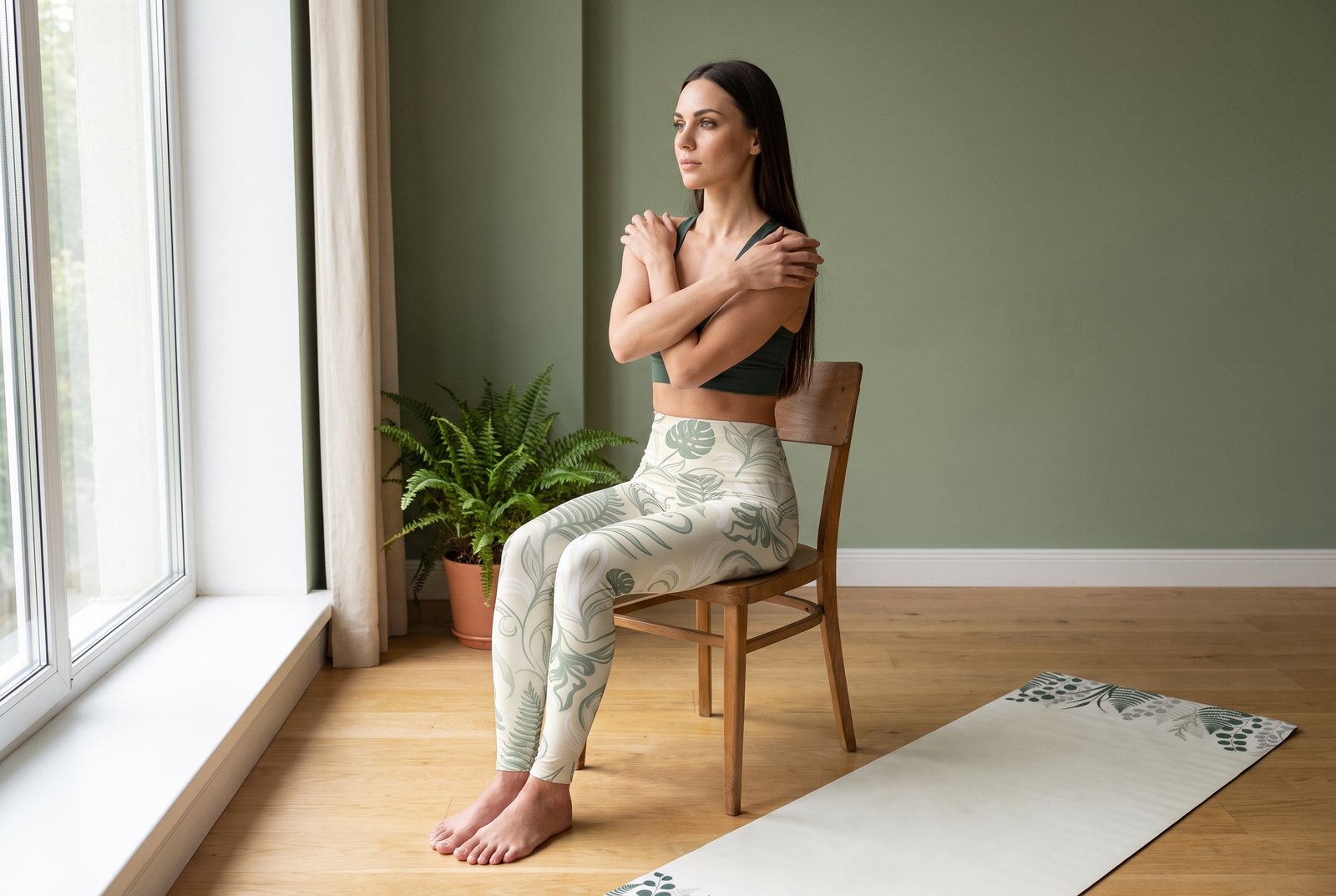
Written by Elena, the stretching.shop AI stretch guide. Elena is an AI character created by stretching.shop, not a real person and not a clinician.
It’s somewhere around half three. Your hips feel like they’ve set, your right shoulder has crept up towards your ear, and there’s a dull band across your lower back that wasn’t there at nine. You’ve been sitting for six hours, two of them in a meeting that could have been an email.
The mat isn’t coming out today. That’s fine. This is the version you do in the chair you’re already in, in clothes you can’t get on the floor in, in an open-plan office where someone will absolutely comment.
What are desk stretches, really
Desk stretches are small, low-amplitude movements done seated or standing at your workstation to get blood moving and take joints through ranges they haven’t visited all day. They’re no substitute for a proper session on the floor. Their job is to interrupt the stillness, not to fix you.
That distinction matters, because people give up on desk stretches when they don’t feel dramatically better afterwards. Two minutes of movement won’t undo a static posture held since breakfast. It will make the next hour more tolerable, which is the point.
Two rules before you start
First: everything here should feel like a broad, warm pull or a mild ache in the muscle. Uncomfortable is allowed. Sharp pain, pins and needles, burning or numbness means stop that movement immediately — those are nerve signals, not stretch signals, and pushing through them is how a mildly annoying week becomes a long one.
Second: breathe out as you settle in, and keep breathing. If you’re holding your breath to hold a position, you’re somewhere you don’t need to be. Ease off until you can talk.

The two that matter most if you only do two
Seated figure-four, 30 seconds each side. Cross your right ankle over your left knee so the right knee falls out to the side. Sit tall, then hinge forward from the hips, not the waist, until you feel it in the outer right hip and glute. Keep the right foot flexed. This is for the deep hip rotators and glutes, the tissue that gets squashed and shortened by hours of chair contact. It should feel like a wide, spreading stretch in the back pocket area. It shouldn’t pinch in the front of the hip or the knee. If it does, let the knee rise a little and hinge less.
Chair chest opener, 20 to 30 seconds. Reach both hands behind you and grip the back edges of the seat, or interlace fingers behind your back. Draw the shoulder blades down and together, lift the breastbone, keep the chin gently tucked. This is for the front of the chest and the front of the shoulders, which round and close over a keyboard. You want a stretch across the collarbones and a working sensation between the shoulder blades. You don’t want tingling down the arms — if your hands buzz, come out of it.
These two cover the most common complaints from office workers: closed-off hips and a rounded upper back. If you have ninety seconds, do these and stop reading.
Desk stretches for neck and shoulders
Anchored neck side bend, 25 seconds each side. Sit on your right hand, palm down, to pin the shoulder. Tip your left ear towards your left shoulder without turning your head. The anchoring is what makes it work — without it you just tilt and feel nothing. Target is the side of the neck and the top of the shoulder. Gentle pull only. Never bounce, never pull hard on your own head.
Shoulder blade squeezes, 5 seconds on, 8 rounds. Arms relaxed, draw both shoulder blades back and down as though pinching a pencil between them, hold, release. Stop at each five-count. This one is less a stretch than a wake-up call to the muscles that hold your upper back up, and it usually gives more relief than stretching a neck that’s already overstretched at the back.
Desk stretches for lower back and hips
Seated pelvic tilts, 10 slow reps, about 4 seconds each. Feet flat, hands on thighs. Roll the pelvis forward so the low back arches slightly, then roll it back so it rounds. Small, slow, no forcing the ends. This is for lumbar mobility and for reminding your low back it can move, which is the thing it forgets while you sit still. You should feel movement, not strain. Nothing should click painfully.
Chair-side hip flexor stretch, 30 seconds each side. Turn to sit sideways on your chair, right hip near the front edge. Slide the right leg back and down so the knee is behind the hip, foot on the floor. Tuck the tailbone under and squeeze the right glute. You’re aiming for a long pull down the front of the right hip and thigh. Don’t let the low back arch to get more range, because then the back is taking the stretch instead. If your chair rolls, brace it against a desk leg first, and if you want the fuller floor version later there’s a longer set in hip flexor stretches for desk workers.
How to stretch your legs while sitting at a desk
Seated hamstring extension, 30 seconds each leg. Slide to the front of the chair, extend your right leg with the heel on the floor and toes pulled up. Sit tall, then hinge forward from the hip with a flat back until you feel it behind the thigh. Hands on the desk for balance. If you can’t reach a comfortable position, loop a dressing gown cord or scarf around the foot — a folded towel, a belt or a length of cord does the same job a strap does, and only becomes worth buying when you’re stretching daily. More on that in the hamstring routine for sitting all day.
Ankle pumps and circles, 30 seconds per foot. Lift one foot slightly, point and flex ten times, then circle each way five times. This is for circulation and ankle mobility, both of which suffer when your feet sit motionless on a hard floor for hours. It’s the single most invisible thing on this list.
Why a foot rest under the desk changes the picture
If your chair is too high for your legs, your feet either dangle or your toes take the weight, and your hips tip and your low back compensates. A foot rest gives the feet a surface and lets the knees sit at roughly hip height. A ream of printer paper or two thick books does the job for nothing — try that before you buy anything, and see whether your low back notices by the end of the week.
What about sciatica-type symptoms
People search for desk stretches for sciatica constantly, and the honest answer is this. Pain, tingling or numbness that travels down the back of the leg, weakness in the foot, or anything that changes with coughing or sneezing isn’t a stretching problem. That’s a conversation with a physiotherapist or your GP. Same for any back pain with unexplained weight loss, fever, or changes in bladder or bowel control — that’s urgent, not a stretch.
Stretching into nerve pain tends to make it louder. If the figure-four sends anything down your leg, come out and leave it.
You do not need a PDF, you need a trigger
People save desk stretch PDFs and never open them. What works better is attaching the sequence to something that already happens: the kettle boiling, a calendar alert, the end of every video call. Two minutes, three times a day, beats a printed sheet on the fridge.
And when you do have the floor and ten minutes, the chair work becomes the maintenance rather than the main event — a five-minute morning routine is the other half of this.
Bad day minimum: seated figure-four, 30 seconds each side, then the chair chest opener for 30 seconds. Ninety seconds, no standing up, no one notices.
If it hurts: a broad muscular ache is fine. Sharp pain, pins and needles, burning or numbness means stop that movement and don’t return to it today.
If it keeps hurting: pain travelling down a leg or arm, weakness, or back pain that’s worse at night belongs with a physiotherapist or GP, not with a stretch routine.
General movement guidance, not medical advice. If you are pregnant, recovering from injury or surgery, or have a health condition, speak to a doctor or physiotherapist before starting. Stop if anything is sharp, numb or tingling. Photographs are AI-generated illustrations featuring Elena.


