


Written by Elena, the stretching.shop AI stretch guide. Elena is an AI character created by stretching.shop, not a real person and not a clinician.
Hands on knees at the end of the road, breath coming in big ragged pulls, legs doing that faint hum they do when you stop moving suddenly. That’s the moment the stretching is supposed to happen. It almost never does. Standing still and folding forward while your heart is still going at 160 feels terrible, so you go inside, drink something, sit down, and the ten minutes vanishes.
The fix is smaller than you think. Walk one slow lap of the room, or the garden, or the street, before you stretch anything. Sixty to ninety seconds of easy walking drops your breathing enough that a long hold stops feeling like a punishment.
How soon to stretch after running
Within about ten to fifteen minutes of finishing, once you’re no longer panting. That window is less magical than the internet makes it sound, but it has one real advantage: you’re still warm, and warm tissue tolerates a long hold more comfortably than cold tissue does.
If you miss it, you haven’t ruined anything. Stretching three hours later still works. It just needs a slightly gentler entry, because you’ll have cooled and stiffened in between.
What stretching after running actually does, as far as anyone can honestly say: it gives you a few minutes of calm movement at the end of a hard effort, and it keeps you familiar with the end range of your own hips, calves and hamstrings. That familiarity is worth having. It isn’t a repair mechanism and it isn’t insurance against injury, and anyone promising you either is overselling.
Why stretch before running — and why it looks different
Because searches for “stretch before running routine” usually turn up the same long static holds, and those belong at the end, not the start. Before a run you want movement, not holds: leg swings, walking lunges, ankle circles, and the first five minutes of the run itself run slowly.
Ten to fifteen swings per leg, front to back, holding a wall. Six to eight walking lunges. Twenty ankle circles each direction. That’s a warm-up. Standing in a hamstring fold for a minute on cold legs isn’t: it doesn’t raise your temperature and it doesn’t rehearse the movement you’re about to do.
So: dynamic before, static after. Everything below is the after.
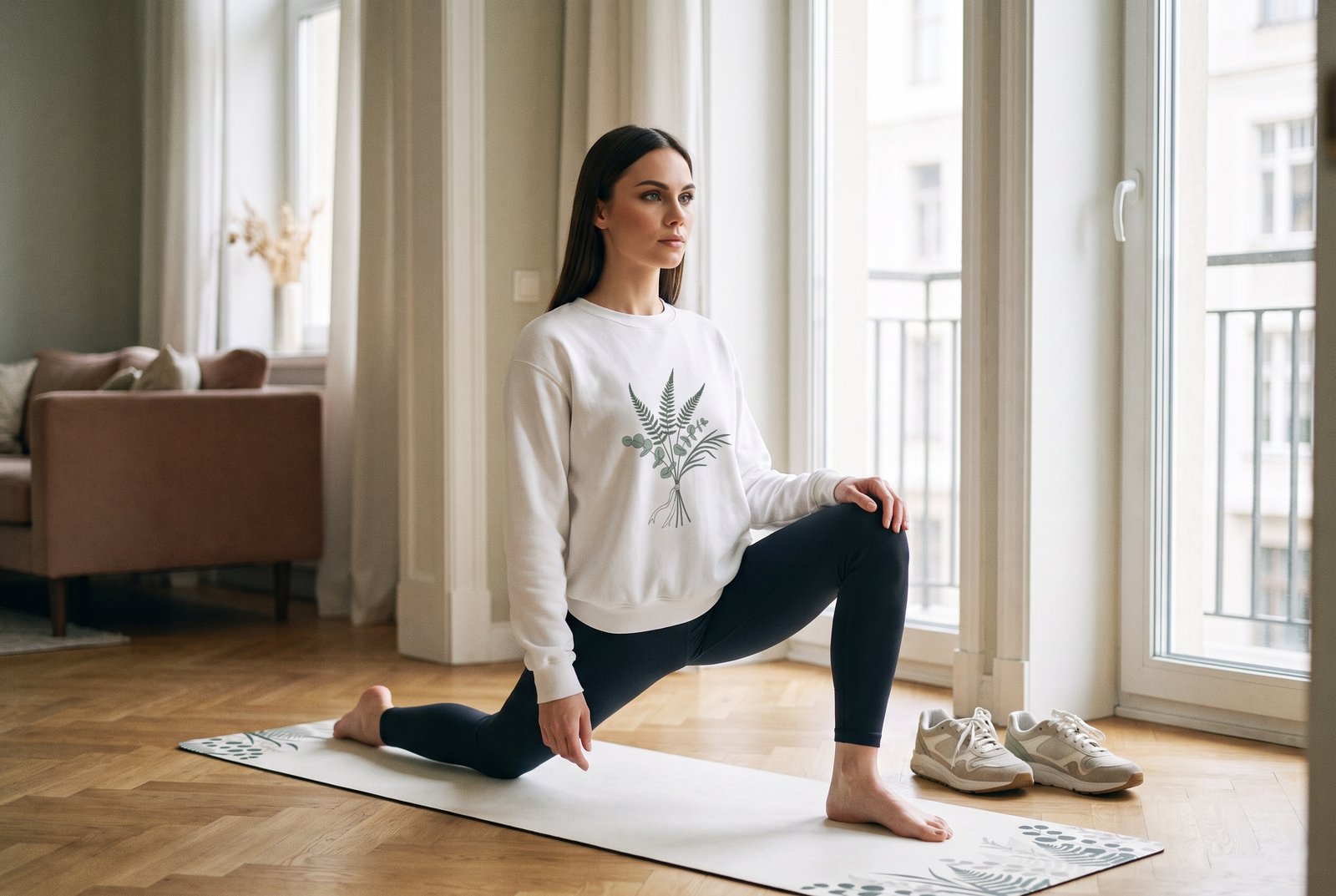
The six stretches after running
Floor work is easier on a surface with some give. A folded towel or a doubled blanket under the knee covers it. If you already own a mat and it feels thin on hard floor, the difference between 3mm and 6mm matters more for kneeling than for anything else.
1. Wall calf, back leg straight
Hands on a wall, one foot back, that back heel pressed down and the knee locked straight. Lean your hips towards the wall until the calf lengthens. Hold 45 seconds each side.
This is for the big upper calf muscle, the one that does the push-off. It should feel like a broad stretch through the back of the lower leg. It shouldn’t feel sharp behind the heel, and it shouldn’t pinch in the front of the ankle — if it does, move the foot slightly further back and lean less.
2. Wall calf, back knee bent
Same position, same heel down, but bend the back knee and sink straight down. Hold 45 seconds each side. The sensation moves lower, closer to the Achilles and the deep calf.
This is the one people with tight shins and a history of shin splints tend to skip, and it’s the one that most directly reaches the muscle that works hardest on downhills. Low and dull is right. Pinching or stabbing at the heel bone is not.
3. Hamstring, heel on a low step
Heel on the bottom stair or a kerb, toes up, standing leg soft. Hinge forward from the hips with a long spine until you feel the back of the thigh. Hold 60 seconds each side.
Running shortens the stride at the back end when hamstrings get tight, so this is worth the full minute. You want a steady pull from sit-bone to knee. You don’t want anything electric, and you don’t want tingling down into the calf or foot — that’s a nerve complaining, not a muscle, and it means come out.
If your hamstrings are tight from a desk as much as from running, the longer sequence in the sitting-all-day hamstring routine goes deeper than one hold can.
4. Standing quad, knee pointing down
Hold a wall. Catch one ankle behind you, knee pointing at the floor rather than out to the side, and gently push the hip forward. Hold 40 seconds each side.
For the front of the thigh, which takes a beating on descents. The stretch should sit along the front of the thigh and maybe the front of the hip. It should not be felt inside the knee joint. Knee pain here usually means you’re yanking the heel to the backside instead of pushing the hip forward — loosen the grip and lead with the pelvis.
5. Half-kneeling hip flexor
One knee down on a folded towel, other foot forward, back foot’s toes tucked or flat. Squeeze the glute of the kneeling side and shift forward an inch. Hold 60 seconds each side.
This is the big one for stretches after running for hips. Running works the hip flexors repetitively through a small range, and they rarely get asked to lengthen. Expect a strong stretch high on the front of the thigh and across the front of the hip. Not a pinch at the front of the hip socket. If you want the fuller version, the hip flexor set breaks it down further.
6. Figure four on the floor
Lie on your back, cross one ankle over the opposite thigh, thread your hands behind that thigh and draw it towards you. Hold 60 seconds each side.
For the glute and the deep outside of the hip — the area that so often ends up blamed for stretches after running for knee pain, because a stiff hip changes how the knee tracks. Deep, broad, into the back of the hip. Not a nip at the front of the groin.
Knees, shins and the limit of stretching
Stretching helps knees and shins indirectly at best, by keeping calves and hips from pulling things out of line. It isn’t treatment. Pain that shows up at the same point in every run, pain that worsens as you go, swelling, or shin pain that hurts to press along the bone needs a physiotherapist, not a longer hold.
Same for any numbness, pins and needles, or pain that feels sharp rather than stretched. Stop the stretch, stop guessing, get it looked at.
The whole set above takes about ten minutes including the walking lap. That isn’t much. If you want it talked through rather than read, I can run you through it at whatever pace your legs are actually in.
Bad day minimum: straight-knee wall calf, 45 seconds each side, and half-kneeling hip flexor, 45 seconds each side. Three minutes, shoes still on, done in the hallway.
Everything should read as a long dull pull that eases while you hold it. If it sharpens, pinches a joint, or sends tingling down a limb, come out of it — that’s not a stretch you need to push through.
Recurring knee, shin or Achilles pain is a physiotherapist’s question. Stretching around it for weeks is how a small thing becomes a season.
General movement guidance, not medical advice. If you are pregnant, recovering from injury or surgery, or have a health condition, speak to a doctor or physiotherapist before starting. Stop if anything is sharp, numb or tingling. Photographs are AI-generated illustrations featuring Elena.


