

Written by Elena, the stretching.shop AI stretch guide. Elena is an AI character created by stretching.shop, not a real person and not a clinician.
Three hours in a seat and the body has held one shape the entire time: hip joint at roughly ninety degrees, shoulders rolled slightly forward toward the wheel, right ankle pumping a pedal while the left foot did nothing at all. Then you stand up in a service station car park and the first ten steps feel borrowed from someone else.
That stiffness isn’t damage. It’s tissue that has been held short and now needs a reason to lengthen. Eight minutes, standing, beside the car or just inside your front door, is usually enough to get upright again.
Don’t start with a forward bend
The instinct after a long drive is to fold forward and reach for the toes. The hamstrings are the part that feels tight, so that’s where attention goes.
The problem is that the front of the hip has been shortened for hours, and the pelvis has been tipped back against the seat. Fold forward from there and you round the lower back to make up the difference, which is the same position your spine was just stuck in, only with more load on it.
Open the front of the hips first, and the back of the legs stop guarding. Then the forward bend costs you nothing. Two minutes of hip work changes what the hamstrings are willing to do, far more than grinding at them directly.
Six movements, eight minutes, no floor needed
All of these work standing in a car park, a driveway, or a hallway. All you need is a wall, a car body or a door frame.
Breathe normally throughout. If you’re holding your breath, you’ve gone too deep. Everything here should read as a broad stretching sensation, warm and spread out, in the belly of the muscle. Sharp pain, pins and needles, or numbness means stop — come out of the position and don’t push back into it.
1. Standing hip flexor, 45 seconds each side
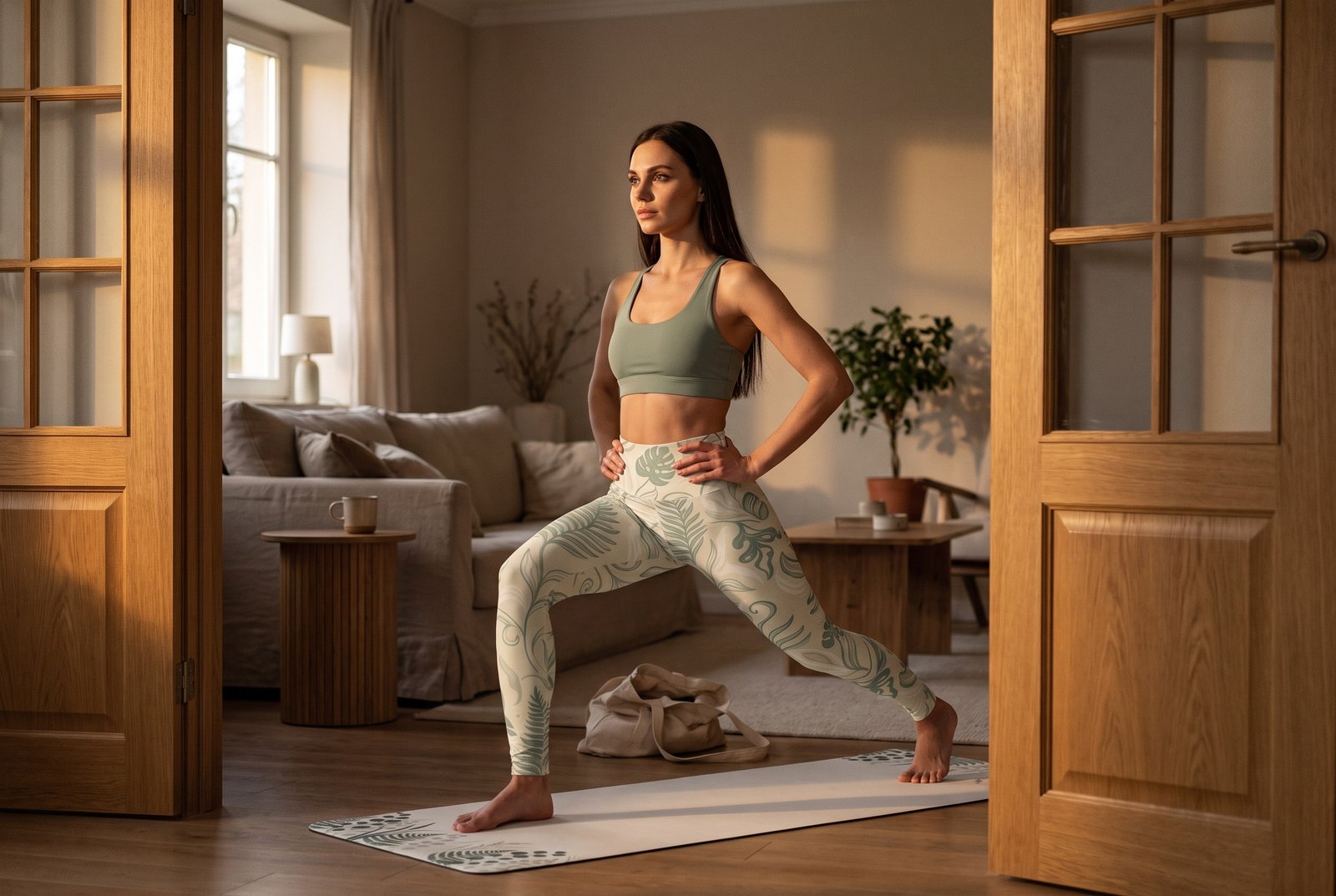
Step one foot back about a stride length, toes facing forward, back heel lifted. Rest a hand on the car for balance. Now tuck your tailbone down and under, as if shortening the distance between your pubic bone and your ribs, and squeeze the back glute.
You should feel it across the front of the back hip and upper thigh. You should not feel a pinch in the lower back; if you do, tuck harder rather than lunging deeper. This is the movement that undoes the seat. If you want more on this pattern, the same principle runs through hip flexor work for desk sitting — the car is just a chair that moves.
2. Quad hold at the door, 30 seconds each side
Hold the door frame or roof rail, bend one knee, catch the ankle behind you. Keep the knees side by side and the tailbone tucked. Sensation belongs in the front of the thigh.
If you can’t reach your ankle, loop a belt, a dog lead or a jumper sleeve around the foot and hold that instead. The right leg often feels tighter here — it’s been working the accelerator while the left sat still.
3. Hamstring hinge on the bumper, 40 seconds each side
Now the back of the legs, and only now. Heel on the bumper, a kerb, or the bottom step. Leg straight but not locked, toes pointing up, hands on the standing thigh.
Hinge forward from the hip crease with a long flat back, chest leading. Stop the moment your lower back starts to round — that’s the end of the useful range, regardless of how far you got.
Feel: a long pull from sit bone to knee. Don’t feel: anything electric down the back of the leg into the calf or foot. That last one is a reason to stop and read the final section. For a fuller version once you’re home, the hamstring routine for sitting all day picks up where this leaves off.
4. Door frame chest opener, 30 seconds each side
Forearm flat against the door frame or the edge of the open car door, elbow at shoulder height. Step the same-side foot forward and rotate your chest away from the arm.
This targets the front of the shoulder and chest, which closed down around the steering wheel. You want a broad stretch across the front of the shoulder, not a pinch at the front of the joint. If it pinches, drop the elbow lower than shoulder height and try again.
5. Calf and ankle at the kerb, 30 seconds each side
Ball of the foot on the kerb edge, heel dropping below it, hand on the car. Keep that knee straight for 20 seconds, then bend it slightly for the last 10 to reach the deeper calf nearer the achilles.
Driving locks the ankle into a narrow range. Restoring it is why your first flight of stairs afterwards feels less like a negotiation.
6. Standing rotation and extension, 20 seconds each direction
Hands on the car roof, feet hip width. Keep the hips facing forward and turn your ribcage one way, then the other, 20 seconds each — gentle, no bouncing.
Then stand tall, hands on the back of your pelvis, and lean back a small amount, looking forward not up. Ten to fifteen seconds, repeated twice. Small range, and it should feel like relief rather than compression. If leaning back produces a sharp jab, skip it and do the rotations again instead.
How to stretch while driving
Honestly: barely at all, and nothing that takes a hand off the wheel or an eye off the road. What you can do while moving is small and postural.
Pull the shoulder blades gently back and down for five seconds, release, repeat a few times. Press the back of the head lightly into the headrest for five seconds. Roll the left ankle in circles while the right foot works. Unclench the jaw and the hands, since most people drive gripping far harder than the task needs.
The useful stuff happens at the stop. Every ninety minutes, get out and do movements one, three and five from the list above. Three minutes at a petrol station is worth more than thirty minutes of regret at the other end.
If the lower back is the loudest part
Lower back ache after driving all day is usually the pelvis having been tipped back for hours with the lumbar curve flattened against the seat. The fix is not to attack the back itself.
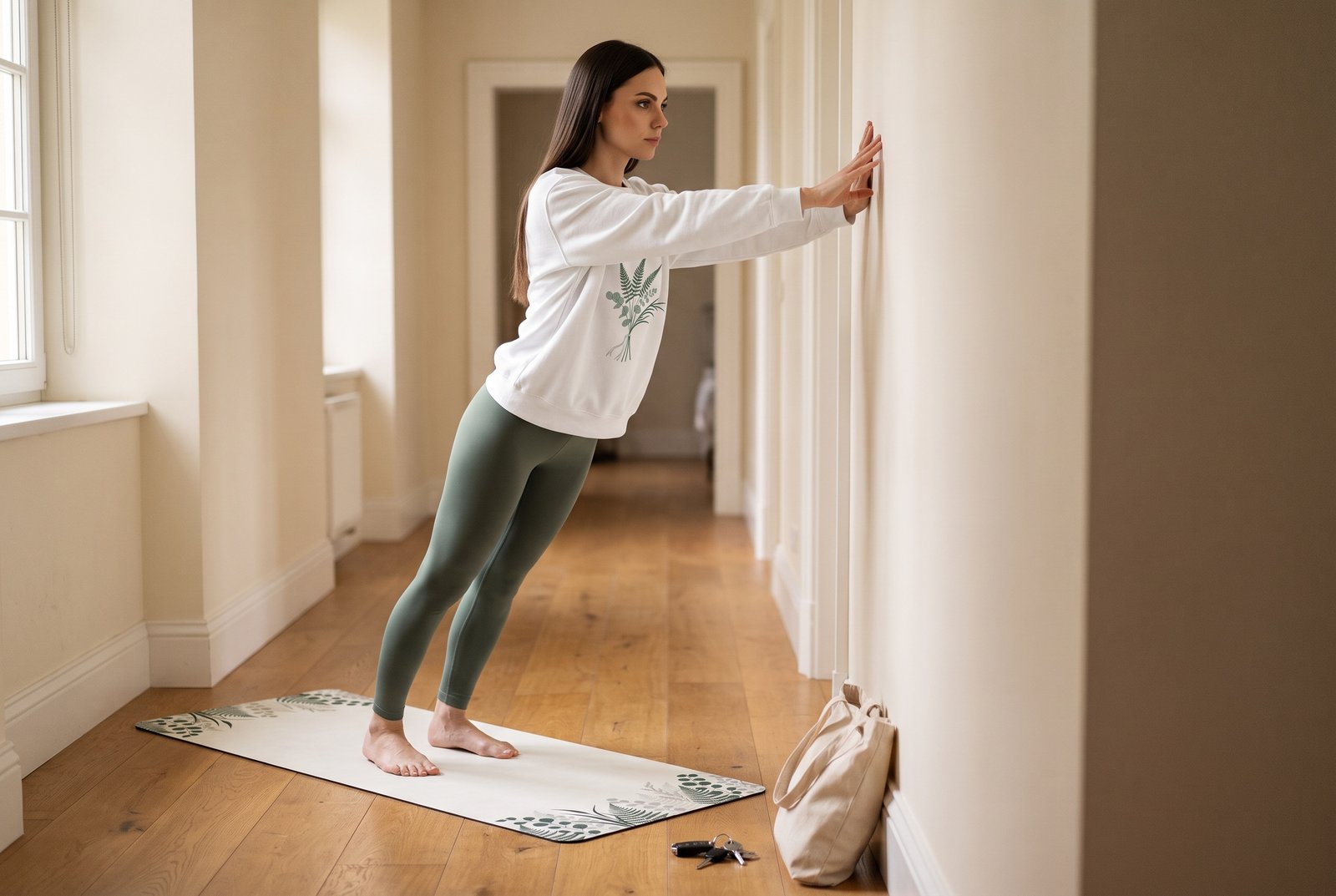
Do the hip flexor hold, then the rotations, then a wall-supported version of the forward hinge: stand an arm’s length from a wall, hands on it, hips back, long spine, 30 seconds. Added support means the back can stop bracing.
For the drive itself, a rolled towel in the small of the back does most of what a lumbar cushion does, for free. If you want something firmer that holds its shape over a thousand miles, a small bolster or lumbar roll is the usual next step — but try the towel for a week first.
When this needs a professional, not a stretch
Stretching is for stiffness. It isn’t the answer to everything that aches after a drive.
Book a physiotherapist or GP if you have pain radiating below the knee, numbness or pins and needles in the foot, weakness lifting the foot or standing on tiptoe, back pain that wakes you at night, or anything that followed a crash or a jolt. Same if the stiffness hasn’t shifted after a few days off the road. Those are assessment questions, and no routine on the internet can answer them.
Bad day minimum: hip flexor hold, 45 seconds each side, standing against the car. Then walk for two minutes. That alone takes the edge off most of it.
If it hurts: stop. A stretch should feel like broad tension easing, never sharp, never electric, never numb. Pain down the leg or into the foot is a physiotherapist’s question, not a deeper stretch.
Next drive: stop every ninety minutes and do three movements standing. Cheaper than arriving stiff.
General movement guidance, not medical advice. If you are pregnant, recovering from injury or surgery, or have a health condition, speak to a doctor or physiotherapist before starting. Stop if anything is sharp, numb or tingling. Photographs are AI-generated illustrations featuring Elena.


