

A 500 ml PET water bottle is roughly 6–7 cm across and 20–23 cm tall, depending on the brand. A common short foam roller is 33 cm long and 15 cm in diameter. Those two numbers are the whole argument, and most of the internet skips them.
So, before anything else: the bottle isn’t a smaller roller. It’s a different tool with a different contact patch, and it’ll do some jobs well and others badly for reasons you can work out on paper. What follows compares household stand-ins with purpose-made rollers on length, diameter and surface, using published specifications only — nothing here has been tested by us.
What diameter actually changes
Diameter sets two things: how deep the pressure goes into one spot, and how far your body sits off the floor.
A 15 cm roller lifts the spine or the calf high enough that the limb can hang and the other leg can stack on top. A 6 cm bottle barely clears the floor, so the surrounding soft tissue bottoms out and the load spreads. Narrower isn’t gentler. It concentrates force into a thinner strip, which is why a tennis ball under the shoulder blade feels sharper than a roller across the whole upper back.
Length sets what you can balance on. At 33 cm you can run a roller across one calf or one thigh. At 90 cm you can lie along it, spine on the roller, both shoulder blades supported, which is a position no household object replicates. A 1.5 L bottle, at around 30–33 cm tall and 8.5–9 cm wide, is the closest household match to a short roller — and the most likely to buckle.
Substitutes for a foam roller, by the numbers
Figures below are typical published or regulated dimensions, not measurements we took. Bottle and towel sizes vary by brand and by how tightly you roll.
| Option | Typical length | Typical diameter | Surface | Where it suits |
|---|---|---|---|---|
| Standard foam roller (short) | 30–33 cm | 15 cm (some 10 cm) | EVA or moulded EPP, smooth or ridged | Calves, quads, upper back, lats |
| Long foam roller | 90 cm | 15 cm | Same, often firmer core | Lying along the spine, chest opening |
| 1.5 L PET bottle, full | ~30–33 cm | ~8.5–9 cm | Ribbed plastic, slippery when wet | Quads, calves, short sessions |
| 500 ml PET bottle, frozen | ~20–23 cm | ~6–7 cm | Hard, cold, ribbed | Sole of the foot, forearms |
| Tennis ball | — | 6.54–6.86 cm (ITF regulation) | Felt over hollow rubber, compliant | Glutes, under the foot, around the shoulder blade |
| Lacrosse ball | — | ~6.3–6.5 cm, 140–147 g (regulation) | Solid rubber, almost no give | Glutes, pecs — far sharper than tennis |
| Rolling pin (barrel type) | ~25 cm barrel | ~5–6 cm | Hard wood, handles turn independently | Quads, calves, seated use |
| Rolled bath towel | ~70 cm | ~10–12 cm rolled | Soft, compresses under load | Support, not pressure |
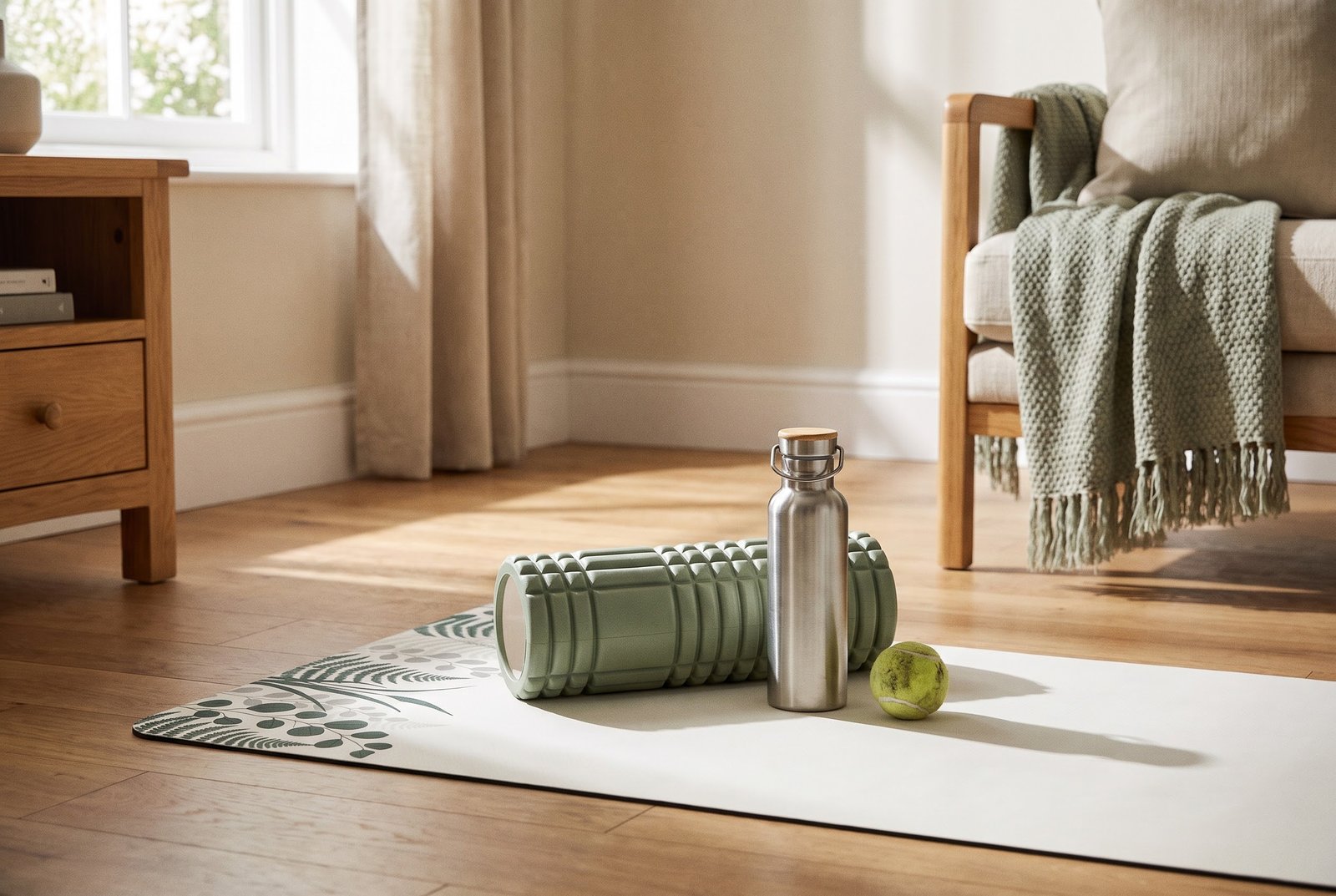
Foam roller alternative for back
This is where free options do worst. The upper back wants a long, wide, slightly compliant surface, and nothing in a kitchen is 90 cm long and 15 cm round.
Two balls in a sock, placed either side of the spine, is the usual workaround — the gap keeps pressure off the bony bits. It covers a few centimetres at a time instead of the full span, so expect to spend longer. A rolled towel laid lengthways under the spine gives support and a mild chest opening, but it compresses to almost nothing under body weight, so a towel roll is a prop, not a pressure tool.
If the back is the main reason you want a roller, the 90 cm version is the one household objects can’t imitate. That’s an honest reason to buy rather than improvise.
Foam roller alternative for calves
Calves are the easiest muscle group to serve with substitutes, because you sit, bend the knee, and apply pressure by hand rather than by body weight.
A full 1.5 L bottle laid on the floor with the calf on top works at roughly 9 cm, lower than a roller, so you’ll lift the hip more to load it. A rolling pin used seated, two hands on the handles, gives finer control than any floor method, and a 5–6 cm hardwood barrel concentrates pressure considerably. Start lighter than feels necessary.
Calves that are tight every morning usually have a hamstring and hip story behind them. The hamstring routine for sitting all day is a better first move than any rolling at all.
The frozen bottle under the foot costs nothing and works fine
Be honest about this one: for the sole of the foot, a frozen 500 ml bottle beats a purpose-made roller on every attribute that matters, and costs nothing.
The foot is a small area. It wants something 6–7 cm across, firm, and long enough to span heel to ball, about 20 cm. A frozen bottle hits all three, adds cold, and you roll it seated at a desk for three or four minutes without changing out of your shoes-off state. Freeze it two-thirds full so the ice doesn’t split the plastic, and wrap it in a thin cloth rather than pressing bare skin onto frozen PET.
Anyone who sells you a dedicated foot roller for this is selling you a bottle with a logo.
Foam roller alternative for travel
Rollers are the worst packing shape in fitness: a 33 × 15 cm cylinder is roughly five litres of air in a suitcase. Hollow-core travel versions exist and pack socks inside, which helps.
Simpler: a tennis ball weighs around 58 g and goes in a jacket pocket. Buy a bottle of water on arrival for the larger muscles and recycle it on the way out. For a long-haul stiffness session in a hotel room, the floor plus the five-minute morning stretch routine covers more ground than any rolling, because hotel carpet has more give than a mat and rolling on it is vague.
Where household stand-ins genuinely fail
Glass bottles. Don’t use one under body weight — the failure mode is not a bruise.
Then there’s the slow stuff. PET bottles dent permanently after a few sessions, and the ribbing dents first, which makes the surface uneven. Rolling pins have no give at all, so there’s no safety margin if you misjudge the load. Tennis balls lose compliance as the felt wears. A moulded EPP roller is rated by manufacturers for repeated loading and doesn’t change shape week to week, which is the real thing you buy: consistency, not performance.
Storage matters more than people expect. A roller that lives behind a door gets used; one in a cupboard doesn’t. If you’re putting a corner together, the under-£200 stretching corner piece sets out what actually earns its floor space.
When rolling is the wrong answer
Pressure on a sore spot is for general stiffness, not for diagnosis. If pain is sharp, localised, present at rest, wakes you at night, comes with numbness, tingling or weakness down a limb, or follows a specific injury, stop rolling it and book a physiotherapist rather than working harder on the same spot. Rolling over a suspected stress fracture, a calf clot or an inflamed nerve makes a bad week longer. Nothing in this article is medical advice.
If it’s your feet: freeze a 500 ml bottle two-thirds full, wrap it in a tea towel, roll three minutes per foot at the desk. Buy nothing.
If it’s your calves or quads: a full 1.5 L bottle or a rolling pin used seated will do the job this month. Replace the bottle when it dents.
If it’s your upper back: no household object is 90 cm long and 15 cm round. Use two balls in a sock either side of the spine, or buy the long roller — this is the one case where the purchase answers something improvisation can’t.
If you keep abandoning the routine: the tool was never the problem. Pick two positions, put them after an existing habit, and leave whatever you use in plain sight.
How this comparison was made: we compared manufacturers’ own published specifications, not our own testing. Where we sell something ourselves we say so. Photographs are AI-generated illustrations featuring Elena, our AI guide.


