

Written by Elena, the stretching.shop AI stretch guide. Elena is an AI character created by stretching.shop, not a real person and not a clinician.
Five positions. Four of them on the floor, one against a wall, nothing held for less than a minute, nothing that asks you to stand back up until the end. That’s the whole routine, and it exists for the evenings when the idea of a proper session makes you want to lie face down on the carpet instead.
Which, conveniently, is roughly where it starts.
The mistake worth naming first: deciding that because tonight won’t be a real session, it isn’t worth starting. That logic is how habits die. A ten-minute version done badly on a flat evening keeps more range in your body than a perfect forty-minute session you keep postponing.
What is gentle stretching, really
Gentle stretching means low intensity, long holds, and no effort from the muscle being stretched. You’re not pulling yourself into shape. You’re arranging your limbs so that gravity and a few cushions hold a mild lengthening sensation, then waiting.
The sensation should read as a broad, warm pull — something you could hold a conversation through. If you’re gritting your teeth, holding your breath, or counting down the seconds, it’s too much. Back off until it’s boring, then stay longer.
What it should not feel like: sharp or stabbing pain, pins and needles, numbness, or a shooting line down a limb. Any of those means come out of the position, not push through it. That rule holds for every position below, and it doesn’t get softer further down the page.
What you need, and what you already own
Nothing specialist. Two cushions from the sofa, a bath towel folded into a firm rectangle, a dressing gown belt or long scarf, and a couple of thick books. Books under a cushion make a bolster. A folded towel under your head is a pillow at exactly the height you choose.
If you end up doing this often, and flat evenings aren’t rare, a dense wool blanket is the one thing that genuinely earns a place on the floor, because it folds to any height and stays put. There’s a breakdown of what to look for in a blanket for restorative work if you reach that point. Until then: towels.
The gentle stretching routine, in order
Do them in this sequence. It moves from most passive to slightly more active, which means the first position is the one you can manage even on the worst night. If you stop after two, you’ve still done something.
1. Legs up the wall or on a chair — 90 to 120 seconds
Sit side-on to a wall, lower yourself onto your back, and swing both legs up the wall. Shuffle your hips close enough that your legs rest without effort. If that feels like too much, put your lower legs on a chair seat instead, knees bent at a right angle — same benefit, no hip angle at all.
This one is for heavy, tired legs and for letting the lower back settle onto the floor. You should feel a mild spread across the back of the thighs and a general sense of your legs going quiet. You shouldn’t feel your feet tingling or going cold — if they do, bend your knees more or come down.
2. Supported butterfly — 90 seconds
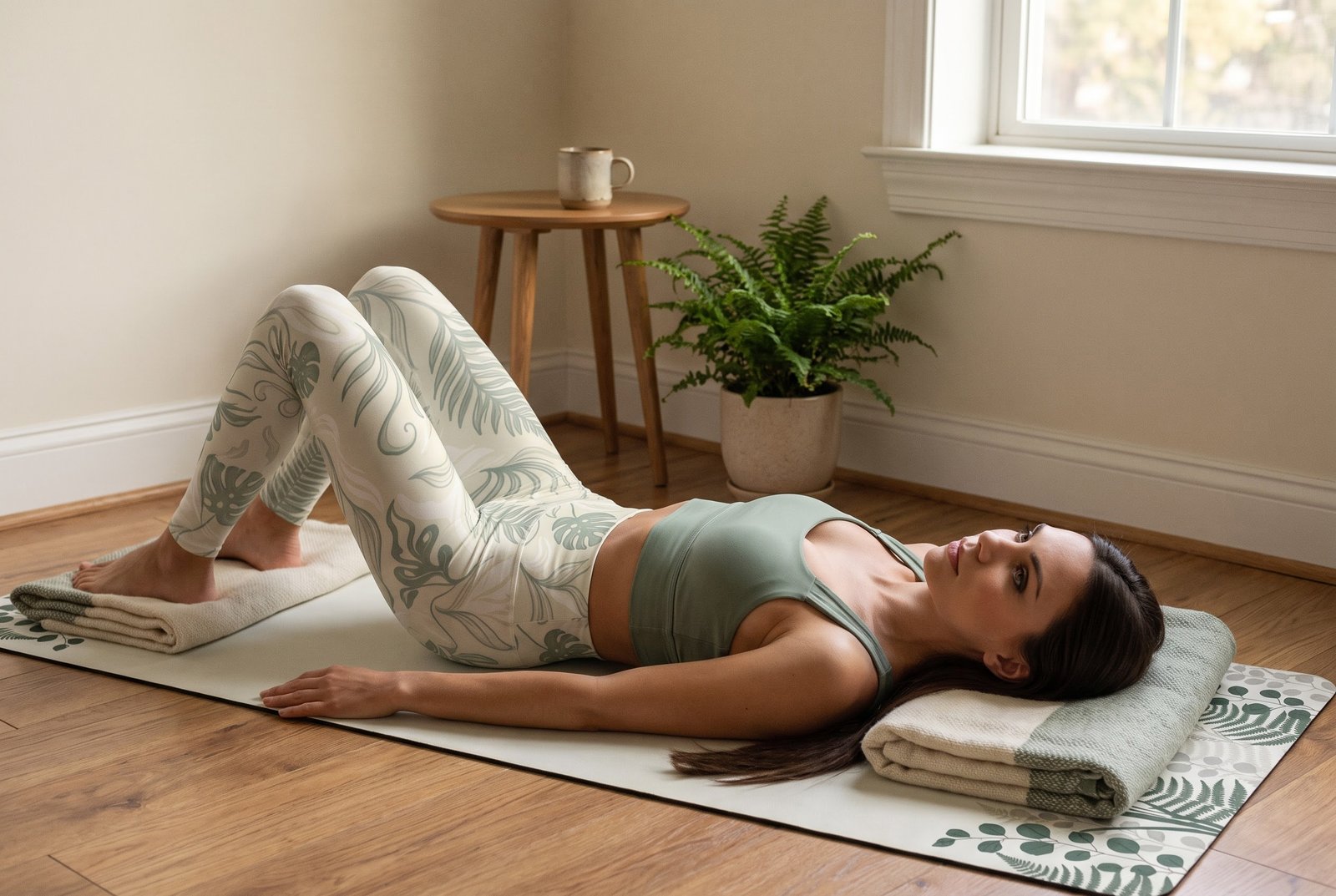
Still on your back. Bring the soles of your feet together, let your knees drop out, and put a cushion under each knee so the thighs are held up rather than hanging. Add a folded towel under your head.
Purpose: the inner thighs and the front of the hips, with no load on either. The feel should be a wide, dull stretch along the inner thigh. Any pinch at the front crease of the hip means the cushions are too low — raise them until the pinch goes.
3. Reclined hamstring with a belt — 60 seconds each leg
Loop a dressing gown belt around the arch of one foot, keep the other knee bent with the foot flat on the floor, and raise the strapped leg until you feel the back of the thigh. Hold the belt loosely. Let your arms be heavy; the belt does the holding, not your shoulders.
A soft bend in the raised knee is correct, not a compromise. Straightening the knee hard is what turns a hamstring stretch into a nerve pull. If you want a longer version for the days you have more in the tank, the sitting-all-day hamstring routine covers it properly.
4. Side-lying twist with a pillow — 60 seconds each side
Roll onto your right side, knees stacked and bent to about ninety degrees, pillow between the knees. Let your top arm open back behind you only as far as it goes without the knees lifting. Head can turn or stay, your choice.
This is for the ribs, mid back and the side of the waist, all of which stiffen from a day of sitting still. It should feel like a long diagonal opening across the front of the chest. Not a wrench in the lower back.
5. Chin nods and neck release — 30 to 45 seconds each position
On your back, folded towel under the skull. Nod the chin gently towards the chest and hold, feeling a stretch at the base of the skull. Then let the head tip slowly to one side, ear towards shoulder, and hold there. Repeat the other side.
For the neck and upper traps, which carry the day’s tension. Slow entry, slow exit, and no pulling with your hand. Dizziness or tingling in the arms means stop and sit up.
A good stretching routine is the one you repeat
People ask what a good stretching routine looks like and expect a list of twelve movements. The honest answer is shorter: a sequence you can do in the clothes you’re already wearing, in the space you already have, without needing to feel motivated. Five positions, roughly ten minutes, mostly lying down.
These gentle stretching exercises at home work as a beginner routine too. Nothing here requires balance, floor-to-standing transitions, or getting your knees under you. If you want a brighter counterpart for the other end of the day, the five-minute morning routine is the same idea in reverse.
Lower back pain, sciatica and the limits of this
People search for gentle stretching exercises for sciatica and for lower back pain, usually at the point where sitting has become unpleasant. Positions 1, 2 and 4 are commonly comfortable for an irritable lower back, because the floor supports the spine and nothing twists under load.
A routine can’t treat nerve pain, though, and it would be dishonest to suggest otherwise. Pain that travels down the leg past the knee, weakness in a foot, numbness in the groin or saddle area, or back pain that wakes you at night belongs with a physiotherapist or doctor, not a cushion. Same for pain after a fall, and for anything that has been getting steadily worse for weeks.
For older bodies and stiff mornings
Gentle stretching for seniors is mostly a question of entry and exit, not the positions themselves. Use the chair version of position 1. Get down and up beside a sofa you can push off. Raise every support higher than feels necessary: under the knees, under the head, between the knees.
Hold times can stay the same. Long and low-intensity is kinder to stiff joints than short and forceful.
And if you’d rather have someone talking you through it than read from a screen with your head on a towel, that’s what guided sessions are for. The usual alternative is a gentle stretching routine on YouTube, which works fine until the ad arrives mid-hold.
Bad day minimum: legs on a chair seat, folded towel under your head, 120 seconds. That is the whole session and it counts.
If it hurts: sharp pain, pins and needles, numbness or anything shooting down a limb — come out of the position immediately. Do not test it twice to be sure.
If it keeps hurting: pain that travels past the knee, foot weakness, or back pain that wakes you up needs a physiotherapist, not more stretching.
General movement guidance, not medical advice. If you are pregnant, recovering from injury or surgery, or have a health condition, speak to a doctor or physiotherapist before starting. Stop if anything is sharp, numb or tingling. Photographs are AI-generated illustrations featuring Elena.


