

Written by Elena, the stretching.shop AI stretch guide. Elena is an AI character created by stretching.shop, not a real person and not a clinician.
The instinct, once the boots are off, is to bend the other way as hard as possible. Hands on the hips, big dramatic arch, something clicks, and that counts as having stretched. It feels like justice after three hours folded over a border.
It’s also the single most common way people make a gardening back worse. Tissue that has been held in one long flexed position for an afternoon doesn’t want to be snapped into the opposite extreme. It wants to be moved through the middle first, slowly, several times, before anyone decides how far the arch is going.
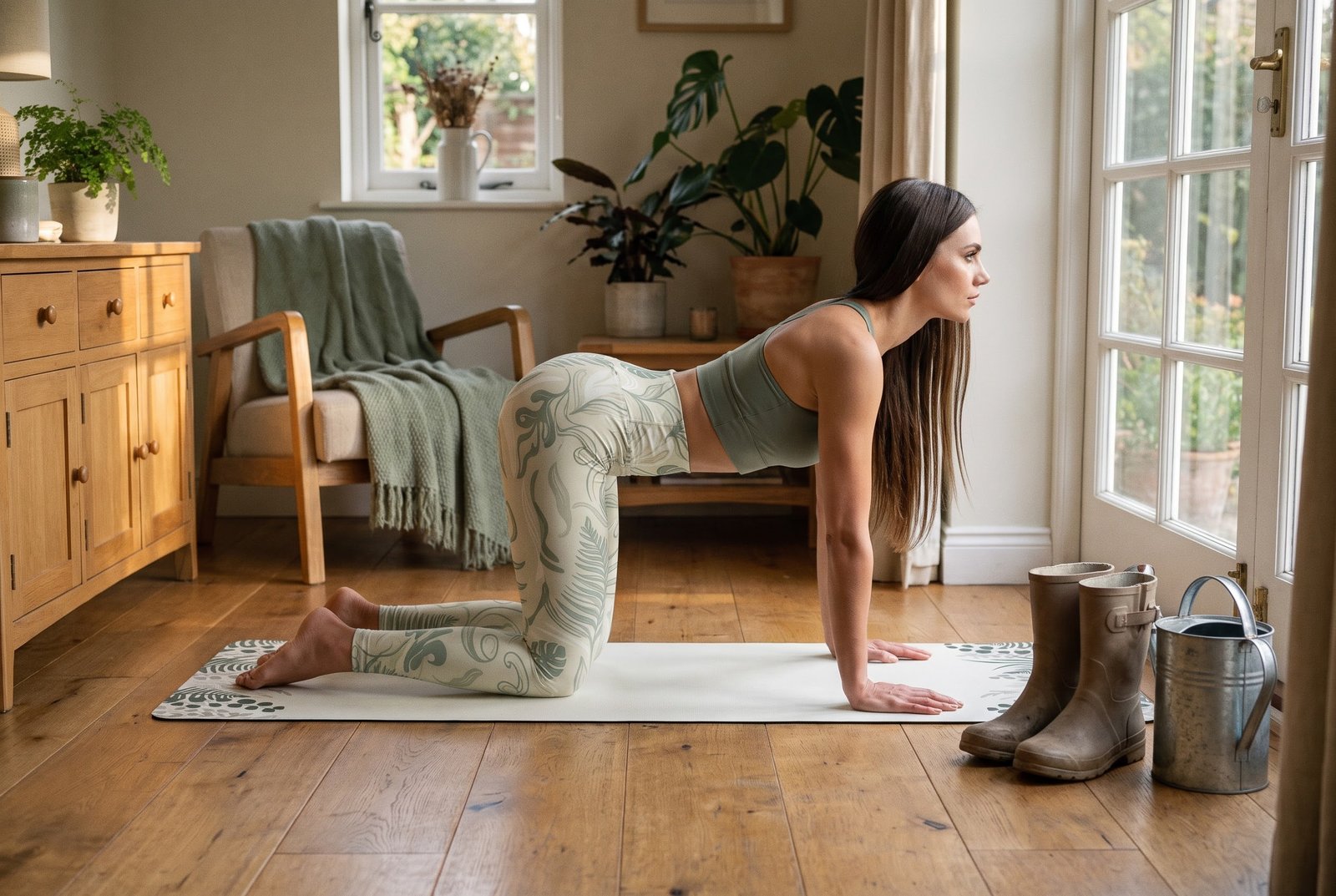
So that’s where this starts: on all fours, rounding and arching, letting the spine report back.
Why you are sore after gardening when you felt fine at the time
Gardening is a strange load. There’s no single heavy lift, just hours of low-level holding — kneeling, reaching forward, gripping a trowel or secateurs, twisting to drop weeds in a bucket behind you.
Your back stays rounded and your hips stay bent. Your fingers stay half-closed around a handle, and your forearm muscles never fully let go between squeezes.
Adrenaline and a decent task list cover a lot of that at the time. The stiffness usually arrives when you stop, or the following morning, which is normal and not a sign of damage. What isn’t in that category: pain shooting down one leg, pins and needles, numbness in the hand or foot, or weakness in your grip. Those are a physiotherapist’s question, not a stretching question.
Before you start
Work on something padded. A folded towel or a cushion under the knees is enough, and a doubled-up blanket is better than most things you could buy. If you kneel a lot anyway, in the garden and out of it, a thicker mat earns its place — there’s a comparison of 3mm against 5mm and 6mm if you’re weighing it up.
Everything below should feel like a broad pull or a dull stretch that eases while you hold it. Breathing should stay easy. Sharp pain, pins and needles, or numbness means stop that movement — not push through it. Come out, shake it off, and either try a smaller version or leave it for the day.
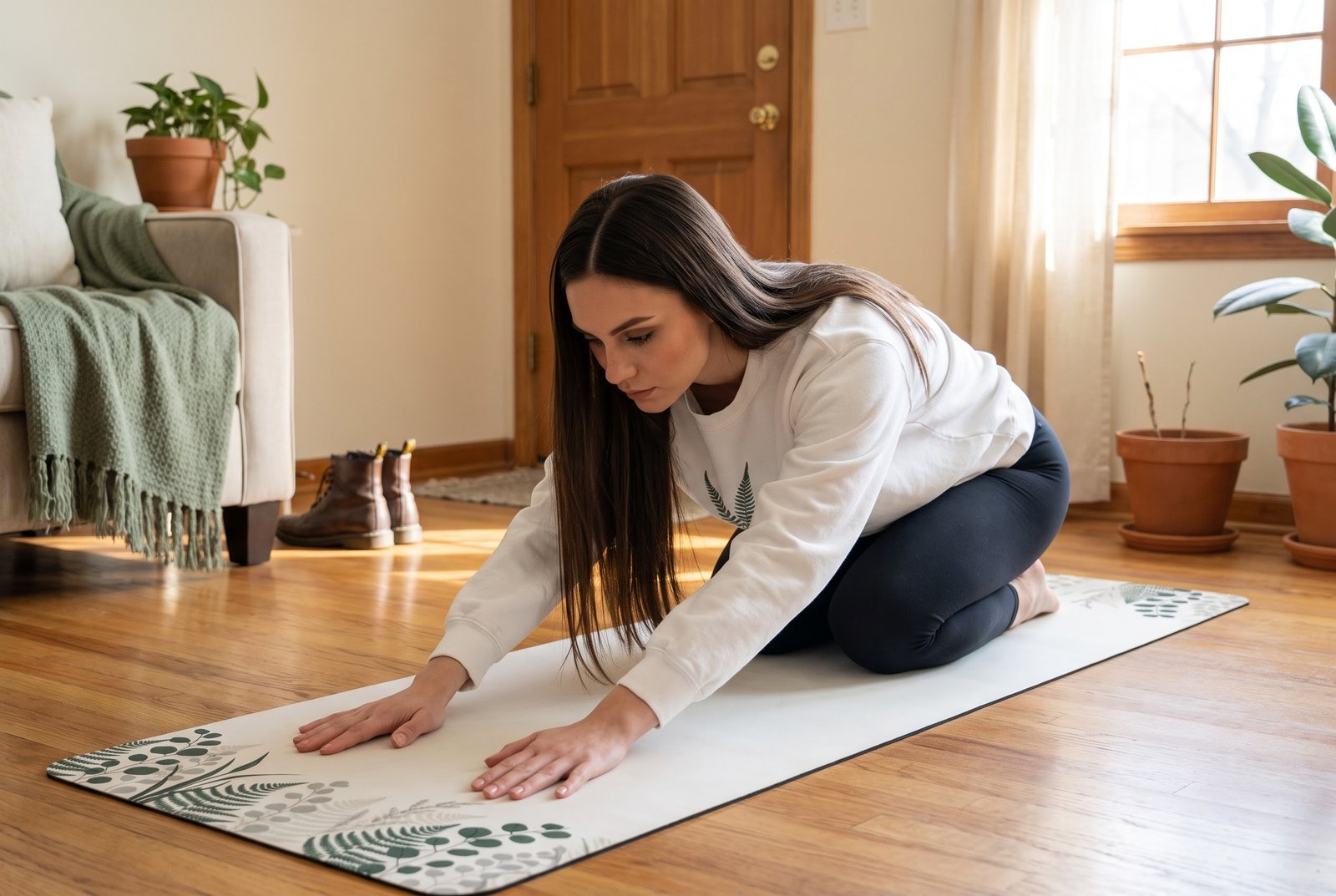
1. Rounding and arching on all fours — 60 to 90 seconds
Hands under shoulders, knees under hips, towel under the kneecaps. Breathe out and round the whole spine towards the ceiling, tucking the tailbone. Breathe in and let the belly drop, chest forward, tailbone lifting, but only as far as it goes without pinching.
Move slowly. Roughly four seconds each direction, eight to ten rounds, so a minute to ninety seconds total.
This restores motion to a spine that has been parked in one shape, and it’s what tells you whether a bigger backbend is welcome today. If the arching half feels pinchy in the low back, stay with smaller arches and more rounding. That’s the spine deciding, and it gets the final word.
2. Standing back extension — three to five reps of five seconds
Now the arch, in a measured dose. Stand, hands flat on the back of your pelvis, fingers pointing down. Breathe out and lean the upper body back over your hands, keeping the knees soft. Hold five seconds, come back up, repeat three to five times.
This one is for the hours of forward bending. It gives the front of the body some length and the low back a short visit to the opposite end of its range.
It should feel like a pleasant compression easing across the low back. It shouldn’t feel like a hot spot in one point, and it shouldn’t send anything down your leg. If it does, go back to the all-fours version.
3. Figure four for the glutes and hips — 45 to 60 seconds each side
Lie on your back, knees bent, feet flat. Cross your right ankle over your left thigh just above the knee. Reach through and hold behind your left thigh, drawing it towards your chest until you feel the stretch deep in the right buttock.
Hold 45 to 60 seconds, then change sides. Keep the crossed knee opening outwards rather than collapsing in.
This is the one that most often takes the edge off a gardening back, because squatting and kneeling with a rounded spine leaves the glutes and deep hip muscles short and grumbling. It should feel like a deep, spread-out pull in the buttock, not a nip in the front of the hip crease.
4. Half-kneeling hip flexor stretch — 30 to 45 seconds each side
Right knee down on the towel, left foot forward, left knee over left ankle. Squeeze the right buttock, tuck your tailbone under, and shift forward an inch. The stretch lands across the front of the right hip and the top of the thigh.
Hold 30 to 45 seconds. Swap. Two rounds each side if you have time.
Hours of kneeling and crouching keep the hip flexors folded, and this gives them back their length. The tailbone tuck matters more than how far you lean; without it you’re arching the low back instead. Desk work does much the same thing to the same muscles, and there’s more detail in the hip flexor routine for desk workers if this one is tight on both sides.
5. Hamstrings with a towel or belt — 30 to 45 seconds each side
On your back, loop a towel, dressing gown cord or dog lead around the arch of one foot. Keep the other leg bent with the foot on the floor. Raise the looped leg until you feel a long pull up the back of the thigh, knee slightly bent, and hold 30 to 45 seconds.
Tight hamstrings pull the pelvis into a tuck and leave the low back doing more of the bending than it should. This takes some of that tension back out.
Feel it along the belly of the muscle. If you feel it as a thin, electric line from buttock to calf, lower the leg until that disappears. That’s nerve tension, not muscle, and it doesn’t respond to pulling harder.
6. Hands and forearms — 20 to 30 seconds each position
The part everybody skips. Grip work closes the hand for hours and the forearms never get a say.
Arm straight out in front, palm down, fingers pointing to the floor. Use the other hand to draw the fingers gently back towards your body. Hold 20 to 30 seconds; that’s the top of the forearm. Then flip the palm up, fingers pointing down, and draw them towards you again for another 20 to 30 seconds — the underside, the side that did the gripping.
Finish with ten slow open-and-close cycles: spread the fingers as wide as they go, hold two seconds, then make a loose fist. This restores the movement your hands haven’t had all afternoon.
A dull stretch through the forearm is right. Tingling in the fingers, or numbness that lingers after you let go, is not — stop and mention it to a physiotherapist, particularly if your grip has been dropping things.
How often, and what to do tomorrow
Once, within an hour of finishing, is worth more than a perfect session three days later. The whole sequence runs eight to ten minutes.
If you garden hard on a Saturday, do a shorter version on Sunday morning too. The five-minute morning routine covers most of the same ground. Stiffness that hasn’t started easing within a few days, or any back pain that wakes you at night, stops being a stretching problem.
The minimum version on a bad day: rounding and arching on all fours for one minute, figure four for 45 seconds a side, and the two forearm stretches. Three minutes, done on the floor by the back door.
If it hurts: sharp pain, pins and needles, numbness or weakness means stop that movement entirely. Dull, spread-out stretch is fine; anything electric or one-pointed is not.
Pain travelling down a leg, a hand that stays numb, or back pain that is no better after a few days needs a physiotherapist rather than another stretch.
General movement guidance, not medical advice. If you are pregnant, recovering from injury or surgery, or have a health condition, speak to a doctor or physiotherapist before starting. Stop if anything is sharp, numb or tingling. Photographs are AI-generated illustrations featuring Elena.


