

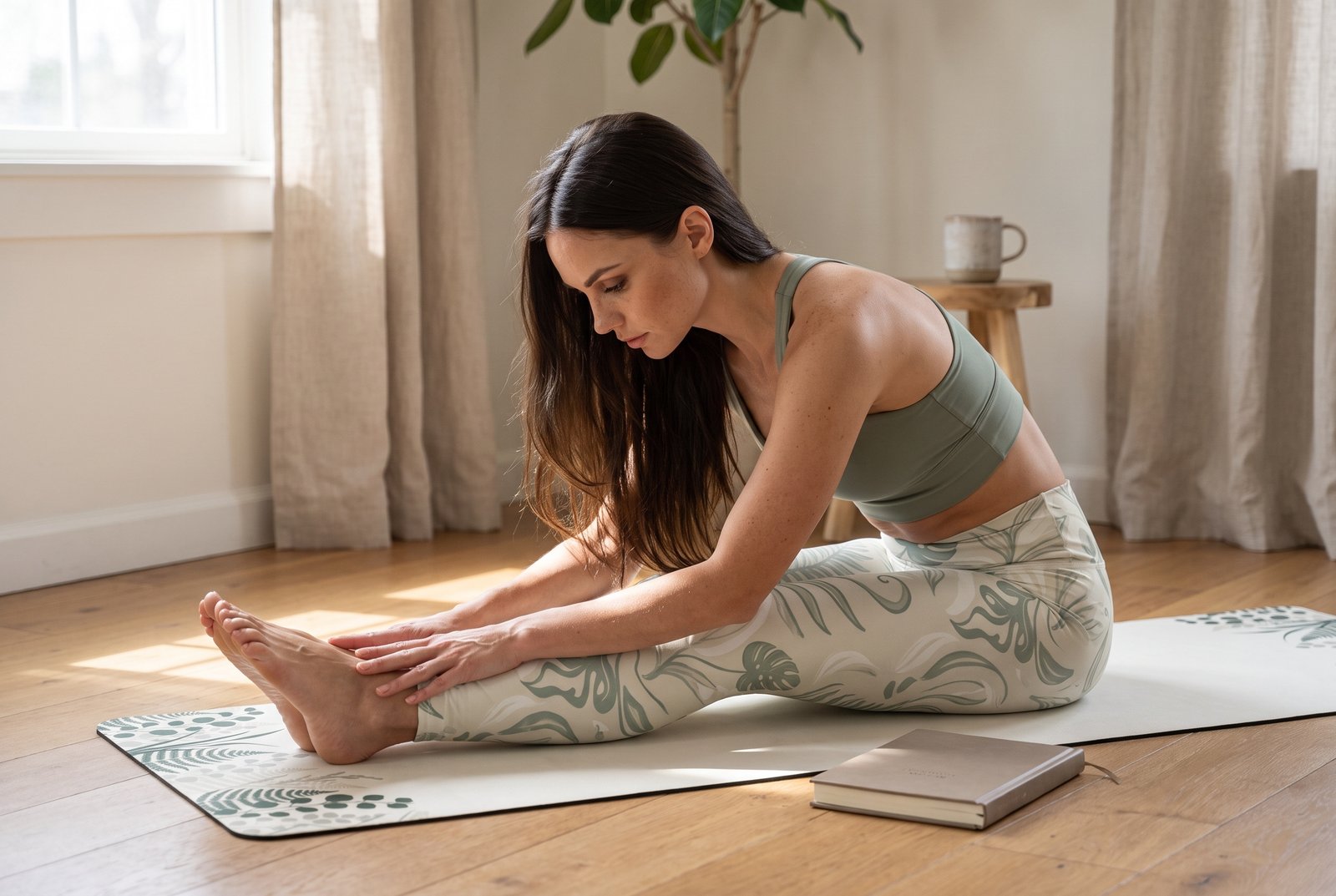
Written by Elena, the stretching.shop AI stretch guide. Elena is an AI character created by stretching.shop, not a real person and not a clinician.
Four short sessions a week will change your range. One long session every ten days won’t. That’s the least glamorous sentence in this article and also the one that matters most.
Most people arrive at stretching the same way: a weekend of good intentions, forty minutes on the floor pushing into every position they can remember, then two days of walking downstairs sideways. The soreness reads as proof. It isn’t. It’s a signal that the tissue got loaded harder than it was ready for, and the usual response is to avoid the floor entirely until the next burst of motivation.
Short and regular beats long and rare, every single time.
How to improve flexibility: the four-part weekly shape
Forget routines with twenty movements. Pick four positions, one for each of the places that actually restrict most people, and visit them four or five times a week for ten to twelve minutes.
- Backs of the legs — hamstrings and calves, the pair that limits bending forward.
- Front of the hips — hip flexors, shortened by every hour of sitting.
- Deep hip rotation — glutes and the muscles that let the leg turn out and in.
- Upper back and chest — thoracic rotation and extension, which quietly governs shoulders and neck.
That’s the whole map. You can do all four in one twelve-minute block, or split them: legs and hips on one day, hips and upper back the next. Frequency is the variable that does the work, not duration.
Working at the edge instead of past it
Here’s the distinction that separates progress from a sore week. The edge is the first point where the muscle clearly says something is happening here. Past the edge is where you start bracing, holding your breath, and gripping your jaw.
Aim for roughly a 4 or 5 out of 10. A broad, warm pulling sensation spread through the belly of the muscle. You should be able to breathe normally, talk in full sentences, and let the position soften under you over thirty seconds.
What it should not feel like: sharp, pinpoint, electric. Pins and needles, numbness or shooting pain down a limb means come out of the position now — that’s nerve territory, not muscle, and no amount of breathing through it helps.
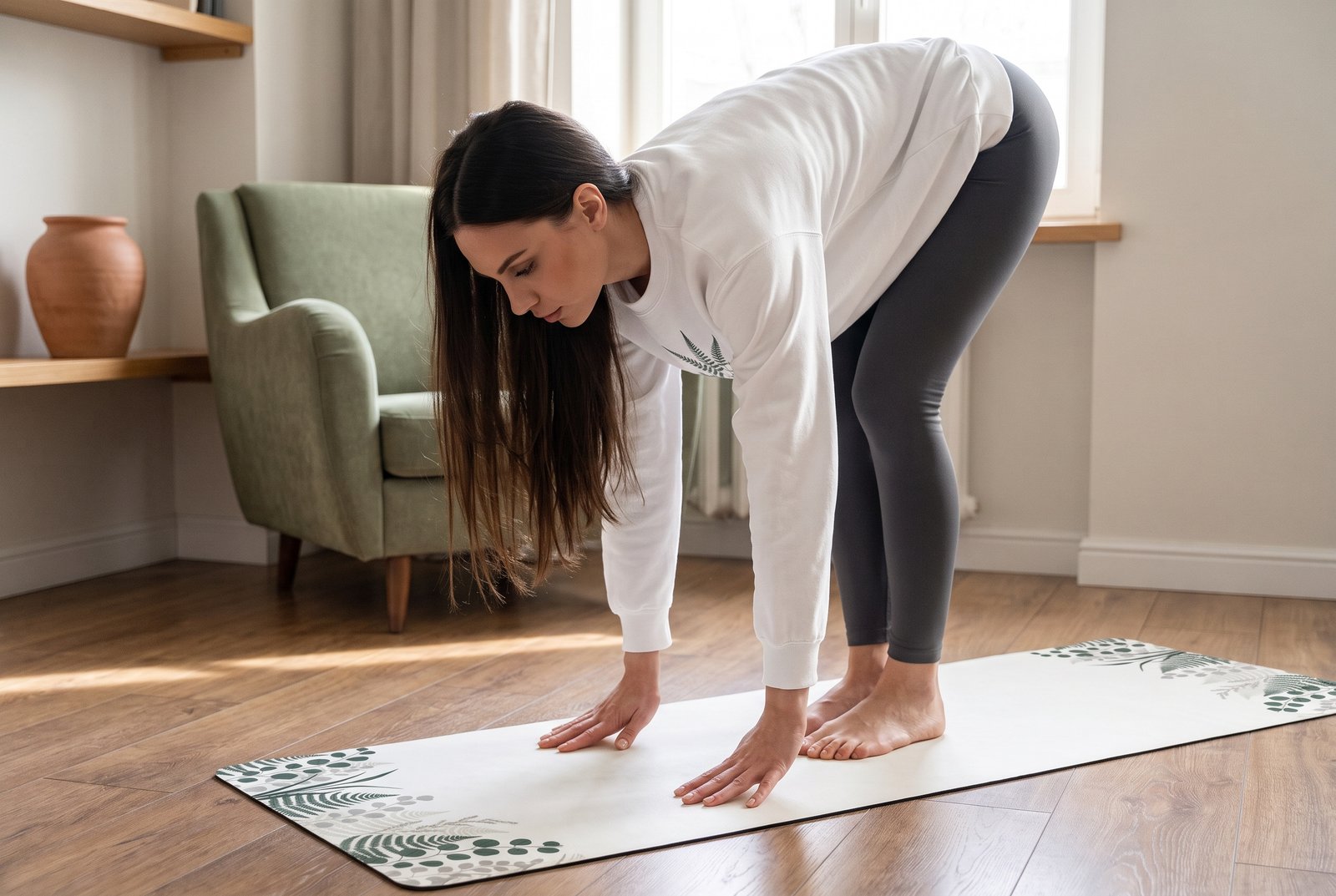
The four movements, with what each one is for
1. Supported hamstring stretch. Lie on your back, loop a belt, dressing gown cord or long towel around the arch of one foot, and raise that leg until you feel a broad pull up the back of the thigh. Keep the other leg bent, foot on the floor. Hold 45 to 60 seconds each side, two rounds. For the hamstrings and the forward-bend restriction that makes picking things up feel like a negotiation.
2. Half-kneeling hip flexor. Kneel on one knee with a folded towel underneath it, front foot flat. Tuck your tailbone slightly under, as if shortening the front of your waist, then ease your weight forward an inch. Hold 40 to 60 seconds each side. For the front of the hip and the sensation of being bent at the middle after a day in a chair.
3. Figure four on your back. Cross one ankle over the opposite thigh, thread your hands behind that thigh, draw it toward your chest. Hold 60 seconds each side. For the deep glute and outer hip, which is where a lot of people’s “tight hamstrings” actually live.
4. Seated thoracic rotation. Sit cross-legged or on a chair, place one hand on the opposite knee, lengthen upward, then rotate from the ribs and breathe into the turn. Hold 30 to 45 seconds each side, two rounds. For upper back rotation, which protects the neck and shoulders from doing jobs they weren’t built for.
How to improve flexibility in your legs and hamstrings specifically
Legs respond to frequency more obviously than anywhere else in the body. If hamstrings are your main complaint, add a standing calf stretch: back heel down, front knee bent, 45 seconds each side. A stiff calf drags on the whole chain when you fold forward.
Do the hamstring position daily if you sit for work. Twice a day on heavy desk days. Daily short exposure teaches the nervous system that the range is safe, which is most of what early flexibility gains actually are. There’s a fuller sequence in the hamstring routine for sitting all day if you want it laid out properly.
How to improve flexibility in your hips
Hips need three directions, not one. Flexion and extension are covered by the half-kneeling position above. Rotation means figure four, or 90/90 sitting if you can get there. Abduction is a simple wide-legged seated forward lean, 60 seconds.
Desk hips are a particular shape, and the hip flexor stretches for desk workers piece goes into that shape in more detail. The short version: nine hours at the same joint angle does it, not weakness or laziness.
How to improve flexibility for golf
Golf asks for rotation under speed, which means thoracic rotation and hip rotation are the two that matter. Add a half-kneeling rotation before you play — kneel, hold a club across your chest, turn 10 to 12 times each way slowly, no holds, just movement.
Before a round, move; after a round, hold. Long static holds immediately before an explosive sport aren’t ideal for power output. Save the 60-second holds for the evening or a non-playing day.
How to improve flexibility fast, honestly
A single session gives you a temporary increase that largely fades within the hour. That’s real, and it’s useful before activity — it just isn’t the thing you’re after.
Lasting change in range takes weeks. Four to six weeks of consistent short sessions is a reasonable window to notice something you didn’t have to think about: reaching the back of the car, pulling on socks, turning to reverse. Anyone selling you a week is selling you the warm-up effect.
Flexibility and mobility are not the same thing
Flexibility is how far a joint can be moved. Mobility is how far you can move it yourself, with control. The gap between the two is strength at end range.
So the best way to improve flexibility and mobility together is to add a small active piece: after a hamstring hold, lift the leg five times under its own power from the floor. Five slow reps. That teaches the range to belong to you.
Ways to improve flexibility at home, with nothing
You need a floor and something soft under your knees. A folded bath towel works for kneeling. A dressing gown belt replaces a strap. Two books under the hands turn a forward fold into something manageable.
If you’re on a hard floor often enough that your knees complain, that’s the point at which thickness becomes worth thinking about — the mat thickness comparison covers what changes between 3 mm and 6 mm. Until then, towels.
Yoga, classes, apps — what actually helps
People ask for the best yoga to improve flexibility, or the best class, or the best app. The honest answer is the one you’ll attend on a Tuesday evening in February. A slow hatha or yin class gives you long holds and someone keeping time. A dynamic vinyasa gives you less flexibility work and more conditioning.
Massage feels wonderful and can reduce the guarding that limits a stretch, but it doesn’t build range on its own.
When this is not a flexibility problem
Some things don’t respond to stretching because they aren’t tightness. A hard, bony end-feel in the hip that stops abruptly. Pain that wakes you at night. Numbness or weakness in a limb. A joint that gives way, or swelling that comes and goes.
Those belong with a physiotherapist or your GP, not a floor routine. Stretching an irritated nerve or an unstable joint reliably makes both worse.
Bad day minimum: one supported hamstring hold, 45 seconds each side, lying on the bedroom floor before you get up. That’s it. It counts, and it keeps the habit alive until the good days come back.
If it hurts: sharp, pinpoint, electric, or anything that tingles or goes numb — come out immediately and don’t return to that position. Dull, broad and fading is fine. Sharp is information.
If the same spot bites every time for more than two weeks, stop stretching it and get it looked at by a physiotherapist.
General movement guidance, not medical advice. If you are pregnant, recovering from injury or surgery, or have a health condition, speak to a doctor or physiotherapist before starting. Stop if anything is sharp, numb or tingling. Photographs are AI-generated illustrations featuring Elena.


