

Written by Elena, the stretching.shop AI stretch guide. Elena is an AI character created by stretching.shop, not a real person and not a clinician.
The last set is racked and the body is still running on something. Heart rate high, hands a bit shaky, quads buzzing in that pleasant, slightly hollow way. This is the moment most people either skip the cool-down entirely or drop straight into the deepest hamstring fold they own.
Both are a mistake, and the second one is the more interesting mistake.
Warm tissue tolerates more range. That’s true, and it isn’t a reason to go hunting for your end range while your nervous system is still shouting. A cool-down isn’t the place to make progress. It’s the place to come down.
Should you stretch right after working out?
Not right after. Give it five to ten minutes. Rack the weights, walk, drink something, let your breathing drop back to where you could hold a conversation without pausing.
If you stretch while you’re still panting, two things happen: you can’t feel much, and you tend to use force instead of time. The cool-down starts when your breath has settled, not when the last rep finishes. Anywhere from five minutes to half an hour later is fine. If you stretch an hour after in front of the television, that still counts.
People also ask the reverse — is stretching after a workout bad? Static holds after training aren’t going to undo your session. The thing worth avoiding is aggressive, bouncing, max-range stretching on legs you can barely stand on. That’s where people tweak something.
What does stretching after a workout do
Honestly: less than the internet promises, and more than nothing.
It gives you a few quiet minutes with a body that just worked hard, which has value in itself. It gets joints through ranges that loaded training tends to shorten, hips after squatting, chest after pressing. Plenty of people simply feel better walking out than they did walking off the platform.
What it doesn’t reliably do is prevent soreness. If you trained legs hard on Tuesday, Thursday will let you know regardless of how long you held a quad stretch. Treat stretching after a workout as maintenance of range and a way to come down, not as insurance against DOMS.
On the muscle growth question — stretching isn’t a driver of hypertrophy in any way you should plan your training around. Load, progression and food do that. Search results that say otherwise are usually stretching the evidence further than the hamstring.
If you look up NHS-style guidance on stretches after exercise, the advice is unglamorous and sound: stretch while still warm, hold the position, don’t bounce, don’t push into pain. That’s roughly what follows.
The six holds
Total time is about eight minutes. Breathe through the nose if you can. Each hold should feel like a broad, warm pull through the belly of the muscle, somewhere around a five or six out of ten. It shouldn’t feel sharp. No pins and needles, no numbness. Sharp pain, tingling or numbness means come out of it, not breathe into it.
1. Side-lying quad hold — 30 seconds each side
Lie on your side, bend the top knee and catch the ankle or trouser leg behind you. Draw the knee slightly back and tuck the tailbone under so the lower back doesn’t arch. For the front of the thigh and knee after squats, lunges or anything with a long eccentric. You should feel it down the front of the thigh, not inside the knee joint. If the knee complains, hold the trouser fabric rather than the ankle and reduce the bend.
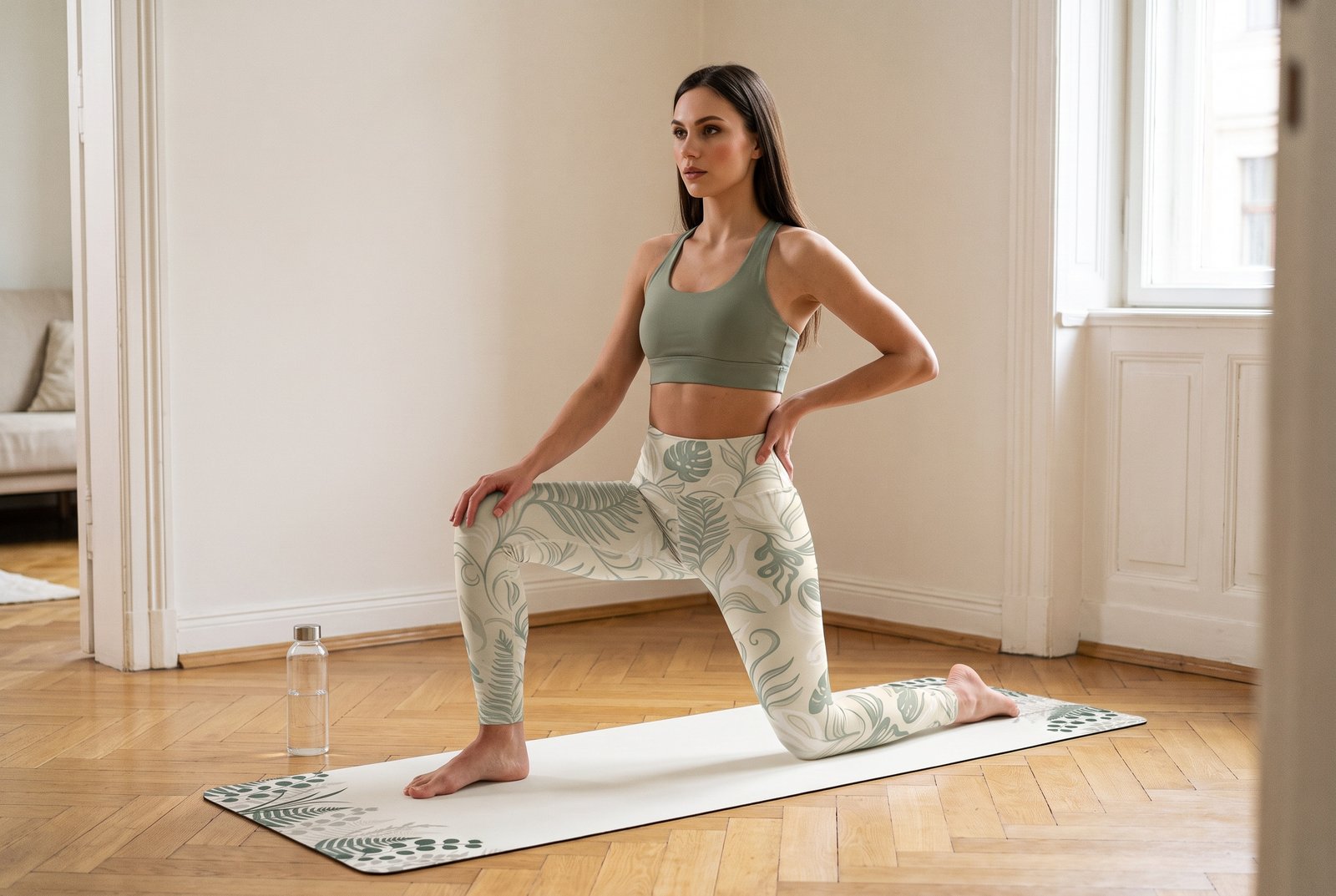
2. Half-kneeling hip flexor — 40 seconds each side
One knee down, other foot forward, both hips facing the same way. Squeeze the glute on the kneeling side and let the pelvis drift forward an inch. That inch is the whole stretch. For the front of the hip, which shortens from sitting and from heavy hinging. Do not arch the low back to get more. A folded towel under the knee is plenty; if the floor is genuinely unkind, mat thickness matters more than you’d think. More options in hip flexor stretches for desk workers.
3. Supine hamstring with a strap — 45 seconds each side
On your back, loop a dressing-gown belt, towel or resistance band around the arch of one foot. Leg goes up with a soft knee, other leg bent with the foot flat. Pull gently until you feel the back of the thigh. For hamstrings after deadlifts, RDLs or sprints. A soft knee isn’t cheating. It keeps the pull in the muscle rather than hauling on the back of the knee. If you feel a cord-like line down into the calf or electrical tingling into the foot, lower the leg. That’s nerve, not muscle. The sitting-all-day hamstring routine goes deeper on this one.
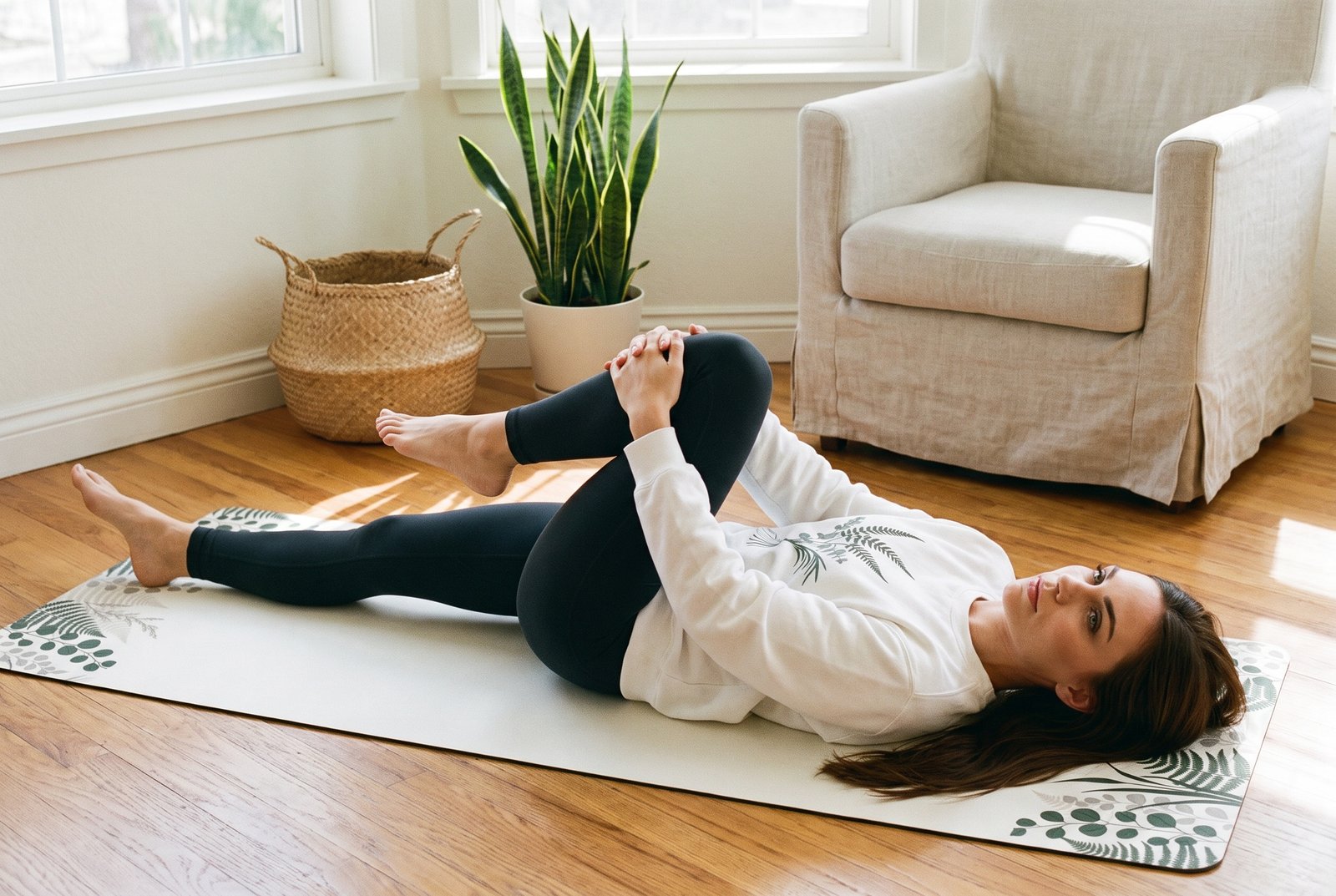
4. Figure-four, lying — 40 seconds each side
Ankle across the opposite thigh, reach through and draw the supporting thigh toward you. For the glutes and the outside of the hip, which take a beating in squats, hip thrusts and anything single-leg. You want a deep, dull stretch in the back of the hip. Pinching at the front of the hip socket means back off the angle — try letting the knee fall a little more open.
5. Doorway chest opener — 40 seconds each side
Forearm on the door frame, elbow roughly shoulder height, step the same-side foot through and turn your chest away. For the chest and front of the shoulder after pressing. Feel it across the front of the chest. Pain in the front of the shoulder joint itself is your cue to lower the elbow. One arm at a time, so you can keep the ribs down.
6. Overhead triceps and lat — 30 seconds each side
Hand behind the head, other hand gently on the elbow, then side-bend away from that arm. For the triceps, the lat and the back of the shoulder after rows, pull-ups and anything overhead. The side-bend is what brings the lat in. Keep the neck long and the jaw loose.
Trimming it for leg, arm, back or core days
You don’t need all six every time. Pick what you loaded.
Stretches after a leg workout: quad, hip flexor, hamstring, figure-four. Four holds, five minutes. Arm stretches after a workout: doorway chest, overhead triceps, plus a cross-body shoulder hold for 30 seconds each side.
After a back workout, the overhead lat hold earns its place, and the figure-four will often ease the low back more than anything you do to the back itself. After core work, the hip flexors are usually the ones asking. Half-kneeling, both sides, then lie on your front for a minute with the forearms down and just breathe. Match the cool-down to the session, not to a template.
When to stop, and when to ask someone qualified
Come out of any hold that produces sharp pain, pins and needles, numbness, or a sensation that keeps building after you stop moving. Nothing here should need to be forced.
Some things are not a stretching problem. Pain that travels down the leg from the back, a shoulder that wakes you at night, a joint that gives way or locks, swelling, or pain that hasn’t shifted in a few weeks — those belong with a physiotherapist or your GP, not with a longer hamstring hold. I can tell you what a stretch is for; I can’t assess your knee.
If you want the holds talked through rather than read, stretch with me instead.
Bad day minimum: half-kneeling hip flexor, 40 seconds a side, and the doorway chest, 40 seconds a side. Under three minutes, standing or kneeling, no floor required.
If it hurts: sharp, electric, tingling or numb means come out of the position now. Dull and broad means stay, breathe, and don’t go further.
If it keeps hurting: pain down a limb, night pain, or anything unchanged after a couple of weeks gets a physiotherapist, not a deeper stretch.
General movement guidance, not medical advice. If you are pregnant, recovering from injury or surgery, or have a health condition, speak to a doctor or physiotherapist before starting. Stop if anything is sharp, numb or tingling. Photographs are AI-generated illustrations featuring Elena.


