

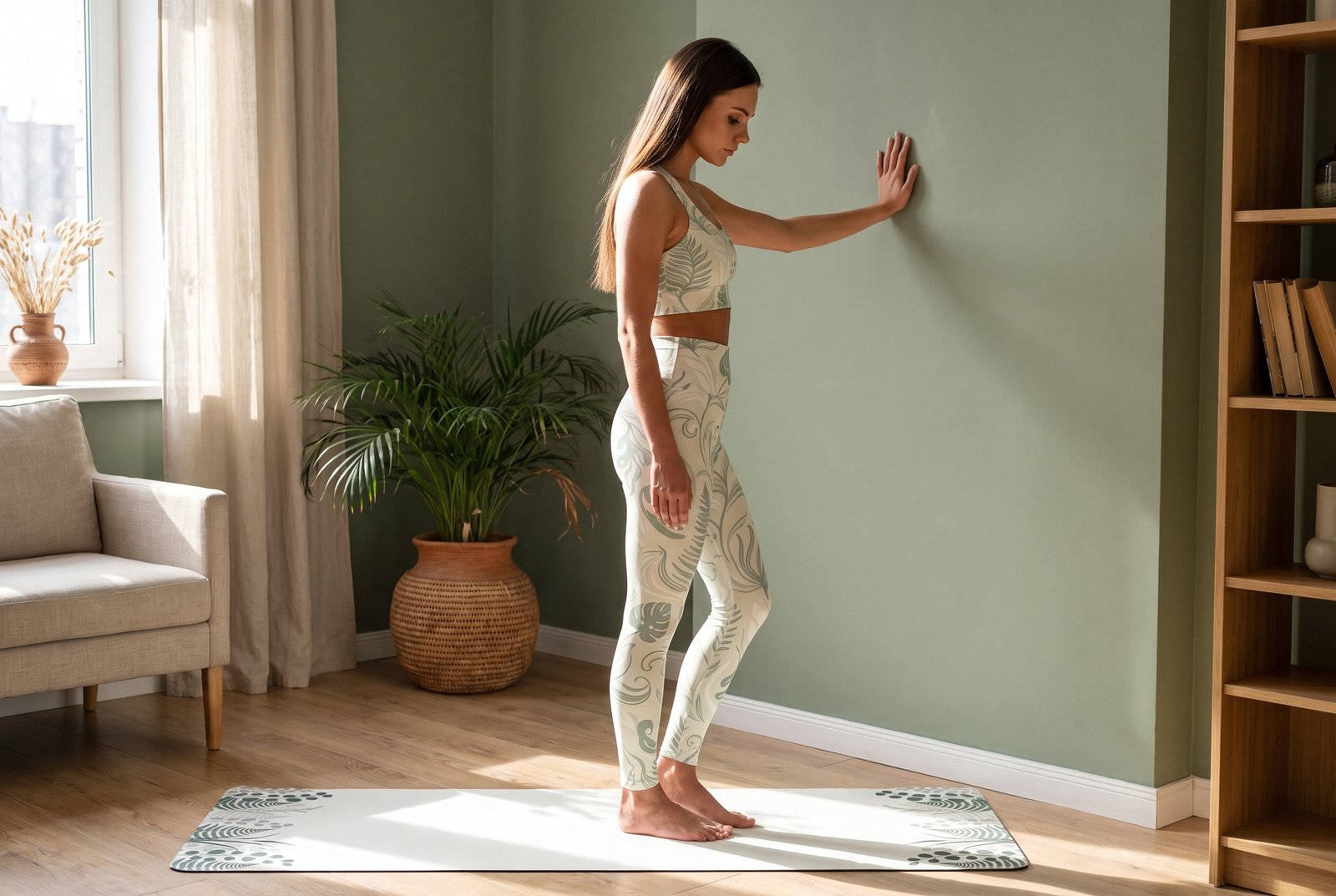
Shoulder mobility is rarely a tightness problem. Most desk shoulders can physically reach the positions — they just never go there, so the end of the range feels foreign, stiff, and faintly alarming when you visit it. That’s a usage problem, and it responds to two minutes at a time rather than one heroic session on Sunday.
What follows is five moves you can do in a shirt and trousers, standing or kneeling, between a 10:30 and an 11:00. Four of them need nothing but a flat wall and a doorframe. One is on the floor, and that’s the only one where a block earns its place.
What shoulder mobility exercises actually are
A stretch holds one position and waits. A mobility drill asks the joint to move through range under some control, reaching, rotating, sliding, pressing, which is why people also call them shoulder mobility drills. Both have a use. Held positions calm down the sensation of shortness; moving drills teach you to own the range you just borrowed.
The shoulder is a shallow ball-and-socket joint with the shoulder blade sliding on the ribcage behind it. So a good shoulder mobility exercise usually asks the blade to move too, not just the arm. If the blade stays glued down, you get the range by arching your lower back instead, which is the single most common fault in overhead work.
The test for a useful drill: you can feel where the movement is coming from. If you can’t, it’s probably coming from your lumbar spine.
The five moves, in order
1. Doorway opener at three heights (doorframe, 90 seconds)
Forearm flat on the doorframe, elbow bent, and step the same-side foot through until you feel a broad stretch across the front of the chest and the front of the shoulder. Do it at three elbow heights: level with your hip, level with your shoulder, and a hand’s width above your shoulder. Thirty seconds each, breathing out slowly, then swap sides.
Each height loads a different part of the pec fan, which is why one height alone never feels like enough. What to feel: a wide pull across the chest. What to stop for: pins and needles, or any pulling sensation that runs past the elbow. That’s nerve, not muscle, and it means step back and reduce the angle.
2. Wall slides (wall, 10 reps)
Stand with your heels about 10 cm from the wall, backs of the hands and forearms against it, elbows at roughly 90 degrees. Slide the arms up until either the forearms peel off the wall or the lower back lifts away from it, then come back down. Ten slow reps, about three seconds up and three down.
Almost everyone loses contact somewhere around ear height on day one. That’s information, not failure. Keep the ribs down — imagine the bottom front ribs staying closed — and work only in the range where everything stays in contact.
3. Wall overhead reach, hinged (wall, 60–90 seconds)
Face the wall, hands flat at about chest height, walk the feet back until your torso is roughly parallel to the floor, arms straight ahead. Let the chest sink towards the floor while the hips stay over the heels. This is the standing version of puppy pose and it hits the same thing: overhead range plus thoracic extension, without putting your knees on an office carpet.
Hold 60 to 90 seconds. You should feel it in the armpits and along the upper back. If you get a sharp pinch at the top of the shoulder instead, lower the hands 15 cm and widen them.
4. Doorframe rotation lever (doorframe, 30 seconds each side)
Grip the doorframe with one hand at shoulder height, arm straight behind you, then rotate your chest and hips away from that hand until the front of the shoulder opens. This is the one that gets at external rotation, which desk work and driving quietly delete.
Turn in small increments. The difference between a good position and an irritated one here is about 10 degrees of torso rotation.
5. Kneeling block reach (block or chair, 60–90 seconds)
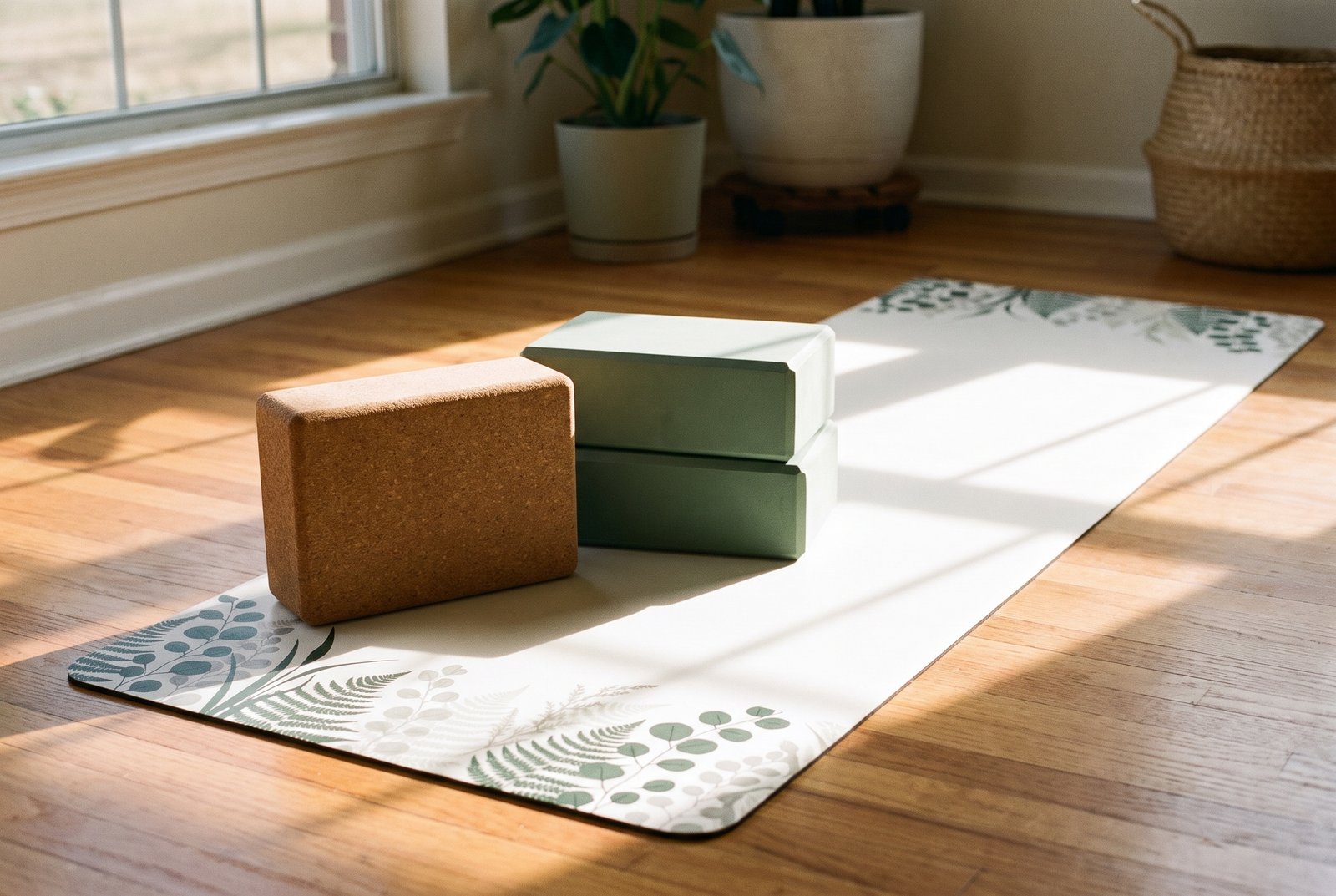
Kneel, place both hands on a block set on its tallest edge, and sink the chest while keeping the hips above the knees. The block raises the hands roughly 23 cm on a standard foam or cork block — published dimensions are typically 23 × 15 × 10 cm — which gives the upper back somewhere to travel into. A chair seat, a sofa edge or two hardback books do the same job for nothing.
If you’re in work clothes, fold a blanket or jumper under the knees. Or skip it and do move 3 twice.
What you need, and what you don’t
These are published specifications and common sense about what each object is, not a test. We haven’t measured these against each other.
| Prop | What it is | Which moves it serves | Honest note |
|---|---|---|---|
| Doorframe | Typically 75–90 cm wide opening | Moves 1 and 4 | Free, and better than any strap for pec work because it gives a fixed anchor |
| Flat wall | Needs ~1 m clear, no skirting board bulge at hand height | Moves 2 and 3 | Free. A door is a poor substitute — it moves |
| Yoga block | Foam or cork, around 23 × 15 × 10 cm, three usable heights | Move 5 | Useful if you already own one. Cork is heavier per spec; foam is kinder on knuckles |
| Chair seat | Usually 42–48 cm high | Move 5, modified | Higher than a block, so less range but easier on the knees. Free |
| Towel or dressing-gown belt | Roughly 120–150 cm long | Optional pass-throughs | Replaces a purpose-made strap entirely for this use |
| Resistance band | Light loop or long band | Strength work, not these five | Needed only when you move from mobility into shoulder strength and mobility exercises |
If you buy one thing for shoulders, buy nothing yet. Run the wall and doorframe version for three weeks and see what you actually miss. If the answer is floor comfort, that’s a mat and a blanket question, and a corner you can leave set up matters more than any single prop.
When to do shoulder mobility exercises
The honest answer is: more often, for less time. Two minutes every ninety minutes beats twenty minutes once, because the problem is positional accumulation, not a deficit of stretching.
Practical anchors that survive a working week: once after the first coffee, once before lunch, once at the four o’clock slump. Doorway opener and wall slides fit in the gap between a meeting ending and the next one starting. Daily shoulder mobility exercises don’t need to be the same five every day — rotate two of them if you’re bored.
Before exercise, use the moving versions (wall slides, rotation lever) and keep holds under 15 seconds. Long static holds just before lifting or swimming can leave the joint feeling vague. Save the 90-second holds for the evening, or pair them with the morning sequence.
Does shoulder mobility improve posture?
Partly, and not in the way the word “posture” suggests. Mobility work changes what positions are available to you; it doesn’t hold you in them. Sitting tall for eight hours isn’t the goal and isn’t achievable.
What tends to shift is this: after a few weeks of the doorway work, the slumped position stops being the only comfortable one. Range gives you options, and options are what posture actually means. Strength decides which option you default to, which is why pulling exercises (rows, band pull-aparts) belong alongside these eventually.
Shoulder pain, and when to stop
Mobility work isn’t treatment. If your shoulder hurts, these drills can be unhelpful or actively wrong depending on what is going on, and nothing here diagnoses anything.
See a physiotherapist or your GP if you cannot lift the arm overhead at all, if pain wakes you at night or stops you lying on that side, if there is numbness or weakness down the arm, if the shoulder has been painful for more than two to three weeks without improving, or if it started with a fall or a wrench. A frozen shoulder in particular behaves very differently from a stiff desk shoulder, and pushing range into it tends to go badly.
Within normal stiffness: mild stretch sensation is fine, sharp pinching at the top of the shoulder is not, and anything that leaves the shoulder sorer the next morning was too much.
Adapting the five
For golf, prioritise move 4. The backswing asks for rotation and separation between ribcage and hips, so add trunk rotation, not just arm work. For swimmers, overhead range matters most, so moves 2, 3 and 5 are the core, and internal rotation deserves attention too.
For seniors or anyone wobbly on their feet, do all four standing moves within arm’s reach of something solid and skip the kneeling one in favour of the chair version. Shorter holds, more often.
And if the upper back is the real bottleneck rather than the shoulder, the pattern is the same one that shows up in hips after years of sitting — the fix is frequency over intensity.
If you have twenty minutes a week total: doorway opener at three heights and wall slides, three times a day, nothing else. Those two cover the front of the chest and overhead range, which is most of what desk work takes.
If you already own a block: add move 5 in the evening for 90 seconds and leave the block by the sofa where you’ll trip over it. If you don’t own one, a chair seat is genuinely fine and costs nothing.
If your shoulder hurts rather than feels stiff: stop reading routines and book a physiotherapist. Night pain, arm weakness, numbness, or anything that followed a fall needs assessing before any mobility plan.
If you’ve abandoned this kind of thing before: tie it to something that already happens, a meeting ending or the kettle boiling, and keep it under two minutes. The routine that survives is the one that never needs a decision.
Written with Elena, our AI stretch guide, and checked against our editorial and safety rules before publishing. General movement guidance, not medical advice. Photographs are AI-generated illustrations.


