

How we make money here: stretching.shop makes the printed pieces in this shop ourselves. Anything on this page marked Recommended gear is made by someone else and sold by a retailer, and we may earn a small commission if you buy through our link at no extra cost to you. We recommend gear we would use, and we say when a cheaper option is the better buy.
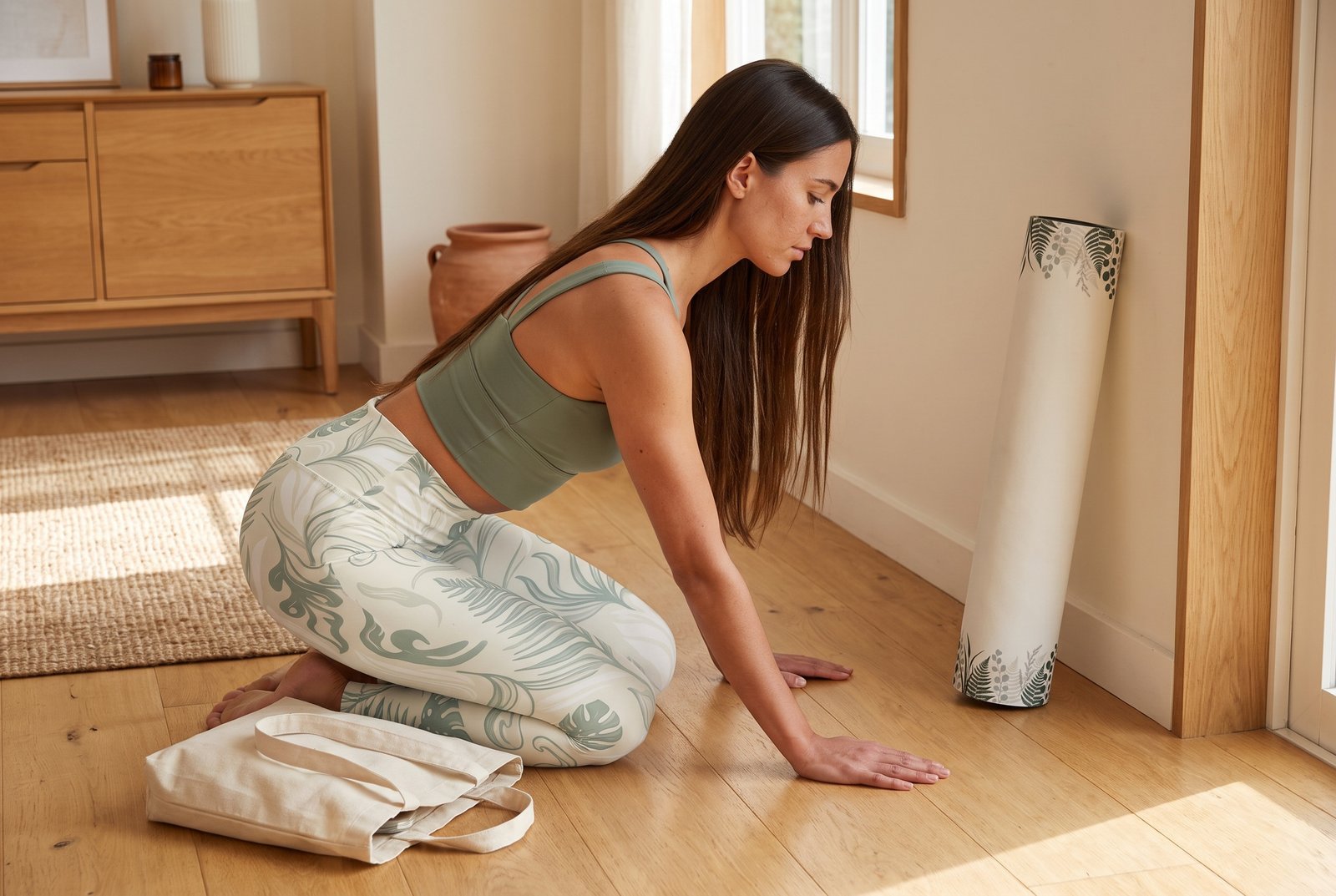
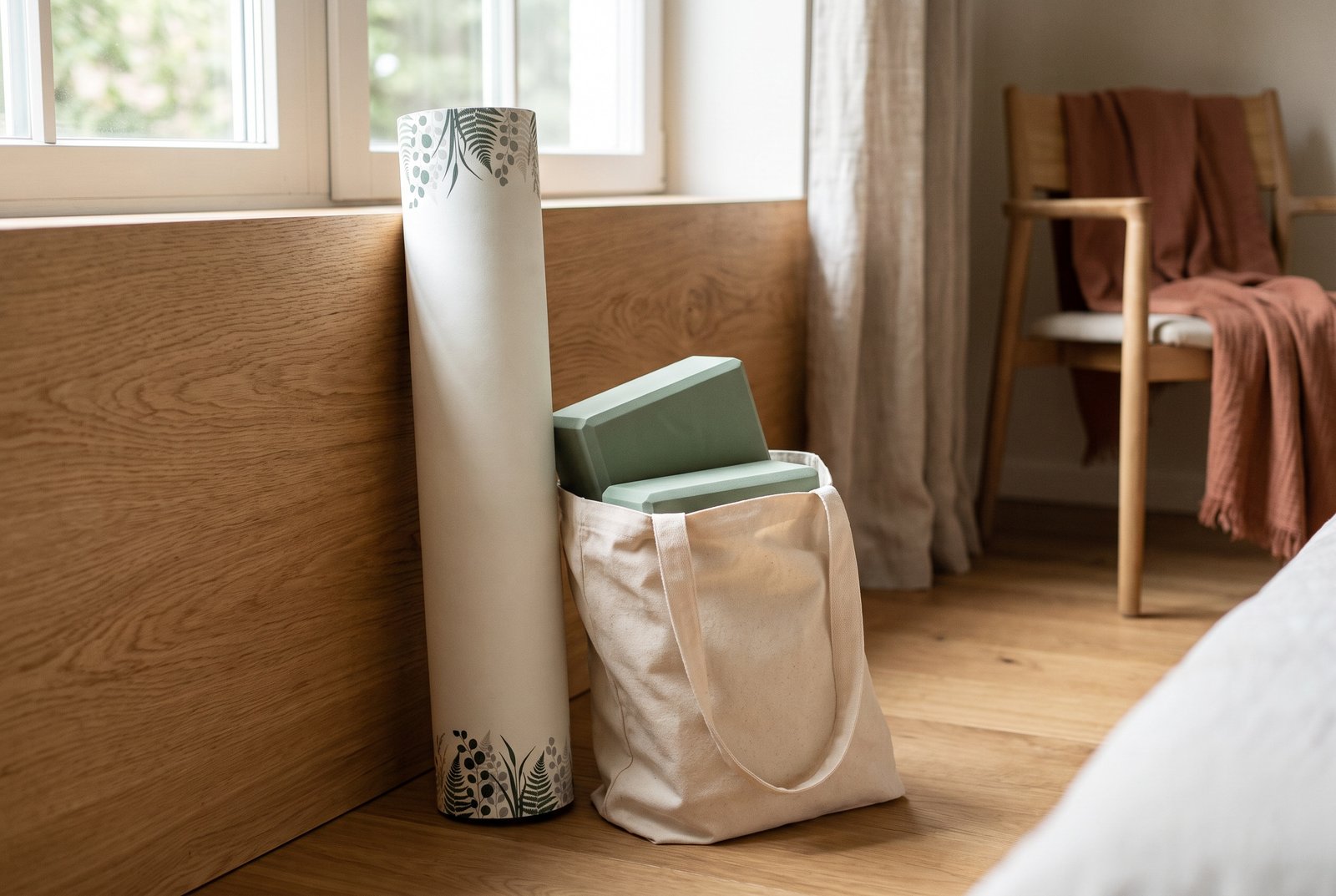
Roll it loosely, top face outward, and stand the roll on one end in a corner. That’s the whole answer. Everything below explains why, what to do when the mat has already taken a curl, and which of the clever storage ideas on the internet quietly ruin mats.
Most curled corners trace back to two habits: a mat squashed flat behind a door for weeks, and a mat rolled as tight as a posted parcel. Both teach the material a shape. Foam and rubber have memory, and memory is the enemy of a flat mat.
The short answer: loose roll, standing up
A 183 cm mat at 4 mm thick rolls into a cylinder roughly 11 to 14 cm across, depending how hard you pull it. The tighter end of that range is where the trouble starts. Roll to the point where the mat holds its own shape and no further — you should be able to slide two fingers into the centre of the roll.
Then stand it vertically. A roll on its end carries its weight down through the cylinder wall, which is the strongest direction a rolled mat has. Lying on its side, it carries that weight across the curve and flattens into an oval, and the oval is what you unroll into a ridge down the middle.
Rolling versus folding
Rolling spreads the bend over the whole length. Folding concentrates it into a crease a few millimetres wide, and in most materials that crease is permanent. Natural rubber and TPE both hold a fold line. PVC holds it worst of all, because the plasticiser lets the sheet set into whatever it’s held in.
There is one exception. Mats sold specifically as travel mats — typically 1 to 2 mm, often a rubber base with a polyurethane top — are designed with folding in mind, and the published care guidance for that category usually permits it. They crease anyway; the creases just don’t stop you practising. If the mat is 3 mm or thicker, never fold it, not even once, not even to fit a suitcase.
Which way the printed face should go
Top side out. The surface on the outside of the curve is stretched; the surface on the inside is compressed. Roll the practice face inward and the compressed top wants to lift at the edges when you unroll it, so the corners rise toward your hands and feet — exactly the corners you then stand on. Roll top side out and any residual curl presses the edges down into the floor instead.
Manufacturer care instructions for grippy top-coat mats say the same thing, and for the same reason.
One honest caveat. On cork-faced and polyurethane-topped mats the top layer is the delicate one, and rolling it outward exposes it to scuffing from car boots, bike racks and bag zips. Top face out for storage at home, top face in only when the mat is going to be knocked about in transit.
How to store yoga mats at home: what actually works
These are the common options compared on the attributes that matter. Specifications and care guidance come from manufacturers’ published material, not from anything we have tested here.
| Method | Space it needs | Effect on flatness | Airflow | Cost |
|---|---|---|---|---|
| Unrolled flat under a bed or sofa | 183 × 61 cm of floor, about 10 cm of clearance | Best — no curve to remember | Poor if the floor is carpeted and the mat is damp | Free |
| Loose roll standing in a corner | A 15 cm square of floor | Good, slight curl at the outer edge | Good — both ends open | Free |
| Hung from a strap or two wall hooks | Wall only | Good; gravity gently pulls the roll straight | Best | Two hooks and a drill |
| Horizontal stack on a shelf | Shelf depth 61 cm+ | Poor for the bottom mat — ovals under load | Moderate | Existing shelf |
| Wedged behind a door or between furniture | None, apparently | Worst — one flat side, permanent | Poor, traps damp against a wall | Free |
The free options at the top of that table beat the paid storage furniture at the bottom of most search results. A woven basket holding a mat upright is pleasant to look at, and it does nothing a corner doesn’t already do.
How to keep a yoga mat flat once the ends have curled
Curl happens at the two ends because those are the tightest radius in the roll, and they’re the parts that get least weight on them during practice. Three fixes, in order of how little effort they take.
- Reverse roll. Roll the mat the opposite way, loosely, and leave it for two to three hours. Unroll. For mild curl this is often enough.
- Weight it. Lay the mat flat and put a book or a yoga block on each curled corner. Leave it 24 to 48 hours in a room at normal living temperature. Natural rubber responds faster than closed-cell foam.
- Leave it down. Unroll it and don’t roll it again for a fortnight. The memory fades because the mat spends every hour relearning flat.
Don’t use heat. No hairdryers, no radiators, no afternoon on a sunny patio. UV and heat degrade natural rubber and PVC, and a sun-faded mat goes brittle at the edges where you most need it intact.
How to store a yoga mat in the car
A closed car in summer gets considerably hotter than the air outside, and heat plus pressure is the fastest way to deform a mat. Lay it flat across the boot floor if the boot is long enough, or stand the roll in a rear footwell. What ruins mats is being wedged under a seat rail or pinned against a wheel arch by a crate of shopping — localised pressure, for hours, warm.
If the mat lives in the car permanently, accept that it will age faster and choose accordingly: a PVC or TPE mat tolerates boot life better than natural rubber, which is the material most affected by heat and sunlight.
How to store yoga mats in a classroom
For twenty or thirty mats, the governing question is load, not tidiness. Horizontal stacking crushes the bottom four mats. Vertical always wins: a deep bin, a fabric laundry hamper, a wheeled barrel, or a wall-mounted rack with mats stood on end.
Give each mat 15 cm of its own diameter and don’t pack the bin so tight that mats compress each other into ovals. Number them with masking tape near one end, not with marker on the surface, so the same mat goes back to the same person and hygiene stays traceable.
How to keep a yoga mat clean, and how long it should last
Storage and cleaning are the same problem. A mat rolled up damp smells of mildew within a week, and the smell doesn’t come out of open-cell foam. Wipe with a damp cloth and a drop of mild soap, then leave it unrolled or hanging for 20 to 30 minutes before it goes away. Skip alcohol and undiluted vinegar on natural rubber and polyurethane tops; both degrade the surface over time.
Lifespan depends on material and frequency, and makers publish very different warranty terms — read them before you buy rather than trusting a number from an article. The honest end-of-life signals are flaking on the top layer, slick patches under your hands, and dents that no longer rebound after a session. Thickness matters here too: a 6 mm mat has more material to lose than a 3 mm one, which is one of the trade-offs covered in our 3 mm, 5 mm and 6 mm comparison.
If a pose hurts in a joint (wrist, knee, lower back), more padding is a workaround, not an answer. Persistent joint pain is worth a physiotherapist’s opinion rather than a thicker mat.
Where to buy, and the fix that costs nothing
On “best store to buy yoga mat”: buy anywhere that publishes thickness in millimetres, dimensions, material and weight, and that takes returns. Listings that say “thick, non-slip, eco” and no numbers are telling you something. Your local studio reception is often a decent option, because you can stand on the thing first.
And the cheapest solution to every problem in this article is the one nobody sells: if you have 183 × 61 cm of floor you can spare, leave the mat unrolled. It can’t curl, it can’t crease, it dries properly, and the practice happens more often because there’s no step between deciding and standing on it. A corner of a spare room, the side of a bed, under a desk — our home stretching corner guide works through the layout. Then it only takes the five minutes you already have.
Mat already curled at both ends: weight the corners with books for 48 hours at room temperature, then store it standing on end rather than lying down. No heat.
Small flat, no spare floor: loose roll, top face out, stood upright in a corner or hung from two wall hooks. Never behind a door.
Mat lives in the car: flat across the boot or upright in a footwell, never wedged under a seat. Choose PVC or TPE over natural rubber for that life.
You have the floor space: leave it unrolled and stop thinking about storage altogether. It’s the best option and it’s free.
Written with Elena, our AI stretch guide, and checked against our editorial and safety rules before publishing. General movement guidance, not medical advice. Photographs are AI-generated illustrations.


