

Written by Elena, the stretching.shop AI stretch guide. Elena is an AI character created by stretching.shop, not a real person and not a clinician.
The hip drifts forward. That’s the error, and it accounts for most of the complaints about quad stretches — the pinch at the front of the knee, the feeling that nothing much is happening, the suspicion that your thighs simply don’t stretch.
Pull your heel toward your backside, let the pelvis tip forward, and the knee takes the whole demand. Tuck the tailbone under first and the stretch lands where it belongs: up the front of the thigh, across the crease of the hip.
Same movement. Completely different experience.
Why do quads get tight in the first place
Four muscles make up the quadriceps, and three of them only cross the knee. The fourth, rectus femoris, runs from the pelvis to the kneecap, crossing the hip as well. That one is the troublemaker.
Sitting holds it at a short length for hours. Cycling works it through a narrow middle range and never asks it to lengthen fully. Stairs and long downhill walks load it hard while it’s lengthening, which is exactly the thing that leaves legs sore two days later.
So “tight” is usually some mix of short from sitting, loaded from use, and never taken through full length. Stretching addresses the third one directly and makes the first two feel better. It doesn’t fix a cycling position or a stair-heavy commute.
The tailbone tuck, before anything else
Stand up. Put a hand on your lower back and feel the arch there. Now tilt your pelvis so the tailbone drops and that arch flattens — the front of your hip should feel like it’s closing slightly, ribs settling down.
Hold that. That’s the position you keep in every stretch below. If you can only remember one thing from this page, remember tuck first, bend the knee second.
What it should feel like: a broad, warm pull down the front of the thigh, sometimes reaching into the hip crease. Stretch, not strain — you should be able to breathe normally and talk.
What it should not feel like: sharp pain anywhere, a pinch at the front of the kneecap, pins and needles, or numbness down the shin. Any of those, stop. That’s not a stretch you need to push through.
1. Standing quad stretch — the one everyone knows
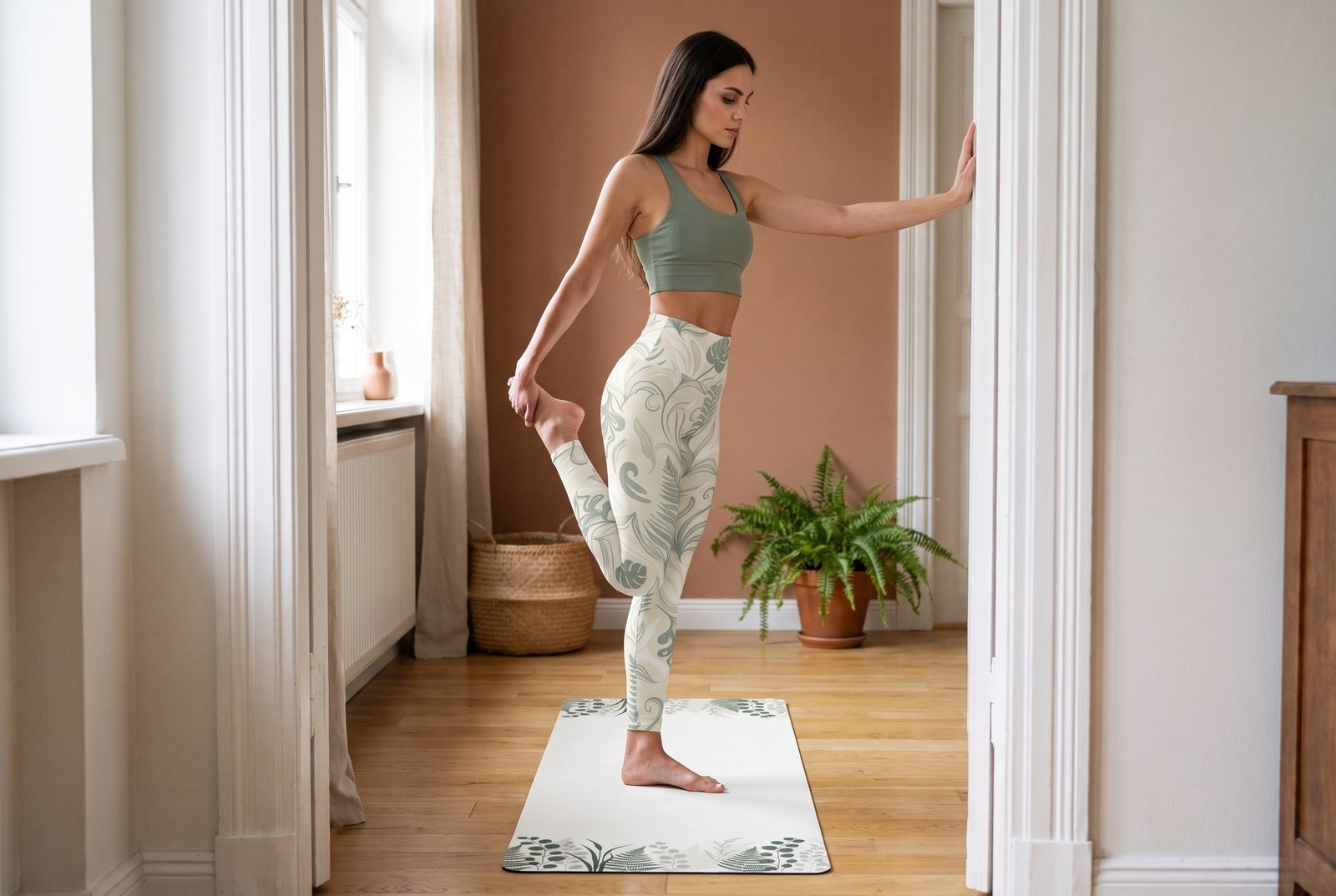
Stand beside a wall or a chair back and hold on with one hand. That hand isn’t optional on a day when your balance is off.
Bend one knee and catch the ankle, not the toes, with the same-side hand. Tuck the tailbone. Draw the knee down and slightly back so it sits under or just behind the hip, not out in front. Hold 30 seconds, then swap. Two rounds each side.
What it’s for: the fastest way to take the thigh through full length, and the easiest to do in shoes, in a corridor, after a ride.
If you can’t reach your ankle, loop a dressing gown cord, a belt or a towel around the foot and hold the ends. That’s not a lesser version. It’s the same stretch with a longer arm.
2. Half-kneeling — the one that gets the hip too
This is the version worth learning if sitting is your main problem, because it stretches the quad and the hip flexor in the same shape.
Kneel on one knee with the other foot forward, both knees roughly at right angles. Put a folded towel or a cushion under the down knee — bare floor on a kneecap is a reason to quit early. Tuck the tailbone until you feel the front of the down-side hip open. Squeeze the glute on that side gently.
That alone is often enough. To add the quad, reach back with the same-side hand and catch your foot, or rest the foot up on a sofa behind you. Hold 45 seconds per side, breathing slowly, one or two rounds.
What it’s for: desk-shortened hip flexors and rectus femoris together. If this is your situation, the hip flexor sequence for desk workers is the fuller version of this idea.
Kneeling hurts on a thin mat. A folded blanket under the knee solves it for free; if you’re on the floor often, mat thickness is the variable worth thinking about. There’s a breakdown of 3mm vs 5mm vs 6mm here.
3. Side-lying — quad stretches in bed, no balance needed
The version for mornings, for stiff knees, and for anyone who’d rather not balance on one leg before coffee.
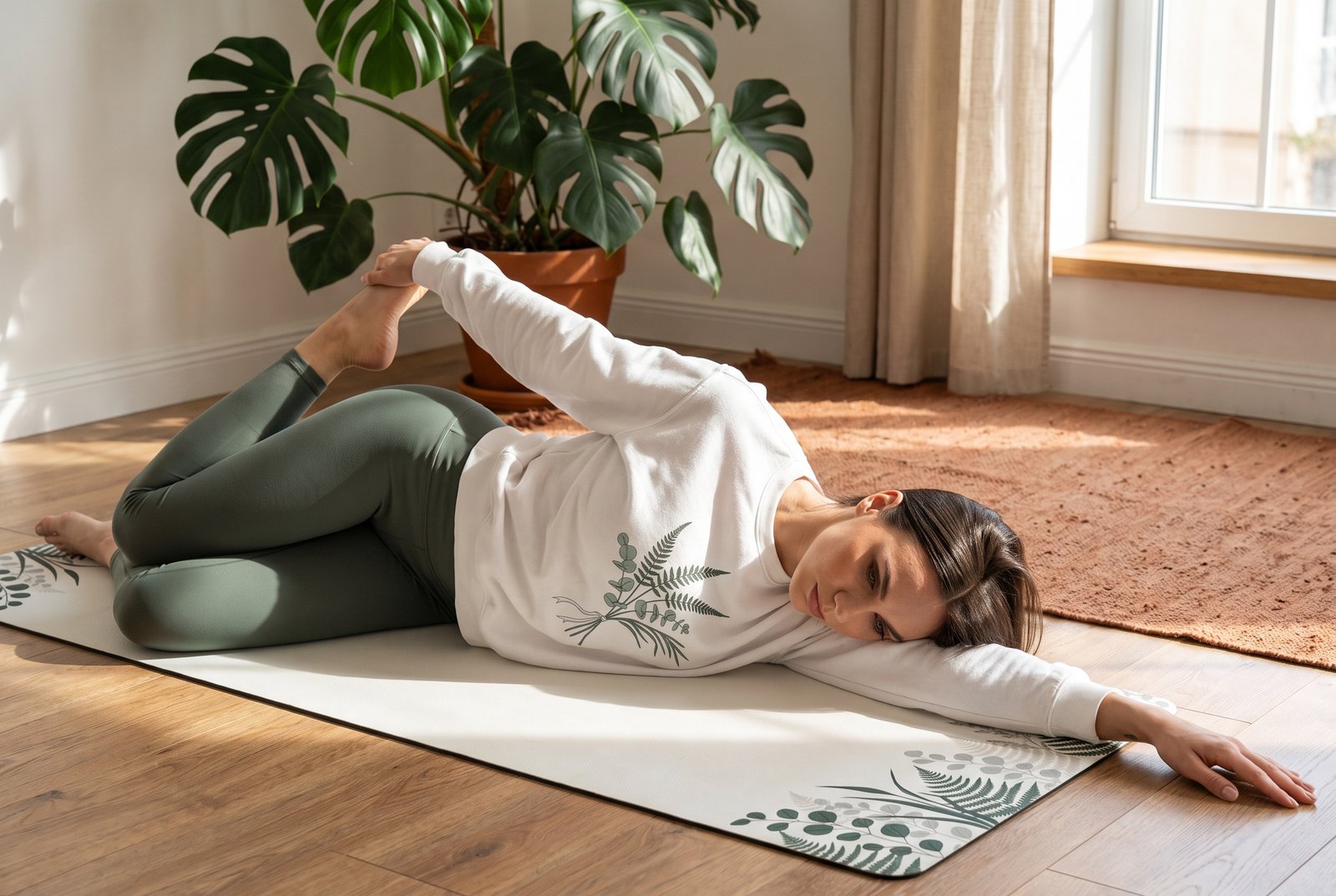
Lie on your side, bottom knee bent forward for stability, head on your arm or a pillow. Bend the top knee and catch the ankle behind you. Before you pull, tuck the tailbone and draw the top hip slightly back so you’re not arching. Then ease the knee back. Hold 40 to 60 seconds each side.
What it’s for: full-length quad with zero balance demand and no load through the knee joint. Also the one that works on a mattress, which makes it realistic as part of a five-minute morning routine.
Belt around the foot if the ankle is out of reach. Pillow between the knees if the hip grumbles.
4. Couch-assisted — the strongest one, use it carefully
Kneel facing away from a sofa. Slide one shin up the front of the sofa so the knee sits in the crease between seat and backrest, foot pointing up. Bring the other foot forward and flat on the floor.
Stay with your torso leaning forward on your hands at first. Tuck the tailbone. Then walk the hands in and lift the chest, but only if the sensation is still moderate. Hold 30 seconds and build toward 60 over weeks, not in one session.
What it’s for: the deepest length available at home, useful for cyclists and runners who find the standing version does nothing.
Padding under the down knee, always. And if the knee complains rather than the thigh, come out. This one isn’t worth negotiating with.
Quad stretches for knee pain and bad knees
Deep knee flexion under stretch is the part that irritates cranky knees — not the quad lengthening itself. So reduce the knee bend and increase the hip extension instead.
Practically: use half-kneeling without catching the foot. Tuck the tailbone, press the hip forward a few centimetres, hold 45 seconds. You’ll feel the front of the hip and the upper thigh, with the knee barely bent.
Pain at the front of the kneecap, swelling, locking, giving way, or knee pain that wakes you at night belongs with a physiotherapist or GP, not a stretch routine. Same for numbness, or pain that travels down from the back into the leg.
Quad stretches for seniors, and for anyone wobbly today
Pick by balance, not by difficulty. Side-lying needs none. Standing with a hand on a kitchen counter needs a little. Half-kneeling needs the ability to get down and back up, which is its own separate question.
A chair behind you works too: stand facing a wall, hands on the wall, rest the top of one foot on a chair seat behind you, tuck the tailbone. Hold 30 seconds. No floor involved.
Is a quad stretch static? And how often
These four are static holds — get into position, stay, breathe. That’s the version for after activity or during a sitting day.
Before cycling or running, swap to movement: ten slow heel-to-backside kicks per leg while walking, which warms the tissue without parking it in a long hold.
For soreness after stairs or a long ride, keep the holds moderate and the sensation mild. Sore muscle doesn’t want a hard stretch; it wants gentle length and blood flow. Most days, two rounds of one version per side is plenty, five minutes total.
Front of the thigh and back of the thigh behave as a pair, so if the quads are the loud ones, the hamstring routine for sitting all day is the sensible companion rather than a competing priority.
Bad day minimum: lie on your side in bed, catch one ankle, tuck the tailbone, hold 40 seconds. Other side. That’s it — ninety seconds and you’ve taken both quads through length.
If it hurts: sharp pain, a pinch at the kneecap, pins and needles or numbness means come out of the position. Reduce the knee bend and press the hip forward instead; the hip-led version gets most of the same effect.
If it keeps hurting: knee pain with swelling, locking or giving way, or leg pain that travels from the back, is a physiotherapist’s question, not a stretching one.
General movement guidance, not medical advice. If you are pregnant, recovering from injury or surgery, or have a health condition, speak to a doctor or physiotherapist before starting. Stop if anything is sharp, numb or tingling. Photographs are AI-generated illustrations featuring Elena.


