

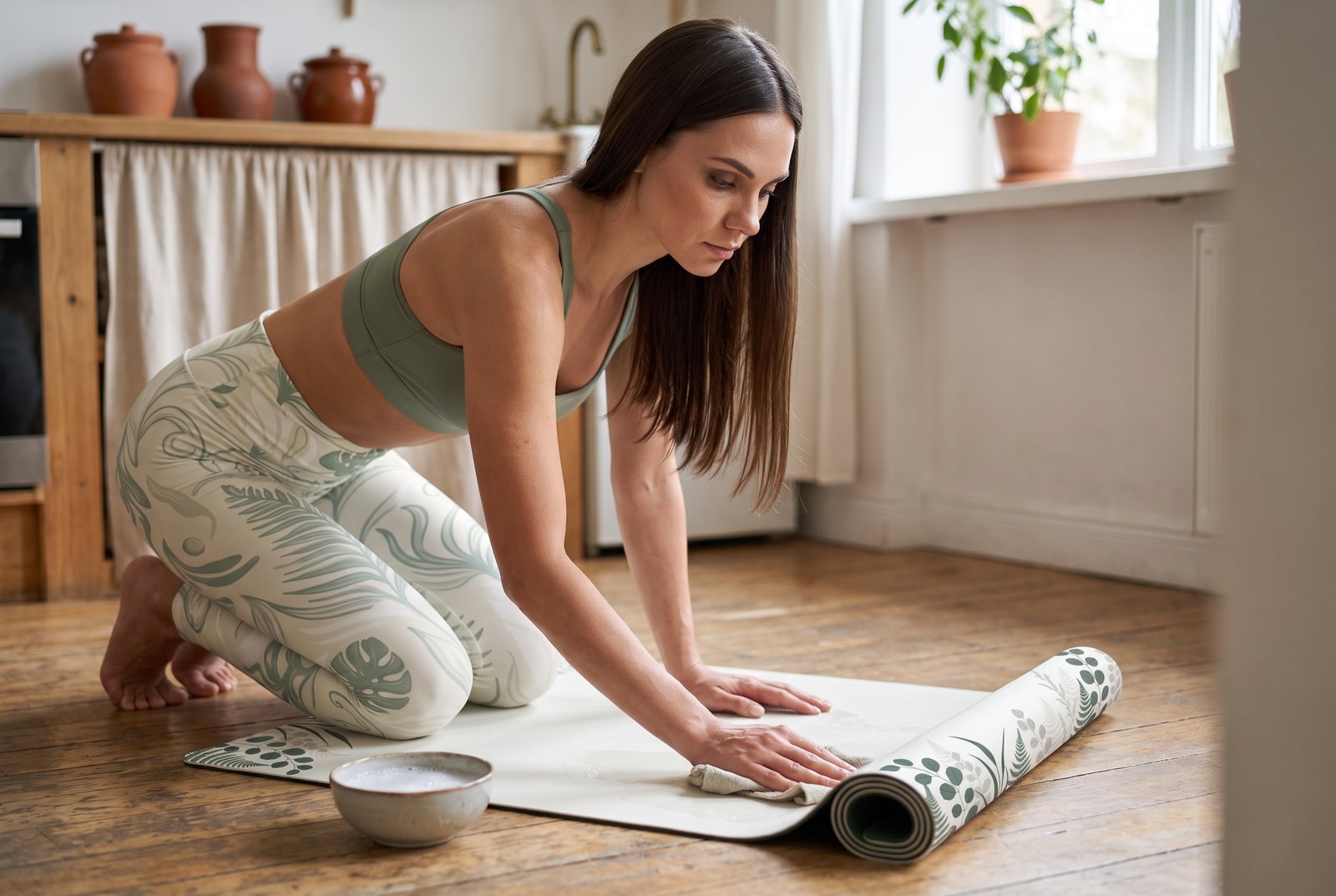
Water, a cloth, and a bare floor. That’s the whole routine for a printed mat, and nearly everything sold in a spray bottle is a more expensive way of doing less.
Printed mats differ from plain ones in one way that matters: the pattern sits in or just under the top surface. On most printed mats that top surface is polyurethane, a thin PU layer bonded to rubber or PVC, and the ink goes on before or within the finishing coat. Scrub that layer with solvent and the print goes chalky at the edges long before the mat itself fails.
How to clean a yoga mat: the 90-second version
After any session where you sweated, do this before you roll it up:
- Wring a microfibre cloth out in plain cool water until it’s damp, not dripping.
- Wipe the whole top surface in long passes, following the length of the mat. Then the underside where your feet have dragged grit in.
- If there is body oil or sunscreen on it, add one drop of unscented washing-up liquid to about 500 ml of water and wipe again, then wipe once more with plain water to lift the soap.
- Leave it flat on the floor, print side up, for 20 to 30 minutes before rolling.
That’s it. No soak, no spray, no rinse under the tap. A damp cloth and cool water is the cleaning method with the fewest ways to go wrong, which on a printed mat is the only metric that counts.
Why drying flat matters more than what you clean with
Here’s the part people skip. A mat wiped with the gentlest cleaner on earth and then rolled up damp will smell within a week, and the smell is the hard part to undo. Moisture trapped inside a roll has nowhere to go, and PU and natural rubber both hold it.
Flat beats hanging. Hang a wet mat over a radiator or a shower rail and you get a crease across the middle; on rubber-backed mats, the fold line can stretch permanently. Flat on a floor, away from a radiator and out of direct sun, takes longer and costs nothing.
Direct sun is the other quiet killer. UV degrades natural rubber and fades pigment, which is why care leaflets for rubber and cork mats so consistently say to dry in the shade. Give a properly washed mat 4 to 8 hours flat indoors before it goes back in the bag, and flip it halfway if the underside was wet too.
If the mat lives rolled in a corner between sessions, roll it with the printed face on the outside. The edges stay flatter and the top layer isn’t pressed against itself. It’s also worth checking whether your mat is thick enough for the floor it lives on, since a thin mat on hard boards gets wiped more often than it needs to be — more on that in our 3mm vs 5mm vs 6mm comparison.
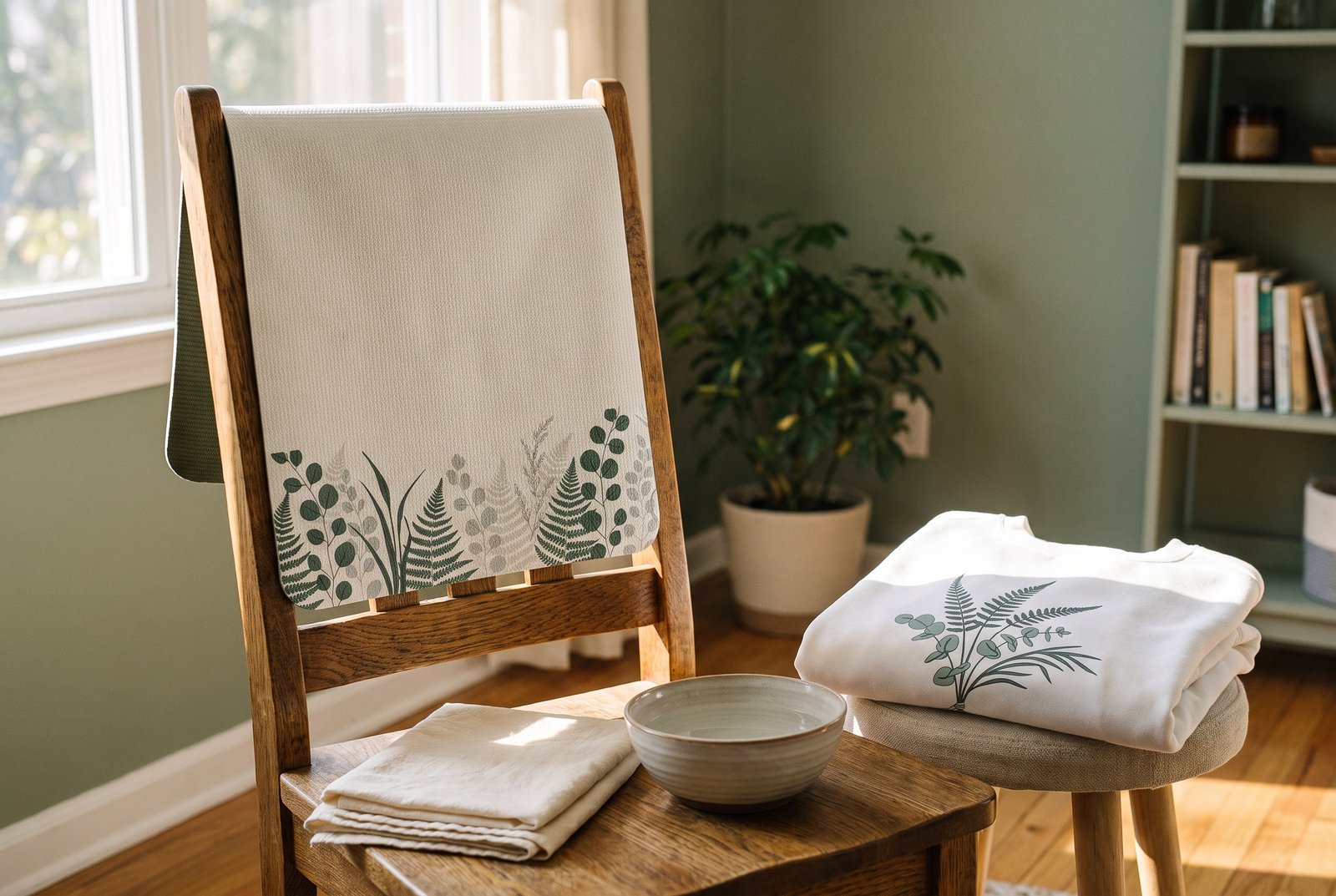
How to clean a yoga mat naturally, and when vinegar is a bad idea
Natural doesn’t mean harmless to a print. The two most popular home recipes are the two most likely to cause trouble.
White vinegar diluted roughly 1 part vinegar to 3 or 4 parts water is a reasonable occasional wipe for PVC and TPE mats, rinsed off with a plain-water pass afterwards. It’s a poor choice for cork and for natural rubber, where manufacturers typically specify mild soap and water only, and acids can dry or dull the surface. On a printed PU top layer, vinegar is a gamble for very little gain.
Essential oils are worse. Tea tree and citrus oils contain terpenes that act as mild solvents on polyurethane, and oil residue on the top surface makes a mat slick in exactly the places your hands need grip. Skip them, along with hand sanitiser, surgical spirit, baby wipes, bleach, and anything branded as an all-purpose degreaser.
Best thing to clean a yoga mat with
Cool water and a microfibre cloth, with one drop of pH-neutral soap when there’s oil to shift. If a bottled mat spray costs more than a bar of soap and claims to do more than this, it is selling you fragrance.
What the manufacturers actually say
We have not tested any of these mats or cleaners. The table below compares published care guidance and the material each method sits on, so you can match the method to what you own.
| Method | Printed PU top (Liforme-style, Lululemon-style) | Cork | Natural rubber / TPE / PVC | Dry time, flat indoors |
|---|---|---|---|---|
| Damp cloth, cool water | Matches published guidance for wipe-down care | Yes, lightly damp only | Yes | 20 to 30 min |
| 1 drop mild soap in 500 ml water | Yes, with a plain-water second pass | Yes, sparingly | Yes — the method rubber mat makers usually name | 1 to 2 hours |
| Diluted white vinegar (1:3) | Not worth the risk to the ink | No | Acceptable occasionally on PVC/TPE; avoid on rubber | 1 to 2 hours |
| Bathtub soak | No — submersion is excluded in most PU mat care notes | No, cork swells | Only if the maker explicitly allows it | 24 hours or more |
| Washing machine | No | No | No, except mats sold as machine-washable (some thin travel mats and mat towels) | 24 hours or more |
| Alcohol, essential oils, bleach | No | No | No | n/a |
The pattern across brands is identical: wipe, do not soak, do not machine wash, dry out of direct sunlight. Liforme’s guidance centres on a damp cloth and avoiding harsh chemicals and oils. Lululemon’s care notes for their PU-topped mats describe wiping with water or a mild diluted soap rather than submerging. Gaiam’s PVC and TPE mats are generally described as cleanable with mild soap and water, spot-cleaned and air-dried. Before you follow any of this, read the leaflet or product page for your own model. Specifications change between versions.
How to clean a yoga mat in the bathtub
People search this constantly, so here’s the honest answer: it works on a plain PVC mat and it’s the wrong move on a printed one.
A tub soak means ten to fifteen minutes of full submersion, usually with more soap than a mat needs, followed by a day or two of drying because water gets into the open cell structure and the bonded layers. On a mat with a PU top layer, repeated soaking is how edges start to lift and prints start to blur. On cork, water swells the surface and raises the grain.
If your mat is genuinely filthy — a festival, a dog, a spill — and it’s a single-material PVC mat, the tub is fine. Use lukewarm water, a few drops of mild soap, no brush, and accept 24 to 48 hours of flat drying. For anything printed, deal with the mess as a spot clean instead: damp cloth, soapy cloth, plain cloth, dry towel pressed on top to pull the moisture out.
Sweat, grip and the towel trick
If you’re cleaning weekly because of sweat, change the input rather than the cleaning routine. A cotton or microfibre towel laid over the mat for hot sessions takes the sweat, goes in the washing machine at 40°C, and keeps the mat’s surface untouched. The mat then needs a wipe once a fortnight instead of after every class.
Grip is a separate question from cleanliness. New PU-topped mats often feel slippery until the factory finish wears in, and a residue of old spray cleaner can feel much the same. If you’ve wiped away residue, dried the mat flat, and your hands still travel in downward dog, the surface of the mat is the issue rather than hygiene, and our guide on choosing a mat covers which surfaces behave which way.
Wrist, shoulder or lower-back pain that keeps showing up in the same pose is not a cleaning problem — if it persists beyond a couple of weeks or wakes you at night, see a physiotherapist rather than buying equipment. If you’re stiff rather than sore, a short daily habit does more than a deep clean: the five-minute morning routine is the one most people actually keep.
A seasonal reset, in order
- Lay the mat flat and vacuum or shake off grit — scrubbing grit in is what scratches print.
- Wipe with 500 ml cool water plus one drop of mild soap, using a cloth, never a brush or scouring pad.
- Second pass with a plain-water cloth to remove soap film, which is the real cause of lingering slipperiness.
- Press a dry towel over the surface to blot.
- Leave flat, print up, 4 to 8 hours, no radiator, no sun, then flip for an hour.
- Roll loosely, print side out, and store standing up rather than under something heavy.
If your mat is printed and you practise at home a few times a week: damp microfibre cloth after sweaty sessions, one drop of mild soap when there’s oil, flat drying for 20 to 30 minutes before you roll it. Buy nothing.
If your mat already smells: the problem is drying, not cleaning. Wipe it with mild soapy water, rinse-wipe, then leave it flat and unrolled somewhere airy for a full day before judging it.
If you own cork or natural rubber: water and mild soap only, never vinegar or oils, and never in direct sun. Check your brand’s own care page first, because specifications differ by model.
If you sweat heavily: put a washable towel over the mat and launder that at 40°C instead of cleaning the mat after every session. The mat lasts longer and the print stays sharp.
Written with Elena, our AI stretch guide, and checked against our editorial and safety rules before publishing. General movement guidance, not medical advice. Photographs are AI-generated illustrations.


