

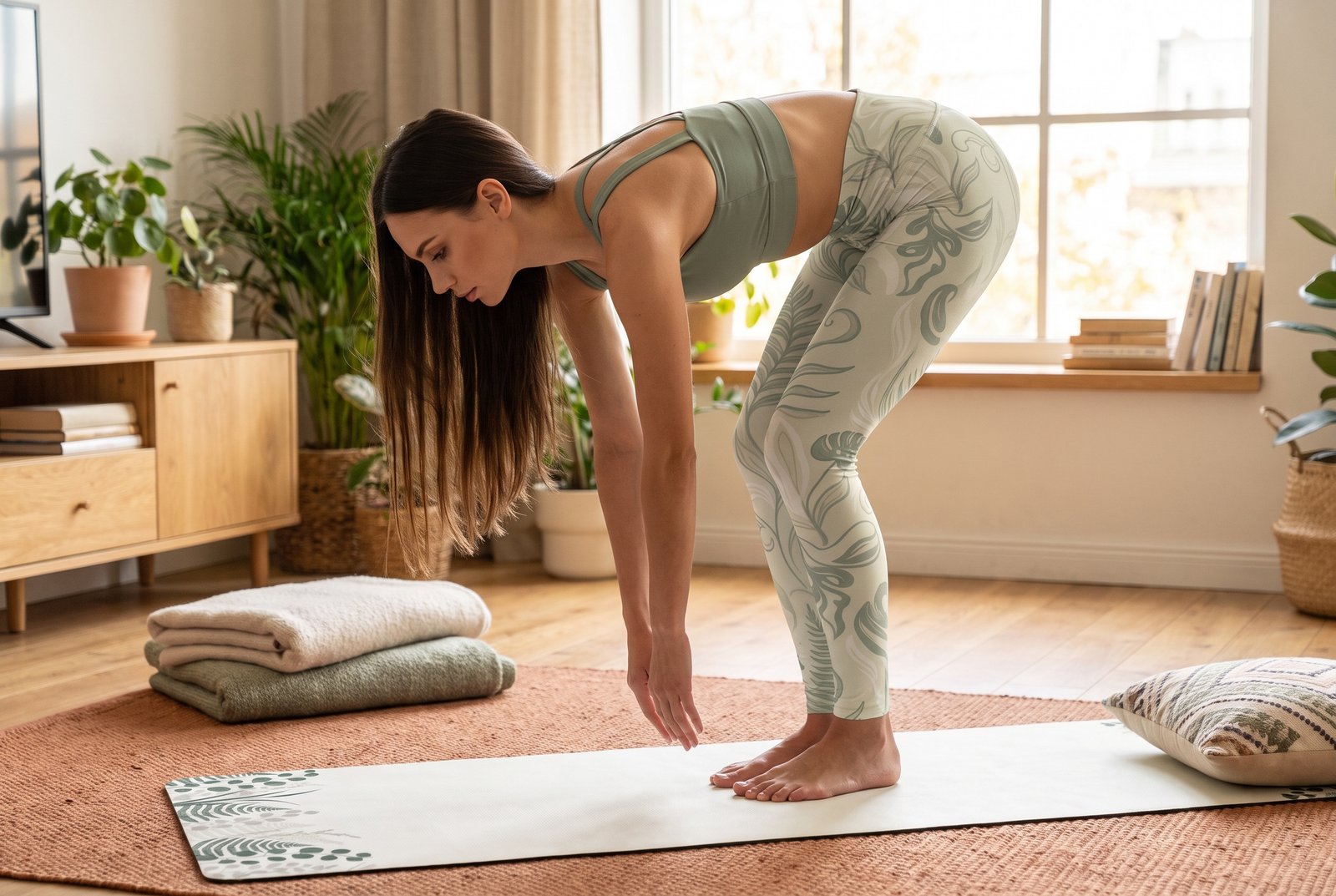
Written by Elena, the stretching.shop AI stretch guide. Elena is an AI character created by stretching.shop, not a real person and not a clinician.
Nine movements. Ninety seconds each. Thirteen and a half minutes of stretching, ninety seconds of shuffling between positions, and you’re done.
The maths matters because of a specific failure. Most people who sit down with fifteen minutes spend twelve of them on hamstrings — because hamstrings are the bit you can feel, and feeling something is satisfying. Then the neck that’s been quietly seizing up since Tuesday gets nothing.
So: a timer. Not optional. The point of a full body stretch routine is coverage, not depth, and a timer is the only thing that enforces it.
Before you start: what you need and what you can skip
A floor. That’s genuinely it.
A folded bath towel under your knees handles the kneeling positions. A second one under your hips helps if the floor is hard, and a dressing gown belt or a long scarf works wherever a strap is mentioned. Two thick books make a fine prop for sitting on.
If you do this routine most days and your knees complain, a mat is worth thinking about — the difference between 3mm, 5mm and 6mm is mostly about whether you kneel a lot.
Set the timer to repeat at 90 seconds. Phone on the floor, face up, where you can see it.
The nine movements, head to feet
Work top to bottom. The order isn’t sacred, but going head to feet means you never have to remember what you’ve already done.
1. Neck side bend — 45 seconds each side
Sit tall. Let your right ear travel toward your right shoulder, then reach your left hand toward the floor to anchor that shoulder down. Hold 45 seconds, swap.
For: the upper trapezius and levator scapulae, the strap of muscle that goes rigid after a day of looking down at a screen. It should feel like a long, warm pull along the side of the neck. It shouldn’t produce pins and needles or tingling into the arm. If it does, come out and leave it.
2. Doorway chest opener — 90 seconds
Forearm on a door frame, elbow at roughly shoulder height, step the same-side foot through until you feel the front of the chest widen. Hold 45 seconds per side.
For: pectorals and the front of the shoulder, which shorten when your arms live out in front of you. Broad stretch across the chest, yes. Pinching at the front of the shoulder joint, no — lower the elbow a few inches if you get that.
3. Open book thoracic rotation — 90 seconds
Lie on your left side, knees stacked and bent to 90 degrees, arms stretched out in front. Lift the top arm and sweep it across to the other side, following it with your eyes, letting the upper back rotate while the knees stay pinned together. Hold the open position 45 seconds, then swap sides.
For: mid-back rotation. This is the one people searching for a full body stretch routine for mobility actually need, because it’s rotation you produce and control rather than length you hang in. It should feel like the ribcage is unwinding. Any sharp point in the low back means your knees have drifted.
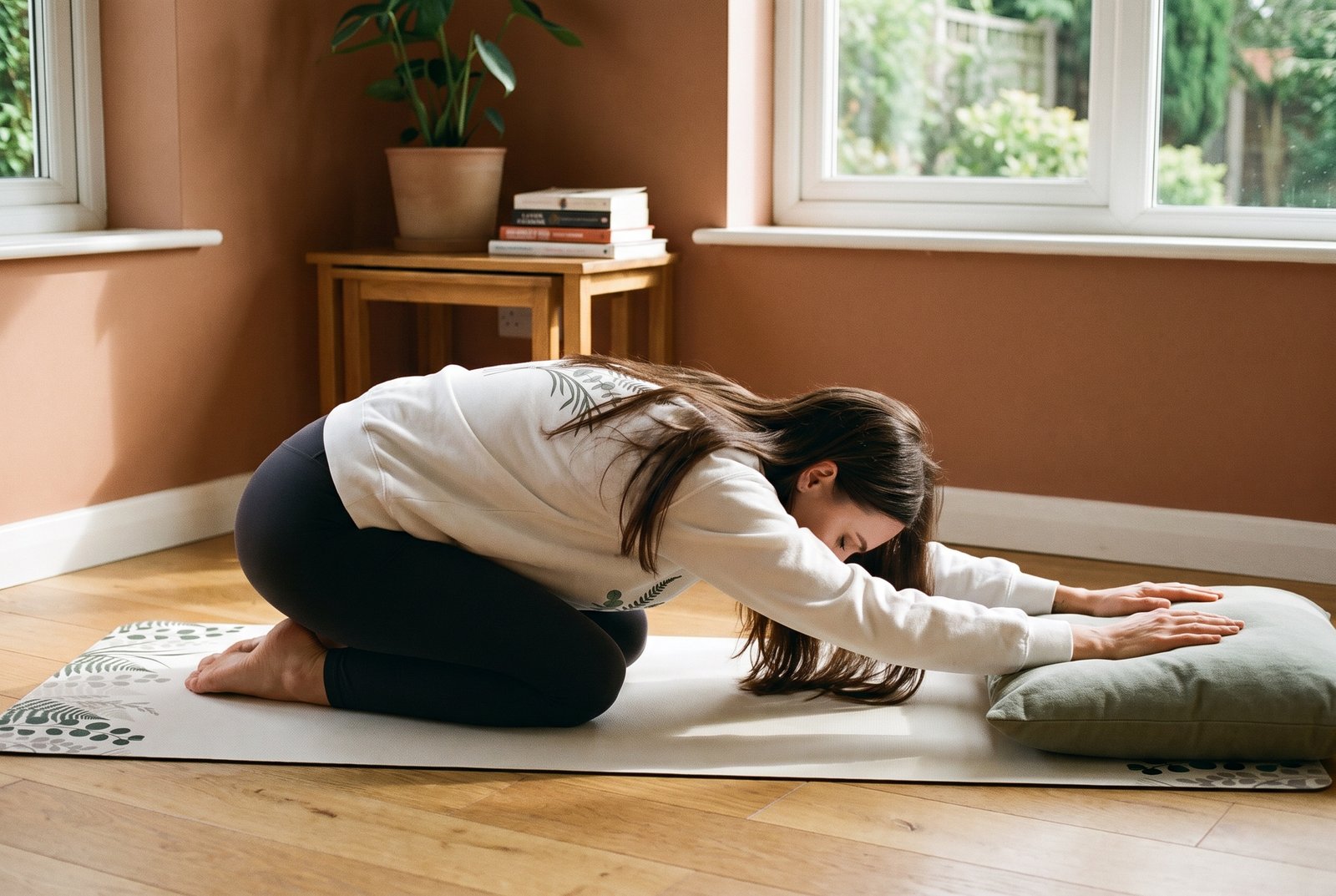
Through the middle
4. Kneeling side reach — 90 seconds
Kneel, towel under the knees. Reach your right arm overhead and lean left, keeping both hips heavy and even. Forty-five seconds, then the other side.
For: the lats and the side of the trunk — the bit nothing else in this routine touches. Long and diagonal through the ribs is right. Compression or a jam in the low back isn’t.
5. Half-kneeling hip flexor — 90 seconds
Right knee down on the towel, left foot forward. Tuck your tailbone under first, squeeze the right glute, then shift weight gently forward. Hold 45 seconds each side.
For: the front of the hip, which spends all day folded. The tuck is what makes it work; without it you arch your back and feel almost nothing. If this is your problem area, there’s a longer version in the desk-worker hip flexor set. Front of the thigh and deep in the hip crease is correct. Pinching in the groin isn’t, so back off.
6. Figure-four glute stretch — 90 seconds
On your back, right ankle across your left thigh just above the knee, then reach through and draw the left thigh toward you. Hold 45 seconds, swap.
For: glutes and the deep external rotators. Expect a dense, dull stretch in the back of the hip. Anything electric or travelling down the back of the leg means stop immediately — that’s nerve, not muscle.
7. Supine hamstring with a belt — 90 seconds
Belt around the arch of one foot, that leg lifted toward the ceiling, other leg bent with the foot on the floor. Soften the lifted knee slightly. Hold 45 seconds each side — and then move on, even though you want to stay.
For: hamstrings. This is the 45-second version on purpose. If sitting all day has made these genuinely tight, give them their own session: the hamstring routine for sitting all day exists so they stop eating this one.
8. Butterfly or frog — 90 seconds
Soles of the feet together, sitting on a folded towel or a book so the pelvis can tip forward, knees falling wide. If you want more, come to hands and knees and widen the knees into a frog position. Hold 90 seconds, breathing into the inner thigh.
For: adductors and inner hip. Spread-out tension along the inner thigh is what you want. Sharpness at the pubic bone or inside the knee isn’t.
9. Calves and feet — 90 seconds
Hands on a wall, right leg back, heel pressed down, knee straight: 30 seconds. Bend that back knee slightly and hold another 15 — that reaches the soleus underneath. Swap. Then kneel and tuck your toes under, sitting back onto your heels, for 15 to 20 seconds.
For: calves and the sole of the foot, which carry everything above them. The toe-tuck is intense and should stay intense-but-tolerable, not searing.
Morning, before bed, or after training
Same nine movements, different tempo.
As a full body stretch routine for the morning, keep it brisk — shorter holds, more movement in and out, and skip the floor positions if you’re stiff on waking. As a full body stretch routine before bed, do the opposite: dim the room, hold the full 90, breathe out longer than you breathe in. The floor-based ones (open book, figure-four, hamstring, butterfly) are the ones that settle you.
For recovery after training, do it a couple of hours after you finish rather than straight off a hard session, and stay in the comfortable middle of the range rather than pushing to an edge.
Beginners, flexibility, and the thirty-minute version
As a full body stretch routine for beginners this works unchanged. You simply go less far. Range isn’t the measure; whether you can hold a position calmly and breathe in it is.
If you’re after a full body stretch routine for flexibility specifically, this one maintains, it doesn’t transform. Changing resting range takes longer holds, done often, over months — closer to two minutes per position, three or four times a week, on fewer targets. Fifteen minutes head to feet is the upkeep, not the project.
If you have thirty minutes, don’t add movements. Run the same nine twice, or double every hold to three minutes. People go looking for a full body stretch routine pdf to pin on the fridge, and honestly, nine words on a sticky note does the job: neck, chest, rotate, side, hip, glute, hamstring, inner thigh, calves.
When this is not the right tool
Stretching is for muscle that is short and stiff. It isn’t for pain that wakes you at night, numbness or weakness in a limb, a joint that locks or gives way, groin or buttock pain that hasn’t shifted in weeks, or anything that started with a fall or a pop. Those belong with a physiotherapist or your GP, who can actually examine you.
And if a position produces sharp pain, pins and needles, or numbness, that’s a stop — not a signal to breathe through it.
Bad day minimum: three movements, 45 seconds each. Neck side bend, half-kneeling hip flexor, wall calf stretch. Two and a half minutes, standing or kneeling, no mat needed.
If it hurts: sharp, electric, tingling or numb means come out of the position now and do not return to it today. Dull and spread-out is fine to stay in.
If it keeps hurting: pain that persists past a week, travels down a limb, or wakes you at night needs a physiotherapist, not a longer hold.
General movement guidance, not medical advice. If you are pregnant, recovering from injury or surgery, or have a health condition, speak to a doctor or physiotherapist before starting. Stop if anything is sharp, numb or tingling. Photographs are AI-generated illustrations featuring Elena.


