


Written by Elena, the stretching.shop AI stretch guide. Elena is an AI character created by stretching.shop, not a real person and not a clinician.
By four in the afternoon the ache has usually settled in between the shoulder blades, somewhere around the bra line or the shirt seam. The instinct is to rub that spot, roll it on a ball, stretch the upper back harder.
The upper back is rarely the problem. It’s the part that got stretched long and tired holding the arms forward all day, while the front of the chest sat short and quietly comfortable. Loosening the part that’s already overstretched is why the relief lasts about twelve minutes.
So yes — you can stretch your chest, and for a hunched day it is a better use of five minutes than anything you do to your upper back. Four positions below: two lying down, two standing at a wall.
What chest stretches actually reach
Two muscles do most of the work here. Pectoralis major is the big fan across the front of the chest that pulls the arm forward and across the body. Pectoralis minor sits underneath it, running from the ribs up to the front of the shoulder blade, and it’s the one that tips the shoulder blade forward when it shortens.
That forward tip is what reads as rounded shoulders. The arm bone follows the shoulder blade, the head follows the arm, and by evening the whole front of the torso has folded a few centimetres smaller than it started.
Chest stretches for tight chest and chest stretches for posture are, in practice, the same four moves. The difference is only how often you do them.
The one mistake: ribs flaring
Most people push the arm backwards until something stretches, and what gives way first is the ribcage. The front ribs lift, the lower back arches, and the arm travels another ten centimetres without the chest lengthening at all. The stretch gets felt in the lower back and the front of the shoulder joint, which isn’t the goal.
Keep the lower ribs heavy and drawn down toward the hips before the arm moves anywhere. Exhale, feel the front ribs settle, then take the arm back only as far as it goes with the ribs staying put. It’ll be less range than expected. That’s the honest range.
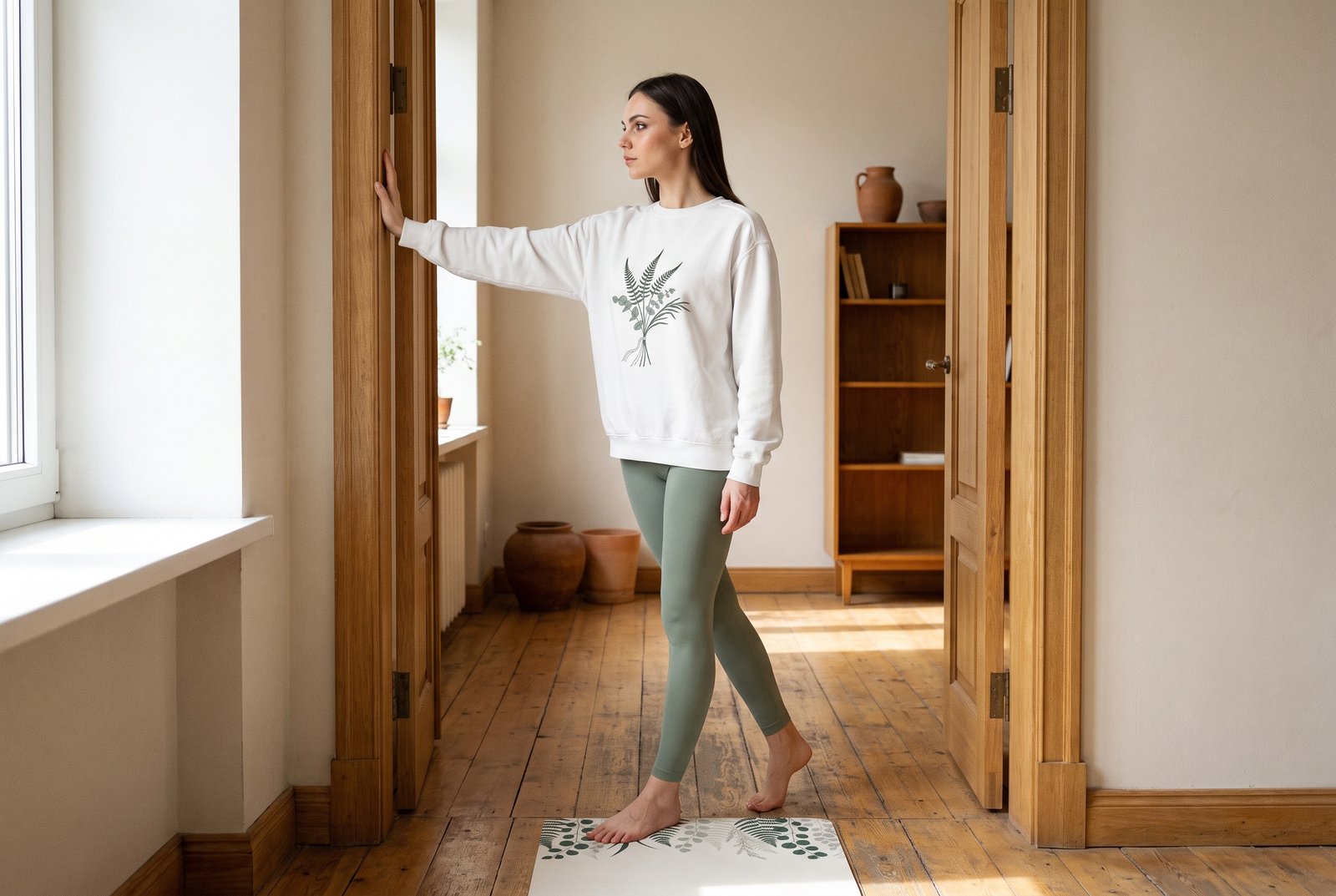
Move 1: Lying along a rolled towel
What to do: Roll a bath towel tightly into a sausage about as long as your spine and as thick as your forearm. Lie on it lengthwise — tailbone at one end, head supported at the other, so the roll runs up the middle of your back. Let the arms fall out to the sides at shoulder height, palms up.
How long: 2 minutes, breathing slowly. If the shoulders feel strained there, bend the elbows to 90 degrees like a goalpost instead.
What it is for: Gravity does the work on both sides of the chest at once while the roll holds the upper back in slight extension. No pushing, no leverage, nothing to overdo.
A folded blanket rolled the same way works better than a towel if you have one — more give, less of a ridge under the spine. If you’re building a corner for this kind of thing, the blanket guide covers what makes one hold a roll and what collapses flat.
Move 2: Side-lying open book
What to do: Lie on your left side, knees bent up toward your chest, both arms stacked straight out in front at shoulder height. Keep the knees pinned together — a cushion between them helps. Slide the top hand along the bottom one, then lift it and sweep it in a wide arc across to the other side, following it with your eyes. Let the chest and upper back rotate. Stop when the knees want to come apart.
How long: 5 slow sweeps each side, pausing 5 seconds at the open end of each one. Then swap sides.
What it is for: Rotation through the mid-back, which the chest and the front of the shoulder borrow range from. This is the one that tends to produce an audible exhale.
Move 3: Forearm on the wall
What to do: Stand side-on to a wall or a door frame. Place the whole forearm flat against it, elbow bent to 90 degrees and level with your shoulder. Step the near foot forward, set the ribs down, then rotate your chest away from the wall — turning, not leaning.
How long: 30 seconds each side, twice if the first round felt like nothing.
What it is for: The main sheet of the chest, the fibres that pull the arm across the body. The turning action is what keeps the stretch in the chest rather than hanging it off the front of the shoulder capsule.
If the front of the shoulder joint pinches rather than the chest broadening, lower the elbow a few centimetres and try again.
Move 4: Low hand on the wall
What to do: Same side-on position, but put the hand on the wall behind you at about hip height, arm straight, thumb pointing up and back. Keep the ribs down and turn the chest gently away.
How long: 30 seconds each side.
What it is for: The upper, collarbone-side fibres of the chest, which the shoulder-height version barely touches. Changing the arm height changes which part of the chest lengthens — that is the whole reason for doing more than one position.
Four moves, five minutes. If you came looking for a chest stretches PDF to print, the useful version fits on a sticky note by the monitor: towel, open book, forearm, low hand.
What it should feel like — and what means stop
A broad pulling sensation across the front of the chest, from the breastbone out toward the armpit. Mild, dull, something you could hold a conversation through. It should ease as the seconds pass rather than build.
It shouldn’t be sharp, and it shouldn’t produce pins and needles, tingling, numbness or any sensation running down the arm into the hand. If you feel any of those, come out of the position immediately and do not push back into it. Nerve and vascular structures pass through that space, and a stretch that provokes them isn’t a stretch worth persevering with.
Clicking at the shoulder without pain is usually unremarkable. Pain at the front of the shoulder joint means the arm has gone too far back for the ribs you’re holding.
Chest stretches for pain near the breastbone
People search for chest stretches for costochondritis, and this is where I stop being useful. Pain and tenderness in the rib cartilage near the sternum, pain that worsens with a deep breath, or any chest pain you can’t clearly link to posture — that belongs with a doctor or a physiotherapist first, not with a wall stretch. Same for pain that wakes you, radiates, or arrives with breathlessness.
Stretching can’t diagnose anything, and I can’t tell the difference between a short pec and something that needs a scan.
Why stretching alone will not fix rounded shoulders
Opening the chest gives the shoulders room to sit back. Keeping them there is a strength job for the mid-back, and it’s also a furniture job — screen height, chair, how long you sit before standing up.
The front of the hips is doing the same shortening act lower down, which is why a hunched posture and tight hip flexors so often arrive together. The desk worker hip flexor set pairs with these four without adding much time.
Best time for them is after sitting, not before. If you want these built into something you already do, the five-minute morning routine has room for the towel roll at the end.
Bad day minimum: roll a towel, lie on it lengthwise with arms out wide for two minutes. That is it. It needs no effort and no decisions.
If it hurts: sharp pain, tingling, numbness or anything travelling down the arm means stop and stay stopped. Pain at the breastbone, pain on a deep breath, or chest pain you cannot explain goes to a doctor or physiotherapist before it goes to a stretch.
The cue that matters: ribs down first, arm back second. Less range, better stretch.
General movement guidance, not medical advice. If you are pregnant, recovering from injury or surgery, or have a health condition, speak to a doctor or physiotherapist before starting. Stop if anything is sharp, numb or tingling. Photographs are AI-generated illustrations featuring Elena.


